Mass Incarceration Accelerating the Spread of HIV Among Black Women

Free of prison, but might be HIV-positive
DURBAN, South Africa – Efforts to halt the spread of HIV among African Americans, the most impacted group in the United States—particularly African American women—will not be successful without reducing the rate of mass incarceration among people of color, according to research made public here Tuesday at the International AIDS Conference.
Read more: Mass Incarceration Accelerating the Spread of HIV Among Black Women
21st International AIDS Conference Commences on "Mandela Day"
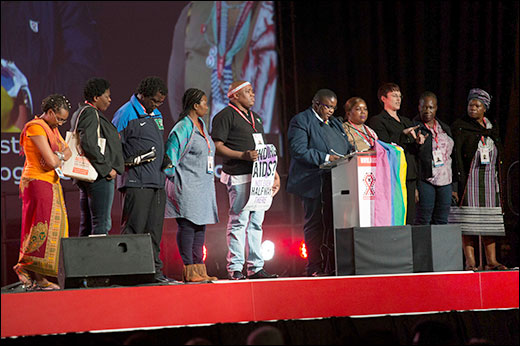
Prayer at AIDS 2016 opening ceremony
It was entirely fitting that the 21st International AIDS Conference kicked off yesterday in Durban, South Africa, on "Mandela Day," a global celebration of the great man's birthday.
Read more: 21st International AIDS Conference Commences on “Mandela Day”
Women Meet to Create an AIDS 2016 Platform at Pan-African Women's Reproductive Summit
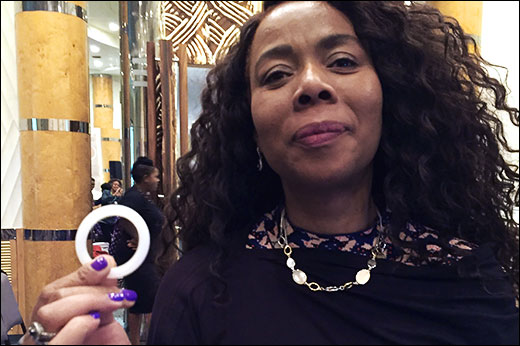
Women Now 2016! Summit co-chair Prudence Mabele shows off The Ring. Photo: Hilary Beard
Despite many scientific and biomedical advances, Black women worldwide are acquiring HIV at an alarming rate. In an effort to shift the global conversation to include Black women's needs, on July 13-15, the Women Now! 2016 preconference to the 21st International AIDS Conference took place in Durban, South Africa.
Read more: Women Meet to Create an AIDS 2016 Platform at Pan-African Women's Reproductive Summit
Activists Hold March to Protest Lack of Access to HIV Treatment
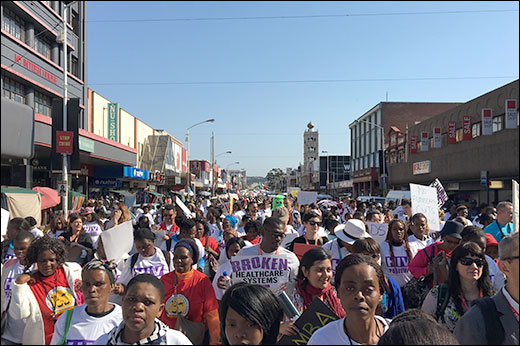
Quality Treatment for All March in Durban, South Africa. Photo: Kali Villarosa
As the last overflowing buses pulled onto Dr. Pixley Kaseme St. on Monday, chants and cheers already filled the air. Passengers disembarked onto the large Durban, South Africa, roadway packed with thousands of people, ranging from elders holding canes to babies strapped to their mother's backs, most wearing HIV Positive t-shirts, regardless of their status. Participants in the "Quality Treatment for All" march spoke numerous languages and U.S., Mexican, Swedish, Peruvian and South African flags blew almost in rhythm to the many dancers moving through the crowd of mostly women. (To watch a video of the march, go here.)
Read more: Activists Hold March to Protest Lack of Access to HIV Treatment
In This Issue
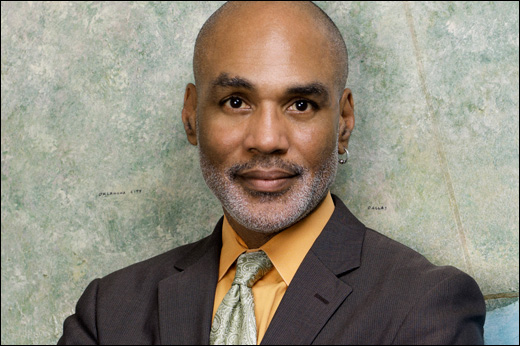
This week, the Black AIDS Institute will be leading a delegation of twenty activists, journalists and faith leaders to attend the 21st International AIDS conference in Durban, South Africa. This year's Conference is significant in a number of ways. This will be only the second time ever that the conference will be convened in Africa. The first time was fifteen years ago, in Durban as well. The 2001 confab was the first time the world leaders had a serious conversation about providing treatment to people living in Africa. Hundreds of thousands of Africans were dying because of the high cost and lack of access to life-saving HIV drugs. Led by activists who rejected the absurd and racist binary paradigm of prevention or treatment, and forced to confront the devastation the AIDS pandemic was sowing all over the continent—not just in PowerPoint presentations, but in the faces of people in the global village and on streets of Durban, genocide that was happening all over the continent—HIV/AIDS policy makers and funders finally made a real commitment to save Black lives in Africa.