Statement:
AIDS Benefit Concert Dangerously Excuses Reggae Artists' Gay-Bashing
A music-industry charity that uses recording artists to raise awareness about AIDS and spur HIV prevention among youth has scheduled a benefit concert that aims to generate “dialogue” about AIDS in the Caribbean American community. Somehow, the organizers have concluded that the best way to accomplish this laudable goal is to hire performers who sing about killing gay people. The July 18 concert in New York, produced by the organization LIFEbeat, will feature a long lineup of performers. Among them will be reggae artists Beenie Man and TOK, both of whom have well-known histories of encouraging anti-gay violence in their music. In one song, “Han Up Deh,” Beenie Man urges listeners to lynch lesbians, singing, “Hang chi-chi gal wid a long piece of rope,” invoking a derisive term for gay women. These sorts of lyrics are all the more troubling given the very real state of terror Jamaican gays and lesbians live under. At least two gay activists in Jamaica have been brutally murdered since 2004. Concert promoters all over the world, with far less lofty missions than LIFEbeat professes, have recognized the damage performers like Beenie Man and TOK inflict and have thus refused to book them. Yet, LIFEbeat finds both performers indispensable for its benefit. When a coalition of Black gay and AIDS activists pointed out these performers’ histories to LIFEbeat and asked that they either be taken out of the lineup or forced to address their gay- bashing lyrics, the organization scoffed. In a terse public statement, LIFEbeat explained that the concert will address the fact that “the Caribbean American community has been tremendously affected by the HIV/AIDS virus and has long kept silent about the epidemic's effect on their community for fear of being stigmatized.” While organizers were well aware of Beenie Man and TOK’s histories, the statement declared, they decided to include the performers because “dialogue opens doors, creating the opportunity for enlightenment, growth and change amongst all involved.” We agree with that much. But so far LIFEbeat has refused to answer the question of when and where this “dialogue” will take place. As plans stand, the concert will merely provide public relations cover for performers who have encouraged murdering gay people, without asking them to address that history in any way. This neither represents “dialogue” nor encourages “enlightenment, growth and change.” Rather, it encourages homophobia, further alienates segments of our community and contributes to the spread of AIDS among people of African descent. As LIFEbeat points out, stigma is in fact the issue. Around the world, it is clear that stigma surrounding not just HIV but the sexual behaviors that put you at risk for it drive the epidemic. Homophobia is literally lethal in too many Caribbean communities. LIFEbeat’s failure to grasp how that fact links up with HIV’s spread reflects a dangerous ignorance about the epidemic. Using AIDS education to condone murdering gay men and lesbians is despicable and indefensible. Despite their feeble, half-hearted protestations to the contrary, that is exactly what LIFEbeat is doing. The Institute joins those voices who continue to urge LIFEbeat to either remove Beenie Man and TOK from its lineup or require them to address their violently hateful lyrics. And we join others in the community in praying that the organization will become a more responsible steward of its crucially important mission.
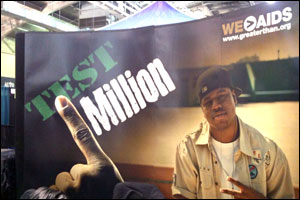
Institute Participates in 30,000 Attendee KwanzaaFest
KwanzaaFest Welcomes the National Greater Than Campaign
The rain didn’t keep the Black AIDS Institute, or 30,000 attendees, from participating in the annual Dallas KwanzaaFest, held last month in the Lone Star State.
The Institute participated in the event to promote the Greater Than AIDS campaign and to support the event’s HealthFest and on-site HIV testing. The event was organized as part of the campaign’s “Test One Million” promotion – an effort to mobilize over a million African-Americans to get tested for HIV. “The Greater Than AIDS campaign was well received. We generated a good awareness for testing and provided information about HIV and ways to prevent infection to hundreds of KwanzaaFest attendees,” said Black AIDS Institute Mobilization Manager Chris Bland. The HealthFest was also a big success with over 750 HIV and other on-site health screenings. Local partners included AIDS Arms, Dallas County Syphilis Elimination/HIV Testing, and the National Urban League. Click here for more information on the Greater Than AIDS campaign. Click here to find out where you can get tested for HIV and become part of the “Test One Million” movement. Become a fan of Greater Than AIDS on Facebook.
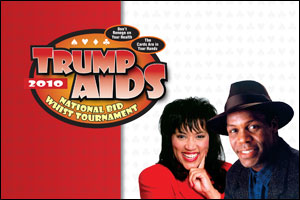
Introducing the 2010 Trump AIDS National Bid Whist Tournament
Institute Kicks-Off New Campaign to Mobilize Black Community and Raise Resources
Martin Luther King Jr. weekend marks the kick-off of the Black AIDS Institute’s National Trump AIDS Bid Whist Tournament in Atlanta, GA.
Trump AIDS provides a platform to mobilize Black communities and serves as a vehicle to raise funds and build awareness in the fight against HIV/AIDS. Participants are encouraged to get involved with ending the AIDS epidemic in the Black community while having fun and potentially winning guaranteed cash Tournament prizes. There are several local qualifying tournaments to participate in from January 15 to the weekend of August 27, 2010. Click here for a complete list of cities hosting events. The Tournament will culminate at the Trump AIDS nationals November 2010. Click here for more detailed information and to register. About Bid Whist
During slavery, plantation owners forbade slaves from learning to read and write for fear that written communications would lead to uprisings and revolts. However slave owners needed slaves to be able to count in order to keep better track of the cotton harvests. As a result slaves were allowed to play cards. Slaves put their own spin on the game and Bid Whist lives on today. The game as we know it today is the form of the game popularized by Black Pullman porters from 1867 until the 1920’s.
Courtesy of the National Bid Whist Association.
South African Health Minister Manto Tshabalala-Msimang Dies at Age 69
The controversial South African Minister of Health, who served from 1999 to 2008 under President Thabo Mbeki, died in Johannesburg December 16, 2009 of complications from a 2007 liver transplant.
Tshabalala-Msimang was highly criticized during her tenure for her public resistance to the use of antiretroviral medicines to aid HIV infected South Africans. She promoted the use of natural remedies such as garlic, beetroot, potatoes and lemons, instead. She refused to take an HIV test, saying this was “a private matter,” and questioned the safety of drugs proven to prolong the lives of those infected with AIDS, according to Bloomberg. It is speculated throughout the media that South African President Thabo Mbeki, who publicly expressed doubts about whether HIV caused AIDS, influenced Tshabalala-Msimang's ill-informed position on HIV/AIDS, according to Mail & Guardian . Current South African President Jacob Zuma announced earlier this month a plan to overhaul the government's HIV policy.
Opinion Editorial by CEO and Founder Phill Wilson
Precious, and a Princess
There is a scene ten minutes into the new Disney animated film “The Princess and the Frog” when young Tiana’s mom and dad come into her bedroom to tuck her in for the night. The little girl’s father asks what she wants to be when she grows up, and she replies, eyes sparkling, that she wants to own a restaurant with him where they can make his delicious gumbo. Dad beams with pride, and then leans down to kiss his daughter goodnight. His loving, departing message is you can be anything you want, Tiana, if only you believe.
Even if this fairytale -- the first Disney film to ever feature an African-American princess -- ended right there, that imagery alone might have been the most defining moment for many Black girls. That’s because sparkling tiaras, frilly dresses and all the other trappings of a fairytale life aside, many of our daughters -- and our sisters and mothers for that matter -- desperately need to be told “you can be anything you want.” Unfortunately, too many young Black women experience a life more like that of Claireese "Precious" Jones in Lee Daniel’s film Precious than that of Princess Tiana. In that movie, Precious is raped by her father, who impregnates her and gives her HIV, and is abused by her mother. Adding insult to injury she is abandoned by a society that cares little about the lives of Black women and children and devalues her physical appearance. Yet remarkably, encouraged by others who see her promise and potential, Precious discovers her own beauty and learns to value herself. In the process she redefines and reconstructs her family, deciding: “If nobody who is supposed to love me loves me, then I can still love myself.” Precious resolves that she can still survive against all odds, no matter what she has been through. The low self esteem that originally engulfed Precious leads some girls to seek love and acceptance in the arms of men who don’t protect them. Many Black girls have sexual relationships with men who are significantly older than they are, increasing their risk of STD's and HIV. This is just one factor contributing to last year's Centers for Disease Control and Prevention (CDC) report that one of every two -- one out of two! -- African-American girls ages 14-19 is infected with an STD. And in 2006, Black teens between 13-19 accounted for 69% of new AIDS cases among teens. Tragically, this picture does not get better with age: three years ago, Black women accounted for 61% of new HIV cases among women -- 15 times the rate of white women. And now, even in the era of a Black president, a Black princess and a Black woman (Oprah Winfrey) with her O.W.N. new television network, HIV infection is the leading cause of death for Black women ages 25 to 34, according to the CDC. It’s a painful trend Delta Sigma Theta president Cynthia Butler-McIntyre believes can be reversed through the creation of more positive self-esteem-building vehicles like “The Princess and the Frog” -- films that teach Black girls that their features and skin color are beautiful, that no matter the length or texture, their hair is “good” hair. It’s the reason why, leading up to the movie’s release earlier this month, McIntyre’s sorority hosted special screenings of “Princess” around the country. Members -- like thousands of other Black parents nationwide -- took their little girls to see the film, with many dressed up as princesses. Structural forces—-poverty, racism, horrible education, terrible parenting, etc.--can not be reversed through better self-esteem-building movies alone. There are two Black America’s today -- the Obama/Oprah/Tiana world and the Precious/Harlem/Washington D.C.’s 7th and 8th ward world. The latter exists in part because too many of us who live in or aspire to the former have abandoned those whom we left behind. More of us need to practice seeing the promise and potential of our girls, no matter what circumstances they are born into. We need to practice speaking life into their spirits and exposing them to activities, role models and situations with the intention of building their self esteem. Every Black girl needs to be told that she is both precious and a princess. And she needs to believe that she can be anyone she wants, including a Black woman without HIV.