Voices:
Learn more about discriminatory attitudes in Nigeria Comfort, a social worker, was in the U.S. recently to attend a conference on HIV treatment. I work with an organization in Oyo, Nigeria. We work in the community, especially in the rural area, where we do mother-to-child transmission and volunteer HIV counseling and testing. Also, we do referrals for positive people to give them access to ARV meds. We have about 300 positive clients, and are working regularly with more than 200. I came to the United States to learn more about the treatment of people with HIV, especially the children. We are still having trouble with the treatment of children in Nigeria. The HAART drugs are not available for them. Without the drugs available for them, they die at 18 months. We are really concerned about how to improve their life span. The HIV prevalence rate, which is based on the mother-to-child transmissions in Oyo state is 3.8. It is 4.4 in Nigeria. We are working in defeat and seeing more and more people become HIV positive. Our agency licenses individuals who then go out into the community to discuss HIV. This is a way to reduce the stigmatism in the community. During the training, they learn how not to discriminate against women with HIV and how to assist their family members and the members of the community who are living with HIV/AIDS. We have found that the stigma comes from a lack of knowledge. People don’t really have in-depth knowledge about HIV or know how it is transmitted. There are a lot of misconceptions. For instance, if you are sitting down with someone who is HIV, you cannot use the same cutlery or live in the same house with them. When we go into the community, we try to education people on the mode of transmission so that they will know you cannot acquire HIV through all of these means, except through sex, needles and mother-to-child transmission. -- As told to Sharon Egiebor

From left, Sen. Hillary Clinton, Sen. Joe Biden, N.M. Gov. Bill Richardson, former N.C. Sen. John Edwards, Sen. Barack Obama, Ohio Congressman Dennis Kucinich, former Alaska Sen. Mike Gravel, Sen. Christopher Dodd
Politics
By Sharon Egiebor
Democratic presidential candidates are aware of the HIV/AIDS epidemic in African Americans, but none of them are offering a comprehensive strategy to reduce the problem, HIV/AIDS activist say. During a June 28 debate on the Howard University campus, the eight candidates provided general comments on how the disease is disproportionately affecting black Americans, who are 12 percent of the U.S. population, but more than 50 percent of those newly diagnosed with HIV or AIDS. “I was happy that there were some answers,” said http://www.balmingilead.org/special_feature/pernessa/essence_35.asp>Pernessa Seele, executive director of the Balm In Gilead. “ The candidates were not totally ignorant of movement like Vice President Dick Cheney and Sen. John Edwards were during the 2004 campaign. I don’t’ recall hearing a clear plan. Just like the Iraq War, HIV/AIDS is a war in our community. We need a plan from our government on how they are going to fight this war right here in our community.” The debate leading up to the 2008 election discussed African American issues and was moderated by Tavis Smiley's, a PBS talk show host. National Public Radio reporter Michel Martin asked, what is the plan to stop and to protect young people from the scourge of HIV/AIDS. African Americans teens are 17 percent of all American teenagers, they are 69 percent of the population of teenagers diagnosed most with HIV-AIDS. Quinton Harper, a senior at the University of North Carolina at Chapel Hill, said Delaware Sen. Joe Biden and Ohio Congressman Dennis Kucinick responded best. ”Sen. Biden talked about sexual education for youth,” said Harper, a journalism major. “Those are the answers I would have loved to heard more of, particularly with President [George W.] Bush’s abstinence-only education, which we have seen to be ineffective. Teenagers are having sex, but they are not aware of the consequences of those adult decisions.” Grazell Howard, vice president of the National Coalition of 100 Black Women, said she was hoping to hear more specifics on HIV/AIDS in African American women. “The responses for black woman and HIV/AIDS ran the gamut from declared Sen. Hillary Clinton’sprovocative and explosive answer to Illinois Sen. Barack Obama’s middle-of-road. In an ideal world, the candidates would have articulated an outline or a frame of a plan. We still have a lot of work to do in educating our national leaders on HIV/AIDS and black women in specific. Now that issue has been placed on a national agenda, we must be vigilant in keeping it at the top of the individual platform of the candidates.” Clinton said the HIV/AIDS situation would be different if it affected white women. “If HIV-AIDS were the leading cause of death of white women between the ages of twenty-five and thirty-four, there would be an outraged outcry in this country.” Jose Nanin, director of education and training for the Center for HIV Educational Studies and Training (CHEST) at Hunter College, City University of New York (CUNY), criticized Clinton’s reference to AIDS as a gay disease in the 1990s. “Hillary Clinton was trying to make a good point but it obviously did not come out of her mouth correctly. The fact is that HIV/AIDS was never a ‘gay’ disease, even in the early days of the epidemic. But that's how it was treated due to the prejudice of so many in our country!,” Nanin said. “HIV infection was and continues to be primarily an infection resulting from ‘behaviors’ that facilitate its' transmission, namely unprotected anal and vaginal sex and the sharing of contaminated needles. Anyone who still attributes HIV infection to specific groups of people [instead of behaviors] needs to be re-educated. I applaud her for ‘trying’ to make a poi
Morris Price, national program officer for the Gill Foundation in Denver, Colo., said he appreciated Clinton’s comments .
“I think Hillary knocked it out of the ball park. She said exactly what most African Americans involved in the fight against HIV/AIDS have been singing and saying for years. If this disease was impacting the majority community, the way it is impacting African Americans, it would be a number one priority at all levels. I applaud her for saying it. If elected, I’d like to see her move it to that level. If not, I hope the other candidates remember the response from the crowd that night.” Edwards , who in 2004 failed to answer a similar question and spoke instead about HIV/AIDS in Africa, offered a three-point plan. “First, we need to fully fund finding a cure for AIDS so we can end this scourge once and for all. Second, we need to fully fund the legislation, the law known as Ryan White, to make sure that the treatment is available for anybody who's diagnosed with AIDS,” said Edwards. “Then finally, we need to ensure that Medicaid covers AIDS drugs and AIDS treatment to make sure that people get the treatment they need, particularly low-income families who are diagnosed with AIDS.” Phill Wilson, executive director of the Black AIDS Institute, a national black policy think tank based in Los Angeles, said before the debate, HIV/AIDS was mentioned only on one candidate’s web site. “AIDS is a large enough issue in Black America that it is shameful that it took a question to get the candidates to speak to this issue. Now the question is what are they going to do beyond the sound bite?” Wilson said. “Black America wants to see their plan to end the AIDS epidemic in our communities. If you fail to plan, you plan to fail. Failure to end the AIDS epidemic in our communities is not an option for Black America. Anyone who wants Black folks to pay their rent at 1600 Pennsylvania Ave. had better have a plan to end AIDS in Black America.” During the debate, Biden inadvertently set off a series of laughs as he encouraged African American men to take an HIV test, like and he Obama has done. Obama asked for a minute to clarify Biden’s statement. “I just got to make clear, I got tested with Michelle, when we were in Kenya in Africa. I don't want any confusion here about what's going on," said Obama. "I was tested with my wife, in public." Wilson said despite the laughter, Biden’s public testing of HIV makes a point. “It is extremely important for leaders regardless of race, or gender to stand with Black America in our efforts to end the AIDS epidemic,” he said. “ Presumably Senator Biden and the others are running for President of the United States, not President of the White United States or President of the HIV negative United States or President of the not at risk [who ever they are] United States. Leadership is Leadership. The story of AIDS in America is a story of failed leadership. It's time our leaders and our wannabe leaders lead.” The debate was the first time that HIV AIDS was addressed by the presidential candidates during a nationally, televised event. Wilson said there are plans to ask similar questions during the next Republican presidential debate. [Email This Article To a Friend] 1. Delaware Sen. Joe Biden 2. N. Y. Sen.Hillary Clinton 3. Sen. John Edwards, former North Carolina Senator 4. Conn. Sen. Chris Dodd 5. Former Alaska Sen. Mike Gravel 6. Ohio Congressman Dennis Kucinich 7 ll. Sen. Barack Obama 8. N.M. Gov. Bill Richardson [Email This Article To a Friend] Michel Martin: I'm sure you'll agree there are a lot of beautiful young people out here in the audience today and are very pleased to be here and conversing, so you can imagine how disturbed we were to find out from the Centers for Disease Control that African Americans are seventeen percent of all American teenagers, they are sixty-nine percent of the population of teenagers diagnosed most with HIV-AIDS. Governor and candidates, what is the plan to stop and to protect these young people from this scourge? Bill Richardson: It is a moral imperative that America have a policy to fight this dreaded disease, both nationally and internationally. You got to make some tough choices. First, we have to use needles. We have to be sure that we have efforts in the African American community, in minority communities, to have comprehensive education. In addition, we have to deal with Africa. Close to twenty percent of the African people have some kind of HIV virus. …I believe it's important that not only we deal with this issue in this country, bringing condoms, finding ways to increase needles, penetrating minority outreach in communities. John Edwards: African American women are twenty-five times as likely to be infected with AIDS today in America than white women. Over half of the new diagnoses of AIDS in America are African Americans. So this is obviously having a disproportionate effect on people of color and on the African American community. … Here are the three things I think we need to do. First, we need to fully fund finding a cure for AIDS so we can end this scourge once and for all. Second, we need to fully fund the legislation, the law known as Ryan White, to make sure that the treatment is available for anybody who's diagnosed with AIDS. Then finally, we need to ensure that Medicaid covers AIDS drugs and AIDS treatment to make sure that people get the treatment they need, particularly low-income families who are diagnosed with AIDS.” Barack Obama: I would add the issue of prevention involves education and one of the things that we've got to overcome is a stigma that still exists in our communities. We don't talk about this. We don't talk about in the schools. Sometimes we don't talk about it in the churches. It has been an aspect of sometimes a homophobia, that we don't address this issue as clearly as it needs to be. I also think there's a broader issue here. This is going to be true on all the issues we talk about. … The problems of poverty, like of health care, like of educational opportunity, are all interconnected. To some degree, the African American community is weakened. It has a disease to its immune system. When we are impoverished, when people don't have jobs, they are more likely to be afflicted not just with AIDS, but with substance abuse problems, with guns in the streets.” Dennis Kucinich: When you think about the statistics that have been cited here, you realize that it's time to get real about health care and education in America. We need to understand that the ability of our public schools to be able to communicate sex education as a priority at the early age helps children understand the consequences of their actions. But there's another dimension here too. That is we have a nation of such wealth, yet we have forty-six million Americans without any health insurance. Another fifty million under-insured. It's time for us to make every American know that they should have access. It is a basic right in a Democratic society. We should be able to fund all those diseases where people are suffering and they need care, but we have to end that for-profit medicine. It is time to take the for-profit insurance companies out of the business. Christopher Dodd: I'd add another addition and that is the need for far broader usage of school-based clinics in our society where children have the opportunity to be able to confront and talk with people that may be willing to give them the kind of sound advice they need on sexual education and the like…. There's a job obviously for government here in funding and support, but I believe that each and every citizen bears a responsibility to reach out and do what they can to educate a child. Our churches are doing this in many ways. We need to do a better job in our schools, inviting parents and insisting there be more participation in our school systems. It isn't just HIV-AIDS. The minority community, the African American community in our country, suffers from a lack of access to a wide variety of health care needs. Infant mortality among the Black community is two and a half times what it is in the white community. The problems of cardiovascular diseases, obesity, diabetes, you go down the long list. It isn't just AIDS. It's a wide range of these issues. We need to begin to address this issue by understanding that it isn't just universal coverage, but access to that coverage and to understand there's a variety of issues that need to be addressed in addition to HIV-AIDS, but each and every one of us as citizens can make a difference. Hillary Clinton: If HIV-AIDS were the leading cause of death of white women between the ages of twenty-five and thirty-four, there would be an outraged outcry in this country. . I'm working to get Medicaid to cover treatment. I'm working to raise the budget for Ryan White which the Bush administration has kept flat, disgracefully so, because there are a lot of women particularly who are becoming infected in poor rural areas as well as under-served urban areas in states where frankly their state governments won't give them medical care. So this is a multiple dimension problem. But if we don't begin to take it seriously and address it the way we did back in the 90s when it was primarily a gay men's disease, we will never get the services and the public education that we need. Joe Biden: You said how do we prevent the seventeen-year-olds from getting HIV-AIDS? How do you prevent that? All the things that were said here are good ideas. They don't prevent that. What's happened is there's a policy of neglect, denial and lack of honesty out there. The fact of the matter is, as Hillary points out, there's neglect on the part of the medical and the white community focusing on educating the minority community out there. I spent last summer going through the Black sections of my town holding rallies in parks, trying to get Black men to understand that it's not unmanly to wear a condom, getting women to understand they can say no, getting people in the position where testing matters. I got tested for AIDS. I know Barack got tested for AIDS. There's no shame in being tested for AIDS. It's an important thing because the fact of the matter is, in the communities engaged in denial, no one wants to talk about it in the community and we do not have enough leaders in the community and outside the community demanding we face the reality, confront the men in the community as well as the women, letting them know there are alternatives.
Mobilization
By Sharon Egiebor
Hollywood A-list actors, musicians and athletes, including Regina King, Jimmy Jean-Louis and Samaki Walker stepped up Monday to take an HIV test in public and to encourage 1 million African Americans to get tested for the disease. Rev. Al Sharpton, founder of the National Action Network, also spoke at the news conference and committed his organization to supporting the national testing effort and the larger fight against HIV/AIDS in the African American community. In anticipation of National HIV Testing Day June 27, the star-studded group helped launch the “1 in a Million Campaign” during a news conference at the Screen Actors Guild Headquarters in Los Angeles. “When I heard about this project, I knew it was something that I had to participate in,” said King, (“Ray,” “Jerry Maguire,” “Miss Congeniality I and 2”). “Make no mistake about it – AIDS is devastating Black America. Young and old, male and female, straight and gay – we are all at risk. You can lie to yourself and say ‘AIDS is somebody else’s problem,’ but that won’t protect you, and it won’t protect your family.” Black Americans are disproportionately affected by HIV/AIDS. Of the 1.3 million Americans living with HIV/AIDS, nearly 50 percent of them are Black. Black Americans represent more than 54 percent of the new HIV/AIDS cases in the United States. AIDS is the leading cause of death for African American women aged 24-34. A study by the CDC showed that forty-six percent of Black gay men in America may already be HIV positive. Twenty-five percent of HIV positive people in the U.S. do not know they are infected. “As actors, our every move is open to the scrutiny of the media. But today, we have the opportunity to work with the media for a greater good – to stop the spread of AIDS in the African American community,” King said. Screen Actors Guild, the American Federation for Television and Radio Artists, the Black AIDS Institute, Artists for a New South Africa, Palms/AACDI and the Beverly Hills/Hollywood branch of the NAACP sponsored the conference. Alan Rosenberg, SAG president, also took a public HIV test. “The “1 in a Million” campaign is critically important, not only the African American community, but for us all. Hollywood is no stranger to AIDS – in fact, the entertainment industry was one of the first communities to stand shoulder-to-shoulder with the gay, lesbian and medical communities to sound the alarm of this epidemic more than 20 years ago,” said Rosenberg, (“The Guardian,” “Cybil”). “However, times have changed, and so has the face of AIDS. We are here today to continue our legacy of embracing those impacted by HIV by talking about AIDS in Black America, and to lead the way for the millions of Americans who don’t know their HIV status to find out.” Other celebrities present included: Several other celebrities who support the campaign could not be present for the news conference. Those absent included actress Gloria Reuben (“ER,” “Life Support”), who was in New York but available for telephone interviews, actor Hill Harper (“CSI New York”) was filming in North Carolina and Shari Belafonte (“The District”). The celebrities talked about the urgent need for individuals to know their HIV status by getting tested, for the greater community to support individuals who are HIV positive, to remove the stigma attached to the disease and for people to move beyond issues of gender. Phill Wilson, executive director of Black AIDS Institute, a national black policy think-tank based in Los Angeles, said the “1 and a Million” campaign is part of a national mobilization to end the AIDS epidemic in Black communities by 2012. During the conference, the agency previewed its national public service announcements featuring black congressional leaders. “We know that’s an ambitious goal – but given the devastation that AIDS is causing in our communities, anything less would be immoral,” said Wilson, who publicly discloses his AIDS diagnosis. “While we can’t eradicate the virus in five years, we can reduce HIV/AIDS rates, increase the percentage of Black people who know their HIV status, increase the percentage of people who are in appropriate care and treatment, and reduce the debilitating stigma that cripples our efforts to ending the epidemic.” There are an estimated 600,000 Black Americans living with HIV and AIDS, out of the estimated 1.3 million Americans. “The only way to end the AIDS epidemic in Black America is for Black folks to get about the business of ending it.” Wilson said. Sharpton, who was in Los Angeles for the 2007 BET Awards, pledged his organization support for the “1 in a Million” campaign. “We are excited about this campaign and will keep pushing to get 1 million people tested. I believe it is a critical issue in our community. We have neglected it. You can’t say you love our people and not be concerned about their health and the disproportionate number of people dying. It is not a matter of whether to get involved it is a matter of whether or not you are going to be involved in something that inadvertently touches all of us in our community.” “It will be the most important thing you do this week, and maybe even the most important thing you do in your life,” Williams said. James Norris, an incoming sophomore at DePauw University in Indiana and a Black AIDS Institute intern, said he was encourage to take an HIV test Monday when he realized Regina King would be present. “James, you are a true inspiration to all young black men and women out there, and I am proud of you for putting yourself out there and doing this. We are used to the spotlight, but you are not. To put yourself out there in the public eye like this is amazing, and you are truly a role model for your generation,” King said. “And you’ve inspired me to take a chance to, so I now I’d like to tell members of the press that I have asked the “1 in a Million” organizers to allow my test results to be revealed here at the press conference. Whatever the results, I want to show America that taking an HIV test is quick, easy, free, and painless – and so important to you and your community.”
Diaspora
By Sharon Egiebor
The Guyana government partnered with private manufactures, retailers and lending institutions to provide job training and crafts skills, business management and micro finance loans for women living with HIV/AIDS. The women then used the skills and loans to open their own businesses. “Jobs are scarce in Guyana,” said Dr. Karen Gordon-Boyle, Community and Clinical Care Officer for the USAID-Guyana HIV/AIDS Reduction and Prevention Program. “Many PLWHA, particularly women, are unable to access jobs or develop the specialized skills necessary to provide for themselves and their families. This contributes to the growing level of poverty plaguing the country.” Guyana, located in South America, has the second-highest prevalence rate in the region, only behind Haiti. AIDS is the number one cause of death in the 25-49 age group in 2004, according to the Presidential Commission Report for HIV 2005. Boyle made a poster presentation on “The New Attitude” demonstration project at the American Conference for HIV Treatment that was held in Dallas recently. The project operated from November to March with 30 women, who were HIV positive, unemployed and lacked self-esteem, Boyle said. Doctors referred the women, who also had to be stable and on their medications. The skills taught ranged from leather craft, basketry, fabric design, fabric painting, jewelry design, and jewelry making. “The small businesses could be anything. It didn’t have to be the same from the crafts they were learning,” she said. Some of the small businesses included print shops, animal husbandry, agriculture and hair dressing. The training classes were held Monday-Thursday. But Fridays was devoted to self-empowerment sessions, Boyd said. “On Fridays, the women learned everything about self, from managing significant relationships, parenting, etiquette, good manners, coping with stress, yoga and deep breathing exercises. We taught anything we thought would be relevant to them becoming better persons in terms of their self esteem and being able to cope with the stress of life.” In the end, 27 women remained in the program; two died from AIDS and a third became pregnant and left the program. Twenty-four of the women started businesses. Boyle said each woman was paid a stipend. A portion of the stipend was kept back by the project and then distributed to the women as part of the loan collateral. TThe loans ranged from about USD$375 to USD$1,75, and were made possible through a partnership with the Institute of Private Enterprise Development (IPED), the Guyana Telephone and Telegraph Company (GT&T) and the Guyana Lotto Company, according to the Guyana government. Each made a unique contribution. IPED has extensive micro financing experience, having been established 20 years ago with support from USAID. Guyana Lotto Company supplies funds for use as collateral by PLHA. GT&T provides general financial support. The micro-lending program was extended to 200 vulnerable people and those living with HIV/AIDS. By March, 100 initiated loan applications and 61 had started their own business. Overall, $5.5 million (GT) was placed in the hands of people living with HIV for new businesses. Boyle said the demonstration project is moving toward its second phase, which includes development of a website and a production line that will carry the logo. “They are l inked to the same businesses that they learned the skills from. So they can produce craft and supply those businesses,” Boyle said. “They are assured of a market at least locally. That’s the beauty of having the private sector on board because they had lots of products before and learned skills but they couldn’t get the product sold.”
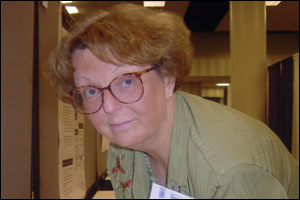
Beverly VanMetre Johnson, RN, explains her poster presentation on increasing the number of veterans tested for HIV during the American Conference for the Treatment of HIV, which was held in Dallas recently.
By Sharon Egiebor
Nearly every health care provider agrees that more people should be tested for HIV. The sticky wicket for some is how to make that happen within their own environment. Beverly VanMetre Johnson, clinical programs coordinator for nurses at , Veterans Medical Center in Martinsburg, W.Va., found a simple solution that had a 97 percent increase in the number of patients voluntarily tested. Johnson reduced the mound of paper work and worked within the administration’s federal laws requiring pre- and post-HIV counseling. “I had been tracking the rate of HIV testing at our medical center and noticed that the number of HIV test we were doing had flattened over the last 6 years,” she said. “I was looking for some ideas of how to improve our rate of testing because we do have a large at-risk population.” But there were barriers, she said. “The paper consent forms are cumbersome and time consuming. Somebody always uses the last one out of the folder and doesn’t make copies,” she said. ”Then the paper forms must be scanned into VA’s electronic medical record.” In August 2006, Johnson had iMedConsent™ testing equipment added to workstations within the Domiciliary Residential Rehabilitation Unit, which has about 350 beds. The equipment includes software the VA was already using and an electronic signature pad, similar to those found in retail outlets and banks. The VA’s Public Health Strategic Health Care Group, which includes the AIDS Information Center, had requested the identical paper HIV forms be included in the new comprehensive computer-based consent system. Johnson, who presented a poster on her findings during the American Conference for the Treatment of HIV in Dallas recently, had used the system in Martinsburg’s surgical and dental divisions. Within one quarter from October-December 2006, Johnson said she had a 97 percent increase in the number of patients who voluntarily agreed to HIV testing. Domiciliary includes patients in the addiction treatment, homeless program, post-traumatic stress syndrome program and in the assisted living facilities. “The Domiciliary is a cluster of at-risk folks. The providers were tickled because it was like a new toy. The patients thought it was novel because they said it was like being at Lowes or Home Depot. It was very user friendly.” “I-Med consent automatically populates a progress note in the electronic medical record and stores an image that can be accessed through the imaging section of our electronic medic al records,” said Johnson. “You can actually look at a complete consent form with signatures and a copy of that can be printed out.” Johnson compared results from first quarter 2006 with the first quarter of 2007 and saw the 97 percent increase. Testing increased 40 percent in the 2007 second quarter, January-March, she said. Johnson said she is considering implementing the program at the agency’s three primary care facilities. “ I’m anxious to see if we are still seeing the increase in our testing rate and I will be looking at other individual locations and sites for testing,” she said. “The benefits is that the I-Med walks the clinician and the patient through the informed consent process, streamlines the work flow, it makes sure also that the consent forms are available where and when they are needed and improves patient education and understanding of procedures because it is something the patient can look at on the screen as we are going through it.”