Statement
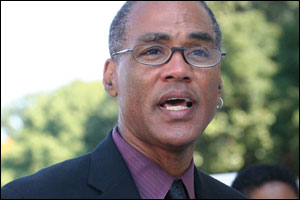
By Phill Wilson
This week, people from all over the world are raising awareness about the HIV/AIDS epidemic as a part of the 19th annual World AIDS Day commemoration. World AIDS Day is observed every year on December 1st. Established in 1988 by the World Health Organization, World AIDS Day provides governments, national AIDS programs, faith organizations, community organizations, and individuals with an opportunity to really think about how HIV/AIDS has affected our lives and make commitments to do what we can to put an end to this deadly disease. I always use this time to remember all my friends and loved ones lost to the disease and think about how far we've come in the fight against HIV/AIDS and prepare ourselves to do whatever is necessary to end this deadly disease in our communities. When was the last time you got tested for HIV? Have you ever been tested? If not, shame on you. Knowing your HIV status is a fundamental responsibility for every Black person. Honestly, It is a responsibility for every person, but this web site is "Black Voices" so all you folks who keep sending the messages about why white people aren't being tested, back off. We have enough to worry about amongst ourselves. There are enough sites that focus on white people to our detriment. There is nothing wrong with us focusing on us. If you are living with HIV/AIDS, are you in treatment? AIDS is not the automatic death sentence it once was. I'm living proof. As some of you know, I have been living with HIV for 26 years. I'm alive today because I got informed, I realized the folks who were calling the AIDS treatments poison were idiots-that's not to say the current drugs are perfect, far from it. They are very strong and there can be serious side effects. But it is time to get over it and get on with it. For the vast majority of Black folks living with HIV the choice is clear get a doctor, get on proper treatment and care or die. It really is that simple. Let's stop the foolishness. Are you involved in efforts to fight HIV/AIDS? In your personal life, thru your church, fraternity, social organization or civil rights group, it doesn't matter, any group that calls itself fighting on behalf of Black people needs to have HIV on its agenda. If you are in a group or organization that is not addressing HIV, take leadership, raise the issue, develop a campaign, and come up with a strategic action plan. If the group that you belong to is not responsive, quite and find an organization that is serious about the care and wellbeing of Black folks. There you have it. This world AIDS day it is all about us. When we have the courage to take action, we see results. When we wait for others to come to our rescue, well... can anyone one say New Orleans or Katrina?
Part of the Solution
Click here to read the blog
"Our goal is to raise money to end the AIDS epidemic and to reach at least one million people with messages about HIV testing, treatment and stigma. We will speak to people about the importance of each person taking part in this critical fight in their own individual way," says Sacco. "The AIDS epidemic looks very different today than it did when I got infected 25 years ago, says Phill Wilson, CEO and founder of the Black AIDS Institute. "Many of us made a promise not to stop fighting until it was over. Mike Sacco is trying to keep that promise. In my book, he is truly one in a million." When: 7 a.m., Saturday, December 1, 2007 What: News conference and start of 14-day, 510-mile run. Who: Sponsored by the Black AIDS Institute, Nike Where: Golden Gate Bridge (Marin County side) Visitor lookout point * Camera Crews may seek additional backstage coverage. Additional B-roll footage for news coverage is available upon request. The Route:
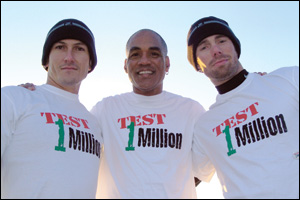
Mike Sacco and close friend Lejon Boudreaux, along with world-renowned, ultra-marathoner Dean Karnazes have signed on to bring awareness to the AIDS epidemic by staging a run from San Francisco to Los Angeles. The 510-mile trip will kick off World AIDS Day activities on Dec. 1 and end two weeks later on Dec. 14, 2007. At the end of each day, the runners will participate in a variety of local activities. The trip will be chronicled via writings and images that will be posted on a blog at www.myspace.com/runinamillion
Scheduled to speak:
Phill Wilson, Executive Director, Black AIDS Institute
Mike Sacco, runner
Lejon Boudreaux, runner
Day 1 Golden Gate Bridge to Pacifica
Day 2 Pacifica to Pescadero
Day 3 Pescadero to Santa Cruz
Day 4 Santa Cruz to Monterey
Day 5 Monterey to Big Sur
Day 6 Big Sur to Lucia
Day 7 Lucia to San Simeon
Day 8 San Simeon to San Luis Obispo
Day 9 San Luis Obispo to Santa Maria
Day 10 Santa Maria to Lompoc
Day 11 Lompoc to Santa Barbara
Day 12 Santa Barbara to Ventura
Day 13 Ventura to Malibu
Day 14 Malibu to Los Angeles

AAHU Community Mobilization College Application has been extended until Wednesday, Dec. 5.
Applications can be downloaded here. If you have any questions regarding the application process, please contact Charlie Baran at (213) 353-3610 x120 or

By Kim Tolley
CINCINNATI -- Mamie Harris could give lessons on the powers of faith and persuasion. Faced with the expiration of two federal grants that helped pay the operating funds for her faith based organization, Harris prayed for a miracle. A donor, who requested anonymity, answered her prayers by giving $30,000 to IV CHARIS (Compassionate Hearts Assisting Rebuilding, Instructing and Service), which provides HIV/STD testing, counseling and education to prisoners, the homeless and high school students. Although IV CHARIS receives a grant from and works collaboratively with the Cincinnati Health Department, the remaining funds weren’t enough to allow the organization to continue its work. Grateful, Harris told the donor how important the service is to the HIV/AIDS community in Cincinnati. By the time the conversation ended, Harris had an even bigger check for $160,000. “I poured my heart out,” Harris said, noting that IV CHARIS is the only faith-based organization in the Cincinnati area that provides HIV testing and counseling. “If it had not been for the donor, we would have had to stop. I wouldn’t have been able to pay rent and staff. It was a miracle from God.” The money will be used to sustain the program from now until the end of 2008 while Harris looks for other funding. The group will also hold fundraising events. According to Harris, it costs approximately $150,000 a year to run IV CHARIS, which serves 150 to 200 people a month. “We had been turned down for grants because although we’re faith based, we’re not a church,” she said Harris. “The donor’s gift is significant because it lets people know God does care.” Harris, who also promotes abstinence education in schools, works as a bridge between the black Christian church and those living with HIV/AIDS. Her involvement in HIV prevention began in 1987 when she and her late husband, Pastor Michael Harris, Sr., started a drug and alcohol recovery program at their church, Emmanuel New Mount Zion Christian Center. The Harrises eventually discovered that many of their clients also were infected with HIV, the virus that causes AIDS. After learning about the correlation between acquiring the virus and some behaviors, substance abuse, Mamie Harris founded IV CHARIS in 2001. It was the first faith-based organization in the Cincinnati area certified by the Cincinnati Department of Health to conduct HIV/STD testing, counseling and education. “I decided to pursue it because of the numbers that I saw,” she said. “People believe [African Americans] are not affected by it. They don’t believe that we, as a race of people, engage in behavior that causes HIV.” African Americans comprise about 43 percent of the city population but are 52 percent of the HIV/AIDS population in Cincinnati and its surrounding areas. As she delved into her new project, Harris decided she wanted to bring the church and the HIV community together. It didn’t take long for her to encounter resistance from church members who were uncomfortable dealing with the issues of drug abuse, promiscuity and homosexuality. Potential clients also expressed skepticism. Today, Harris said the organization receives $1,000 a month from a local church. Another Cincinnati church also makes sporadic donations. “Mrs. Harris is very passionate and committed,” said Rochelle Shields, the chair of CHARIS’ board of directors. “You need to have that passion to do this kind of work. She’s well respected and has shown the community her sincerity. She’s not reaping any financial rewards but she feels this is what God wants her to do.” Shields, who has been involved with the Harris’ ministry for 15 years, said she believes that Mamie Harris’ efforts have made a definite impact between the two groups. “I think attitudes have shifted,” said Shields. “The churches never wanted to embrace anything like that. I think the change occurred because Mrs. Harris met with them, gave them information and knocked on doors. Pastors have begun requesting that she speak to their churches. In the African American community, that’s huge.” In 2005, Harris graduated from the African American HIV University, sponsored by the Black AIDS Institute in Los Angeles. In 2004, while Harris was attending classes on the West Coast, a personal tragedy brought the pastor’s wife closer to her gay classmates. “My husband died,” Harris said. “I was in California and people in the program nurtured me. Without them, I would have been a mess.” In their efforts to help the local community, Harris and her husband also worked with Dr. Judith Feinberg, a clinical researcher of HIV at the AIDS Clinical Trials Unit at the University of Cincinnati. “She has done really important work in Cincinnati,” said Feinberg. “She’s able to reach people who might not otherwise be tested.” According to Feinberg, the HIV infection rate in Cincinnati mirrors the national trend. In 2005, the national rate of HIV diagnosis (number of cases per 100,000 population) among black men was nearly seven times higher than that of white men, and more than twice that of black women, according to the Centers for Disease Control and Prevention. African American women are also severely affected. Among black women in 2005, the rate was more than 20 times that of white women. Racial disparities in HIV diagnoses are particularly severe among young people. Overall, blacks made up half (51 percent) of all new HIV diagnoses between 2001 and 2005. But among youth aged 13 –24, blacks accounted for 61 percent of diagnoses. “The people that we care for are increasingly adolescents, African Americans and women,” Feinberg said. “It’s important that an African American brings [the information] to their attention because not everyone will listen to a white person like me.” Harris and Feinberg said they hope to encourage more African American participation in the clinical trials for new medications. “If only gay, white males are participating in the research, how do we know if the drugs work for black men and women?” Feinberg asked, noting that it is particularly difficult getting women, who are often the caretakers of their household, to participate. “We need a proportionate representation in the studies to be able to say it works for everyone.” When AIDS first came into the public’s awareness over 20 years ago, the faces most frequently depicted as suffering from the disease were white, male and homosexual. Through aggressive campaigns, the gay community emphasized the importance of safe sex and/or abstinence and saw a decrease in infections. Conversely, the rate of infections in the African-American community, particularly among women, went up. Experts have blamed the increase of HIV infection on a variety of causes. “I don’t know what causes us to continue to walk in a place where we’re doing it to ourselves,” Harris lamented. “It amazes me that people I encounter don’t know the risks. I run into a great number of African Americans who will not get tested because they don’t want to know. The reluctance may have a historical context. A number of African Americans cite the federal government’s 40 year involvement in the Tuskegee experiment where 400 black men suffering from advanced syphilis were deliberately misled about their condition. In 2005, a survey by the Rand Corporation and Oregon State University revealed that 43 percent of 500 respondents thought HIV was man made, while 53 percent thought a cure was being withheld from poor people. “I’ve come across some very intelligent people who believe the disease is an agent of the government,” said Harris. IV CHARIS has tested over 10,000 people since it was founded and counsels approximately 200 people a month. Of the 1,085 people tested this year, four learned they were positive. They were referred to a program run by Feinberg, which provides care to patients with HIV. “People still think you can catch the disease by coughing on someone,” said Harris. “We’re attempting to enlighten the community so we can remove the stigma of this disease.”
NNPA Commentary
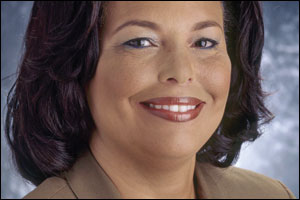
By Debra Lee
When you turn to Black Entertainment Television/BET, you may catch one of our “Rap-It-Up” public service announcements. For example, in the PSA you will find a man and woman wrapping up their romantic evening. The woman turns and asks her date if he would like to come in. Her date says yes. But when he enters her home, out jumps a security guard with a hand held scanner and loaded with lots of questions. The woman sits down while the security guard does his job. The guard tells the woman’s date to step aside, spread his arms and empty his pockets. Then, the guard asks the man if he has any prophylactics and tells him he is not letting any viruses in. This PSA campaign is our way of breaking the silence when it comes to AIDS/HIV in the Black community. Silence has been a deadly weapon in the spread of the HIV/AIDS epidemic in the African-American community. The latest U.S. Centers for Disease Control report on the U.S. epidemic shows that in 2004 within the African-American community Black men account for 65 percent of all AIDS cases and Black women account for 35 percent. BET has worked to be an active and vocal partner in the fight against this disease since 1988. Statistics show 53 percent of African-American adults get information about HIV/AIDS from the media, including radio, TV and newspapers. Only 15 percent say they get information from friends and family and only 14 percent say they receive information about HIV/AIDS from their doctor. For African-American young people, the role of media is even more profound. Seventy-nine percent of African-Americans age 16-24 say they get their information about HIV/AIDS from TV, magazines and websites. The media's potential to reach millions of people on a daily basis puts it in a very powerful position to raise awareness about the issue. I am extremely proud of the contributions that BET has made in the fight against HIV/AIDS through our “Rap-It-Up” campaign. “Rap-It-Up,” in partnership with the Kaiser Family Foundation, is an extensive public education campaign that seeks to inform African-Americans about sexual health issues, including HIV/AIDS. Since the launch of the campaign, BET has produced a total of 24 different full-length specials and more than 45 PSAs. All of our PSAs and on-air programs are tagged with a toll-free hotline number, 1-866-RAPITUP, and website, www.rap-it-up.com, for viewers seeking additional information. Through these services, viewers can receive a free informational guide and they can talk to counselors at the Centers for Disease Control’s HIV/STD hotlines or a local Planned Parenthood. To date, over 1.1 million people have called the hotline and over 404,000 people have received the free sexual health guides. We also have an extensive grass roots initiative to compliment our on-air and on-line components. This year, BET teamed up with Scenarios USA to create a script writing competition for 13-18 year olds asking contestants to describe what it has been like growing up in the age of AIDS. The success of “Rap-It-Up” is undeniable. A recent survey by the Kaiser Family Foundation found that “Rap-It-Up's” public service ads, full-length specials, news pieces and integration into top-rated shows was seen by nine out of 10 African-American 18-24 year olds, with most seeing a variety of content multiple times. Eight out of ten young people saw the campaign on-air, saying it made them more likely to take their sexual relationships more seriously. Three out of four say it made them more likely to use condoms during sex. 58 percent took at least one action to protect their own health after seeing the ads or shows, including getting tested for HIV and using protection. Half say they were moved to talk to their partner about safer sex by the ads or shows they saw on BET. No media campaign alone can be the ''silver bullet'' that changes behavior as personal and sensitive as sex.
However, such a campaign can help to increase awareness about HIV/AIDS and how to prevent it. It can encourage testing and address the role that stigma and discrimination play in the spread of the disease. Media can do all of this in a variety of formats that can appeal to a variety of audiences. There are important roles for many different parts of the community to play in addressing HIV/AIDS, including government, parents, health providers, religious institutions, grass roots organizations and schools.
The media is but one part of a multi-pronged, nationwide effort to address the crisis of HIV/AIDS in the African-American community. If used correctly, the media can be a powerful player.
Debra Lee is president and chief operating officer of Black Entertainment Television.