Statistics
The U.S. Department of Health and Human Services (HHS) and CDC’s National Center for HIV/AIDS, Viral Hepatitis, STD and TB Prevention is offering an educational opportunity for HHS grantees and partners. On Friday, Nov. 16 from 2-3 p.m. EST, the agencies are hosting a live webcast in advance of World AIDS Day to discuss the state of the HIV/AIDS epidemic in the United States. Program participants will include: Dr. Anthony Fauci, Director of the National Institute for Allergy and Infectious Diseases, NIH, Dr. Deborah Parham Hopson, Associate Administrator for HIV/AIDS, HRSA, Beverly Watts Davis, Director of the Center for Substance Abuse Prevention, SAMHSA , and Christopher H. Bates, Acting Director of the Office of HIV/AIDS Policy, who will serve as the moderator. NCHHSTP grantees are encouraged to e-mail questions during the webcast. Questions will be presented to the moderator for consideration. To join free webcast, please visit http://www.aids.gov/webcast_information.html or send an email to Use the subject line “HIV/AIDS Webcast” and include your name, organization, and zip code. You will receive an e-mail with instructions on how to view and listen to the webcast. Please note: space to watch the webcast “live” is limited to the first 1,000 participants. A video and transcript of the webcast will be available on www.AIDS.gov after the event.
Dr. Kevin Fenton Director. National Center for HIV/AIDS, Viral Hepatitis, STD, and TB Prevention, Centers for Disease Control and Prevention,
Research
By Chris Bournea
An innovative study is comparing how HIV-positive women respond differently to medication than their male counterparts. The Gender, Race and Clinical Experience (GRACE) study was launched last fall to compare how women and men respond differently to the drug Prezista darunavir) and antiretroviral agents. The groundbreaking study is also exploring racial differences in treatment outcomes. “Women and people of color have been under-served in clinical research,” said Dawn Averitt-Bridge, founder and board chair of The Well Project, which provides access to health resources for women diagnosed with HIV and AIDS. “This clinical trial is really exciting because both gender and race are finally being considered.” Women account for almost 30 percent of new HIV diagnoses in the U.S., and rates of HIV infection are particularly high among women of color, according to GRACE study researchers. However, women have been underrepresented in HIV clinical trials despite research suggesting that women may have different tolerability issues to HIV medications than men. “GRACE is a landmark study because HIV treatment trials -- including those looking at treatment-experienced populations -- have traditionally included very small numbers of women, especially in the earliest studies of new antiretroviral agents,” said Judith Currier, M.D., associate director of the University of California, Los Angeles, Center for Clinical AIDS Research and Education and a lead investigator in the GRACE study. “We know that there are gender-specific complications associated with HIV disease. However, we do not know a great deal about how gender impacts the efficacy and side effects of HIV medications.” The GRACE study includes 63 sites in the United States, Mexico and Canada, with an enrollment goal of 420 participants -- 70 percent of whom are women. “Women who participate in GRACE will play a very important role in advancing the understanding of HIV treatment in women,” Averitt-Bridge said. Deneen Robinson, a columnist for BlackAIDS.org and African-American woman who has enrolled in GRACE, said the study is the first of its kind to specifically address the needs of women and minorities. “The GRACE study is important for African-American women because it offers the first opportunity for the majority of the participants to represent two important groups in HIV -- women and African Americans,” Robinson said. “The study will show us for the first time if there are any unique differences in HIV treatment for these two groups. This study will begin answering for the larger African-American community about the benefit of therapy for ‘us.’ It will also answer whether or not we have different needs versus other races when it comes to treating HIV disease. Finally, we will have evidence that women, African Americans and inexperienced researchers can participate effectively in research when barriers are addressed.” In addition to involving a record number of women and African Americans, another innovative aspect of the GRACE study is that almost half of the study sites are in Southern U.S. states.
While the South represents a little a more than one-third of the U.S. population (38 percent), it now accounts for 40 percent of people estimated to be living with AIDS and 46 percent of the estimated number of new AIDS cases, according to the Southern AIDS Coalition.
The GRACE study encompasses “sites that are not the usual sites people go to do clinical research. If we wanted to reach out to people who were not enrolling in clinical trials, we had to reach out,” Averitt-Bridge said. “We had to consider bringing the clinical trials to them instead of just going to the large academic institutions. Some of the large academic institutions do a good job of enrolling minorities and women, but not all of them.”
The GRACE study is sponsored by Tibotec Therapeutics Clinical Affairs, which developed Prezista and markets the drug in the U.S. Study participants receive Prezista along with ritonavir and other antiretroviral agents. Enrollment period for GRACE was November 2006 to November 2007. “The last patient should be enrolling by the first of November,” Averitt-Bridge said. “The first findings will probably be at the International AIDS Conference next summer.”
The International AIDS Conference will be held Aug. 3-8, 2008, in Mexico City. The study will also be discussed at the U.S. Conference on AIDS, sponsored by the National Minority AIDS Council, to be held Nov. 7-10 (2007) in Palm Springs, Calif.
More in-depth findings from the GRACE study will be unveiled at the Conference on Retroviruses and Opportunistic Infections in February 2009.
For more information about the GRACE study, visit www.clinicaltrials.gov, call 1-866-512-7943 or
Chris Bournea is a reporter for ThisWeek Community Newspapers in Ohio.
Dallas Outreach
By Sharon Egiebor
One in an occasional series from Making Black Communities HIV/AIDS Smart Campaign in Dallas
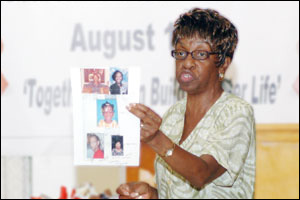
DALLAS -- Carolyn Puyol carries a photo album with pictures of relatives who died from complications of AIDS. Every opportunity she gets, Puyol shares the pictures and talks about AIDS’ ravishing effect on her and her extended family. She speaks at church programs. She takes the microphone during question-and-answer sessions at open community forums. She tells her story when asked. Puyol, who had seven children, 20 grandchildren and 10 great-grandchildren, says she wants a dramatic effect so that young people will take the disease seriously and work harder to stay HIV negative. “My youngest daughter was Adrienne. Adrienne was a beautiful black girl,” said Puyol, as she passed the photographs around recently for students at Paul Quinn College to view. “Then there was Adrianna, Adrienne’s daughter. She was a beautiful 9 years old. Look at Nicole, this is my grandbaby.” The stories are laced with tales of illicit drug use, secret sex lives, prison and love. “This one at the bottom is David,” she said, as volunteers paraded the photos in front of the seated students. “This is my godson. I adopted him because his family didn’t want anything to do with him because he was gay and had AIDS. I took him in and took care of him until the Lord took him home. “ David, who had been in prison, lived with HIV/AIDS for 20 years, she said. She shows a picture of Tina, whose husband wrote a letter on his deathbed saying his best friend was actually his lover and that is how he contracted HIV. The college students laughed, she Puyol said Tina’s children threatened to go to the cemetery to dig him up and kill him again. The petite woman with the large brown eyes and booming voice forgoes the microphone. “I took her in because her grandmother was afraid if she gave her a glass of water she would get AIDS,” Puyol said. Overall, Puyol said she has seven relatives who have died or are living with HIV since 1996. “Tina, my goddaughter. I took her in because her grandmother was afraid if she gave her a glass of water she would get AIDS.” Puyol worked in home health care for about 35 years, where she took care of elderly patients. After she her daughter Adrienne died in 1996, Puyol went to work for an insurance company that provides death benefits for terminally-ill patients. “Once they get AIDS, there is no insurance,” she said. “That is when I starting with the homesteader’s life insurance policy. You can get something and pay on it for how ever many years you want. It will cover them for burial only.” She says that is how she met Tina and David. But it is Adrienne’s story of drug abuse and prostitution that she keeps coming back to. Telling, more and more as her 20-minute speech allows. “Adrienne had everything that this disease can give you. Name it, she had it. Tuberculosis, syphilis, blindness and IV’s,” she said. “I had to quit my job because I had to take care of her. My Friends would come to the house and they would peek in and ask, ‘How’s the baby doing?’ but they wouldn’t come in and help. “The hardest thing about losing Adrienne, I had to ask the Lord to just go on take her because it was a horrible death. And guess what, when you become promiscuous, and you say ‘I have to die for something.’ It is not just you. It is not just about you. What about me?,” she said raising her voice. “It was about me. I was Mom. I had to take care of her. I had to change her. I had other kids. One said what about the toilet? I said go home and use your own toilet.” She said Adrienne died in 1996 after she refused to take her medication. “I asked Adrienne, ‘How did you make it out there in the street like that so long.?’ That child was so ugly. ‘Did they put a bag over your head?’ She was on drugs and they had dragged her down. She turned completely black; her hair was thin. She looked horrible. She said, ‘Momma, you would be surprised. They [men] come down to South Dallas dressed up pretty... ministers, people in high office. I didn’t have any bad men looking me.’ “She said I did whatever they asked me to do. I just couldn’t imagine that it didn’t matter how you looked. That girl bathed all of her life, and smelled good. She used to take three or four baths a day.”
“She said I did whatever they asked me to do. I just couldn’t imagine that it didn’t matter how you looked. That girl bathed all of her life, and smelled good. She used to take three or four baths a day.”
Puyol said Adrienne’s daughter, Lafadra, followed in her mother’s footstep. She became a drug user, contracted HIV and died in April. In between the two women, her son’s girlfriend and granddaughter died from HIV. Earlier this year, her 40-year-old daughter announced her HIV positive status. “People say, ‘How you can through this?’ Nothing but the grace of God. Still nobody wants to hear my story,” she said. “You’re here to day, and you have an opportunity to turn yourself around. I know you’re young. We weren’t born grown folks. I was a kid too. I loved to party, get high, and do a little dance,” she said as the audience laughed. “I loved to party, and I still dance now. I’m 66 years old and it is never too old to get tested.” After Puyol’s speech, AIDS service organization employees and the college nurse explained to the college students that people with HIV/AIDS can live a full life.
NNPA Commentary
By Bev Smit
New Story on How AIDS Traveled to America. There was a day I will never forget. I was sitting on my deck in beautiful Rockville, Md., drinking vodka gimlet with one of my best friends and we were discussing all of the AIDS work I had done on my nationally syndicated talk show. He said, “Oh Bev, you don’t know how this work is going to change lives.” He had always been interested in my show, but this was different. We got quiet and were just enjoying living in suburbia and as I was thinking how blessed I was, he looked at me and said, “I have AIDS.” I broke down and cried. This was the moment I made up my mind I would make a difference in the lives of not only him, but anybody touched by this disease. I lost Ricky, Jack from New York and Flynn from Washington, D.C. They were people who had beautiful hearts, souls and spirits whose families had abandoned them. There was also Gregory, who I worked with in Washington, D.C. We thought he was going to beat the disease, but he died too. This disease is always living with me because there is not a day that goes by that I do not miss and wish I had Ricky in my life. As long as I live, I will do whatever I can to stop this disease from ruining lives. As the only female African-American nationally syndicated talk show host for the American Urban Radio Networks, I have always been involved with issues regarding HIV/AIDS. I have been in the business for more than 40 years and the theme for my talk show is “Get Involved.” I push this phrase and even put it onto T-shirts: “Stand up, Be Counted, Get Involved.” Why? First of all, I am not just your average talk show host. I am an activist. Therefore, my talk show is not about sitting around and talking, but about making changes in peoples’ lives. This is what I’m all about. However, my awareness on AIDS/HIV was heightened after reading Randy Shilts’ book, “And The Band Played On.” As the first black in Miami with a talk show, I began to get involved because I could not believe that the Centers for Disease Control could put out a theory that said a green monkey bit a man who went to San Francisco and had sex, and went from San Francisco back to New York and that is how it spread. [For a full explanation of U.S. government-funded research on the origin of AIDS. Visit [http://www3.niaid.nih.gov/news/newsreleases/1999/hivorigin.htm.] It just sounded like I ought to be singing ''dooda, dooda.'' I thought that was asinine. I believe the origins of HIV/AIDS is man-made. According to “QUEER BLOOD: The Secret AIDS Genocide Plot,” by Dr. Allen Cantwell Jr., M.D. the smallpox eradication vaccine program sponsored by the World Health Organization was responsible for unleashing AIDS in Africa. Cantwell also debunks the African green monkey theory of AIDS and explains how AIDS started as a covered-up genocide experiment, using blacks and gays as guinea pigs. I also think the Black community is ignorant about AIDS. According to the Henry J. Kaiser Family Foundation, in 2004 African-Americans represented 61 percent of HIV/AIDS cases among 13-to-24 year olds. This alarming statistic tells me there is a hidden silence that says: “Don’t talk about it and it will go away” and “Don’t mention you have a gay friend.” “Don’t mention that there are gay people in the pulpit, gay people in the White House.” “Don’t talk about it and it will go away.” I would like to see that mindset changed, because we still do not get how widely this disease impacts us all. No matter how many young college women I have on the show who say, “I just went with him one time” or no matter how many wives who say, “My husband came home from prison and I contracted the disease,” the Black community still sees this as the gay disease. We have senior citizens with AIDS! Yet, our churches are still too judgmental, but God will deal with them. Still, I am going to talk about it no matter what kind of response I get from the audience. I am straight up. So, if you do not like it, turn the channel. When there is a problem, whether it is racism or George Bush or whatever, I am going to address it. So, I am not afraid. I have never had a problem. Maybe, I am just blessed. Maybe, the Lord just says, “I’m going to take care of this fool.” But if you don’t stand up for something, you’re going to fall down for everything.
Statement:
Black faith leaders from around the country convened earlier this month to plot a legislative strategy for ending the AIDS epidemic in Black America. The remarkable meeting -- which drew roughly 200 participants, including not only African American clergy but also Black medical professionals and congressional members -- was a critical step in a clergy-led campaign to push both local and national elected officials into action. "Not since the civil rights movement of over 50 years ago has African American clergy in this country been galvanized to fight yet another social plague that carries with it the potential to obliterate the African American community," said Butts of the meeting. The ministers drafted a statement of priorities in which they vowed to push HIV testing, treatment and overall AIDS awareness in their own congregations, and then called on lawmakers to draft and pass a National HIV/AIDS Elimination Act. The clergy statement added to a chorus of calls for the federal government to develop an overarching national plan to deal with the epidemic. After 26 years, the U.S. still has no overall strategy guiding its response to the domestic epidemic. The U.S. insists any nation receiving foreign assistance for an AIDS program have just that sort of plan and it is long past time that we have one of our own. "The Act will include measurable goals, timetables, and specific objectives designed to eliminate the HIV/AIDS epidemic," the Oct. 9 statement reads. "As a part of the National AIDS Plan, the Elimination Act will highlight and address the key structural drivers of the AIDS epidemic like poverty, low-literacy, stigma, unemployment, incarceration, racial disparities, and other structural drivers of the epidemic in the United States."
The Oct. 8 meeting was convened by Bishop T.D. Jakes, of Dallas' The Potter's House, and Rev. Calvin Butts, pastor of Harlem's Abyssinian Baptist Church and chair of the National Black Leadership Commission on AIDS. Jakes and Butts led the group in hammering out a series of principals and priorities that will inform the drafting of federal legislation addressing the Black AIDS epidemic. New York City Rep. Charles Rangel, the powerhouse chair of the House Ways and Means Committee, pledged to sponsor the resulting bill and drive it through Congress.
In addition to creating a national plan, the proposed Elimination Act would declare the epidemic among African Americans a public health emergency, thereby authorizing substantial targeted funding for the Black epidemic. And it would "establish an Institute to document the historical treatment of African Americans and its impact on the issues that have evolved and must be addressed." The clergy meeting was the latest in a series of high-profile efforts to mobilize Black America's traditional leadership in the fight against AIDS. In September, the Black AIDS Institute released its 2007 State of AIDS in African Americans Report, which chronicles many of those community-level advancements. It's available at www.BlackAIDS.org The report, We're the Ones We've Been Waiting For, highlights the commitments of 16 traditional Black organizations to draft their own strategic plans for combating AIDS. In February 2008, the Institute will release a report further detailing those plans and measuring how closely each organization has come to meeting its commitment. No one individual, organization or institution can end Black America's AIDS epidemic, but there are few institutions more critical to the success of such an effort than the Black church. This conclave, while not the first time Black clergy have answered the call, is unique in its efforts to build a mass Black mobilization inclusive of all our institutions and members of our communities.