Dallas Outreach
By Sharon Egiebor
One in an occasional series from Making Black Communities HIV/AIDS Smart Campaign in Dallas
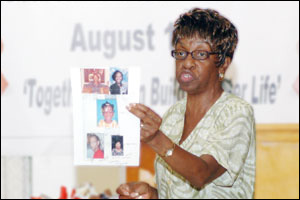
DALLAS -- Carolyn Puyol carries a photo album with pictures of relatives who died from complications of AIDS. Every opportunity she gets, Puyol shares the pictures and talks about AIDS’ ravishing effect on her and her extended family. She speaks at church programs. She takes the microphone during question-and-answer sessions at open community forums. She tells her story when asked. Puyol, who had seven children, 20 grandchildren and 10 great-grandchildren, says she wants a dramatic effect so that young people will take the disease seriously and work harder to stay HIV negative. “My youngest daughter was Adrienne. Adrienne was a beautiful black girl,” said Puyol, as she passed the photographs around recently for students at Paul Quinn College to view. “Then there was Adrianna, Adrienne’s daughter. She was a beautiful 9 years old. Look at Nicole, this is my grandbaby.” The stories are laced with tales of illicit drug use, secret sex lives, prison and love. “This one at the bottom is David,” she said, as volunteers paraded the photos in front of the seated students. “This is my godson. I adopted him because his family didn’t want anything to do with him because he was gay and had AIDS. I took him in and took care of him until the Lord took him home. “ David, who had been in prison, lived with HIV/AIDS for 20 years, she said. She shows a picture of Tina, whose husband wrote a letter on his deathbed saying his best friend was actually his lover and that is how he contracted HIV. The college students laughed, she Puyol said Tina’s children threatened to go to the cemetery to dig him up and kill him again. The petite woman with the large brown eyes and booming voice forgoes the microphone. “I took her in because her grandmother was afraid if she gave her a glass of water she would get AIDS,” Puyol said. Overall, Puyol said she has seven relatives who have died or are living with HIV since 1996. “Tina, my goddaughter. I took her in because her grandmother was afraid if she gave her a glass of water she would get AIDS.” Puyol worked in home health care for about 35 years, where she took care of elderly patients. After she her daughter Adrienne died in 1996, Puyol went to work for an insurance company that provides death benefits for terminally-ill patients. “Once they get AIDS, there is no insurance,” she said. “That is when I starting with the homesteader’s life insurance policy. You can get something and pay on it for how ever many years you want. It will cover them for burial only.” She says that is how she met Tina and David. But it is Adrienne’s story of drug abuse and prostitution that she keeps coming back to. Telling, more and more as her 20-minute speech allows. “Adrienne had everything that this disease can give you. Name it, she had it. Tuberculosis, syphilis, blindness and IV’s,” she said. “I had to quit my job because I had to take care of her. My Friends would come to the house and they would peek in and ask, ‘How’s the baby doing?’ but they wouldn’t come in and help. “The hardest thing about losing Adrienne, I had to ask the Lord to just go on take her because it was a horrible death. And guess what, when you become promiscuous, and you say ‘I have to die for something.’ It is not just you. It is not just about you. What about me?,” she said raising her voice. “It was about me. I was Mom. I had to take care of her. I had to change her. I had other kids. One said what about the toilet? I said go home and use your own toilet.” She said Adrienne died in 1996 after she refused to take her medication. “I asked Adrienne, ‘How did you make it out there in the street like that so long.?’ That child was so ugly. ‘Did they put a bag over your head?’ She was on drugs and they had dragged her down. She turned completely black; her hair was thin. She looked horrible. She said, ‘Momma, you would be surprised. They [men] come down to South Dallas dressed up pretty... ministers, people in high office. I didn’t have any bad men looking me.’ “She said I did whatever they asked me to do. I just couldn’t imagine that it didn’t matter how you looked. That girl bathed all of her life, and smelled good. She used to take three or four baths a day.”
“She said I did whatever they asked me to do. I just couldn’t imagine that it didn’t matter how you looked. That girl bathed all of her life, and smelled good. She used to take three or four baths a day.”
Puyol said Adrienne’s daughter, Lafadra, followed in her mother’s footstep. She became a drug user, contracted HIV and died in April. In between the two women, her son’s girlfriend and granddaughter died from HIV. Earlier this year, her 40-year-old daughter announced her HIV positive status. “People say, ‘How you can through this?’ Nothing but the grace of God. Still nobody wants to hear my story,” she said. “You’re here to day, and you have an opportunity to turn yourself around. I know you’re young. We weren’t born grown folks. I was a kid too. I loved to party, get high, and do a little dance,” she said as the audience laughed. “I loved to party, and I still dance now. I’m 66 years old and it is never too old to get tested.” After Puyol’s speech, AIDS service organization employees and the college nurse explained to the college students that people with HIV/AIDS can live a full life.