Newsmaker Interview
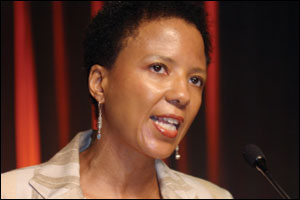
Black women featured prominently in discussions among researchers at the Centers for Disease Control and Prevention’s annual HIV prevention conference this week. As African Americans have accounted for increasingly lopsided shares of the epidemic among women—67 percent of new AIDS cases in 2003—they’re primary risk has also gradually shifted from injection drug use to heterosexual sex. “We actually don’t know a lot about the partners of these women,” CDC epidemiologist Lisa Fitzpatrick acknowledges. “One of our next steps has to be to find out who the partners are.” University of North Carolina researcher Dr. Adaora Adimora, however, presented a study at the Atlanta meeting that suggests poverty and structural inequality may be HIV risk factors. Her team interviewed just over 200 North Carolinian African Americans who said they were neither men who have sex with men nor injection drug users. Seventy-eight percent were women. She discovered trends that suggest slowing HIV’s spread among Black women will require more than simply encouraging safer sex. Adimora explained her findings to BlackAIDS.org editor Kai Wright. BlackAIDS.org: So we’ve got this data about heterosexual transmission among women, but we don’t really know about their partners. What can we say broadly about what’s driving that? Adimora: It’s quite complex. It’s many things at the same time. But it’s relatively clear that a couple of major issues are among the things that are driving heterosexual transmission among African Americans in the United States—specifically, the high prevalence of STDs, because STDs facilitate HIV transmission, and also sexual network patterns. Sexual network patterns have been recognized as increasingly important in HIV and STD transmission in recent years. And when you say “sexual network patterns,” tell us what you mean by that. Who is having sex with whom, and the nature of the links that connect people sexually with each other. What ways are those unique for heterosexual Black women? Among the patterns that are of particular interest are the patterns of mixing, for instance, and the patterns of monogamy--long-term monogamy and sequential monogamy. So, for the patters of mixing, it’s whether people at low risk for HIV infection are mixing exclusively with other people who are at low risk for HIV infection, or whether low- and high-risk people are mixing, which can promote the spread of HIV and other STDs throughout a population. Also, whether or not people have partners that overlap in time, or what we call “concurrent partnerships.” They may have sex with one person, then move on to another person, and then return to the original person—this is an example of concurrent partnerships. All of these network patterns are important in the spread of HIV and STDs. And in those concurrent partnerships, are African American women more likely to be involved in those? Well, I don’t want to make specifically that statement. What I’ll say is at least in some studies there is evidence that there is a higher prevalence of that type of partnership among African Americans. And we looked at that, for example, among women in the United States in the 1995 cycle of the National Survey of Family Growth. And in fact that type of partnership was more prevalent among Black women. However, the major reason for its prevalence among Black women appeared to be related to lower marriage rates, because marriage rates are considerably lower among Blacks than they are among other ethnic groups. So in fact when you control for marital status and age at first sexual intercourse—that’s another risk marker for STDs and future sexual behavioral risk—as well as age-at-time-of-interview, the difference between Blacks and whites in the extent of concurrency markedly decreases. So much of the concurrent partnership that we saw among African Americans appeared to be related at least in part to low marriage rates. And where does that come from? That may be beyond the research you’re doing, but if you can speculate… Well, I’m certainly not a sociologist, but I’ve read some of the work of sociologists. And there are a number of explanations. But the major explanation for the lower marriage rates among Blacks in the U.S. have included economic factors—such as joblessness, poverty and the other obvious economic factors that make it less likely that people will marry and less likely that people will stay married once they do marry. … The other major one is the ratio of men to women, which is much lower among Blacks than it is among other ethnic groups. That’s because of the [early] death of Black men due to violence, due to disease, and it is further lowered by the disproportionate incarceration of Black men. And it’s felt that this low sex ratio, in concert with other factors, has a negative impact on marriage rates, which in turn clearly influences the prevalence of concurrent relationships. So the bigger picture that you’ve talked about is these social and economic structures are contributing to why Black women are more likely to encounter HIV. Yes, specifically some of these socio-economic factors—poverty, inequality, discrimination—appear to relate to sexual network patterns and certainly too sexual behaviors. I mean, they’re not the sole explanation, but they do clearly influence them. And they influence people’s risk for getting infection once they engage in the behaviors. One of the things you mentioned this morning was crack use in the South and its concurrence with HIV infection. Can you tell us about that? My impression is that there are varying levels of crack use in different regions in the United States. We examined risk factors for heterosexual transmission of HIV infection among African Americans in certain parts of North Carolina, and crack was among the factors that emerged as independent risk factors—and I will say that this data was collected between 1997 and 2000, so that was a few years ago, but from what we see in our clinic, crack use is actually still quite prevalent. To return to the study though, risk factors that emerged were smoking crack—that’s crack use on the part of the respondent or crack use on the part of the respondent’s partner—having less than a high school education and having a partner who was an injection drug user. You’ve also talked about women in that study who have no identified risk. Most people in our study reported some behavior that you would identify as reasonably high-risk behavior. None of them injected drugs, but they had other behaviors, typically, that were high risk. And actually, the other thing that was associated independently was increased numbers of partners; the more partners you have the more likely you are to be at risk for HIV infection. But more than a quarter of respondents did not have such high-risk behavior, and in that group among the risk factors that emerged were having a high school education and reporting what I would call food insecurity--that is having a concern about getting enough food for themselves or their family in the past 30 days. And also, having a partner who had other partners in the course of the relationship. Why do those things then equate to risk? Well, first, having a partner who had other partners is not a surprise. But having low socio-economic status is a marker for disease in general. Decreased social capital over time can place people in situations that increase their susceptibility for a variety of things. So poverty is a risk factor for disease. And when you get to the intersection of poverty and discrimination [the risk factors multiply.]
BlackAIDS.org Forum The faith-based community has been called on to step up and make a difference in the fight against HIV infections in African Americans. Some churches, congregations, synagogues and mosques embrace the challenge. Others are keeping an arm’s length between themselves and the topic. BlacksAIDS.org contributing editor Sharon Egiebor discussed this divide with a minister, a church program director, a person living with HIV and a federal government employee, all of whom are working with individuals and corporate religion to draw leaders of faith into the prevention fold. Their consensus is that prevention cannot continue to exist without the church, in whatever form individuals describe their religious beliefs and tenets. Qairo Ali Ali saw the need to include the church in the prevention message and then found a way to provide the funding. “The faith community’s role is phenomenal and often understated,” said Ali. “Traditionally, the faith community and its leaders have played a magnificent role in social issues and in establishing the development of working with marginalized populations. Its influence comes primarily from its access to the community, to individuals, to families, and on a frequent, regular basis. When you take that into consideration, one would be remiss to not include the faith community and its leaders in HIV prevention.” These leaders should be engaged in conducting HIV prevention, spreading the HIV message and interacting with those who are affected and infected by HIV. “I know they may not necessarily have the skills. It is a matter of learning how to do this. Business leaders have had to learn how and government institutions have had to learn how to deal with people who are affected and infected. It is a learning process, and it depends on where you enter into the fight. I’ve never bought it that there is a certain way or that you’ll promote religion.” Caring is usually the first step, said Ali, who began working with faith-based groups more than a decade ago. “I’ve actually found that those involved with HIV prevention do so simply because they care,” said Ali. “The church is a model for other faith leaders to reduce stigma. You reduce stigma by demonstrating compassion for those infected and affected.” Ali said the CDC is planning to form an alliance of national, prominent religious leaders to participate in HIV prevention. She is planning to invite 25 to 50 leaders from several faiths to join the alliance, which will be in place by the end of the year. “I don’t think there are enough voices. I know faith leaders are learning how. They have said we do not know how to do that. It is a huge job…especially when they are used to helping Mother Mary get food or keep the lights on or helping Deacon Jones with something else. “This requires faith leaders to think about, to dialogue about, to share concerns about sexuality. Sexuality is something that is intimate and they have not necessarily have had to do that in a proactive way. HIV prevention requires a proactive approach and you have to learn how to do that.” Ali said faith communities must understand that the HIV/AIDS epidemic is not over. “The faith community is one of the most viable venues or settings for HIV prevention. If were are really going to have the impact that’s needed, we must make sure they are included to make a good fight and that we understand the value faith leaders can bring.” Dr. Jacqueline Hampton Hampton says ministers are conflicted when it comes to ministering to people living with HIV/AIDS. “You have to have the conversation in terms of theological comfort. They are wrestling with sexuality, sin and theology,” said Hampton. “We meet them where they are. Do you think it is possible that you can buy gas for the van to help people without condemning? Often they will say yes.” She recommends clergy look at those with HIV as human beings who have a disease, and at HIV as part of the whole spectrum of diseases affecting African Americans. “When you have a health fair and are screening for other diseases, have HIV testing,” she said. “If you’re uncomfortable with that, have some pamphlets you can hand people or be willing to refer them to someone. This way, you can say, ‘I’m not comfortable discussing the issue, but I can refer you to someone.’” Metropolitan, formed in 1981, offers several support programs for its congregants, including a wellness center, alcohol and drug coordination, a spiritually-based HIV/AIDS prevention program, a methadone maintenance program, a capacity building program, primary care clinic and a child advocacy program. Hampton said the capacity building program has worked with more than 200 churches nationwide in the past five years, helping most of them have some input in HIV prevention. The church’s senior pastor, Rev. Edwin C. Sanders, II, said some folks think Metropolitan is a mega-church with thousands of members, a fancy dome and televised services. In reality, he said, it is a small place with 350 members, half of what it was before several members who didn’t support the vision drifted off. What remains, he said, are the committed workers. In 1992, Sanders committed to preach about HIV/AIDS each Sunday for 52 weeks, following a meeting with the Balm of Gilead, a national faith-based organization in Harlem. The secret to the church’s success, he said, is surrounding himself with people smarter than he is, and then dividing the work load. Rev. James Suber Suber says HIV is just too personal for most churches in the South, many of which are very conservative. “The church has been very uncomfortable with dealing with HIV because of behavior and sexuality. They take the view that it is a negative sexual behavior associated with HIV,” said Suber, who received his theological training at the Interdenominational Theological Center on the Morehouse College campus. “Ministers are not prepared to deal with sexual connotations and sexual issues in the church, no matter how much training they get.” His senior pastor, Dr. Barbara Lewis King-Oatly, came to the church after a career as a social worker. Her experience, he said, is one of the reasons that the 7,000 to 10,000- member congregation has 33 auxiliary programs and a strong HIV/AIDS ministry. “We are a new thought church that came out of Unity of Church of Religious Science,” he said. Super explained the theology of “new thought” churches, saying, “We get into metaphysics to explain behavior and changes that go on in our life today.” “Pastors do not survey their congregations enough to get a feel for whether or not they should deal with this,” he said. “Then we have the pastor who says, ‘I don’t want someone to think that we are comfortable with that and we would start allowing other people of other persuasions to come into the church--the gay community. If we do, then we’ll have to have a gay alliance or an AIDS program, and I am not comfortable with that.’” Suber said attending seminary often perpetuates a lack of empathy for diverse populations. “When you go to seminary, you get this intellectual understanding of what religion is. You don’t study diversity or empathy classes--at least not at the protestant seminary classes I attended,” he said. “The majority of guys focused on having a big church, a big car and a big home, not outreach, not social programs, not faith-based initiatives.” This mindset, he said, leaves a lot of hurt people within the church. He gave as an example a conversation he had with a pastor who has 15,000 members in the Atlanta area. The minister says he accepts gays but not homosexual behavior and that his congregation is clear about its beliefs. When approached by the Atlanta AIDS Interfaith Network about developing an outreach program, the minister declined the offer. “I have some of his congregants come to me for counseling. The congregant said, ‘My pastor loves me as a gay man, but not as a homosexual. So what do I do with these feelings I have?’ “You have this person who will probably end up with some mental health issues, if he stays there,” Suber said. Judith Dillard Last year, Dillard returned to her native Fort Worth, Tex., after living in Los Angeles for 19 years. Her mother’s illness prompted the move, but she almost didn’t stay. “I started to go back to Los Angeles when I found out the how people with AIDS were treated in Fort Worth. I felt like I was traveling back in time,” said Dillard. “I found a lot of stigma.” She stayed because her family said they missed her. But she joined a predominantly white congregation. “They understand me more and they respect more. I wouldn’t deal with the stigma in the Black church. [At the new church,] they don’t judge you. You don’t have to be a ‘Ms. It.’ They accept you from where you are. … They actually show the love of God, regardless of your situation.” Dillard said she became empowered while living in Los Angeles and learned a lot from working with several prominent AIDS organizations. “I learned from these women and…these people helped me to grow. I now can commiserate with those less fortunate women. I really grew in Los Angeles to where I can stand on my feet in Fort Worth and know that I can make a change.” Part of making change in the community is making herself available to mentor to other women. “I don’t care where a person is. It is not easy getting an HIV diagnosis. It was hard for me then and it is hard now. I can care. I can be there for them. I know what they are feeling. I can hug you. You can cry on my shoulder. When I got diagnosed, I didn’t have a shoulder to cry on.” Dillard said she’s been in Fort Worth for a year now and was able to find an apartment that was financially supported by Samaritan House, a nonprofit agency that provides housing and support for people and families infected and affected by HIV. “I’ve got a wonderful life in Fort Worth and I know that [my family] missed me. I didn’t want to come home at first,” said Dillard. “I’m 51 years old. I got infected at 36 and I didn’t think I’d live to be 40. I know that I’m blessed and that the Lord has me in his hands,” she said. What she does, is “all for my Lord and Savior. It makes me want to share my love for others. “I didn’t go home at first. With that great support from my family, I know that I can soar.” This fall, she’ll help organize a group from San Diego that is participating in the national Campaign to End AIDS, where thousands will converge on Washington, D.C., to encourage the government to increase AIDS funding and research.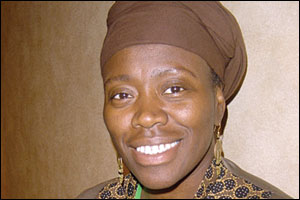
National coordinator of the U.S. Centers for Disease Control and Prevention’s Faith Programs and HIV Partnerships.
Coordinator and project planner for Metropolitan Interdenominational Church Technical Assistant Center in Nashville, Tenn.
Director of Life Ministry at Hillside Chapel and Truth Center in Atlanta and program director for Atlanta AIDS Interfaith Network.
Volunteer for CHAMPS, a New York City-based HIV/AIDS mobilization project and a coordinator for the national Campaign to End AIDS.
VOICES from... the National HIV Prevention Conference
By Sharon Egiebor
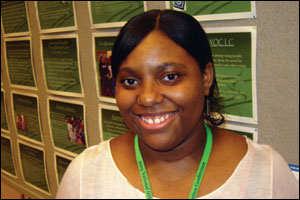
Candace Webb could barely contain herself. Sitting in front of a poster presentation for Advocacy for Young Women of Color Leadership Council, Webb was her own picture of youthful energy. She was animatedly detailing the virtues of her organization’s goals--providing education, inclusion and empowerment messages to girls 13 to 24 years old--to a New York college student she’d just met. They sounded like old friends catching up. In a matter of minutes, the two young women hashed through mutual concerns of culture and race, of stigma and accessibility and college classes and life. Webb, a 23-year-old graduate student form Tampa, Fla., promised to send Terry-Ann Smith, a graduate student from Brooklyn, N.Y., contact information for council members in her area. The 23-member council, based in Washington, D.C., supports adolescents in making good decisions about reproductive health. Members are from a variety of ethnic backgrounds, sexual orientations and income and education levels, said Webb, who has been a member for two years. In the discussion and design of HIV prevention programs, young women of color need to be considered and consulted, she said. “Young women of color need to participate. How can they design the messages to young women of color if we are not on board?” Webb asked. The two women were attending the 2005 HIV Prevention Conference. Webb was sharing the success of the leadership council and Smith was learning more about the molecular structure of HIV subtypes. But for outreach, Smith presents prevention messages to young women from the Caribbean. “My school is predominantly white. They don’t understand how culture impacts HIV. It is a health issue and it is a culture issue,” said Smith, a graduate student at New York University. “First, in the Caribbean community, sex is not an open topic like it is for Americans,” said Smith, who is working toward her Ph.D. in molecular biology and researching HIV subtypes in Cameron. “Things are on the hush-hush. You do not talk about going to the doctor to get an HIV test. Women do not negotiate condom use. …Having to negotiate your sexual action is not in the context of what we consider good behavior. …You want to be seen as a good person.” The women also discussed access and acceptability of new female barrier products. Smith said in her New York neighborhood, condoms are kept under lock and key at the pharmacists and many women are hesitant to ask for them. The potential use of microbicides would face cultural roadblocks, she said. Webb said new research on female barrier methods should first consider whether the products would be feasible in all communities. “It has to be accepted even if it is 100 percent effective,” she said. Just like with condoms, there is an issue of gender roles and expectations of women. The two women also discussed balancing advocacy with life. Webb, who is a student in the College of Public Health at University of South Florida, said she spends her time creating awareness programs and workshops around key national HIV/AIDS awareness days, such as National HIV Testing Day. “My personal life and my academic life are related,” she said. In her message to other young women, Webb said she talks frequently about self-esteem and responsibility. “I really stress self worth and self love. You have to be responsible for our own destiny. No one else can do it for you. You have the responsibility to make the decision of whether to be abstinent or to have safer sex.”

The National HIV Prevention Conference
By Keith Green
ATLANTA, Ga. -- Nearly half of Black homosexual and bisexual men tested positive for HIV in a first-of-its-kind federal study. These men are among the U.S. Centers for Disease Control and Prevention's newly-revised estimate of 1.1 million people living with HIV, of which 47 percent are African American.
Dr. Alan Greenberg, acting deputy director of the CDC's Division of HIV/AIDS Prevention, presented the data at the 2005 National HIV Prevention Conference held in Atlanta yesterday.
The CDC developed the numbers through its first use of a 2004-2005 comprehensive national surveillance system. The analysis monitors the entire pathway of HIV, from high risk behaviors to HIV incidence and prevalence, to HIV illness, AIDS and death.
This data emerges in the midst of a dispute between AIDS activists and the Bush Administration over the federal HIV prevention budget. Congress has cut the CDC’s HIV and STD prevention budget each year since 2004, and the White House proposed another $4 million cut for the coming fiscal year. Congress has just begun deliberations over that budget.
In the study of homosexual and bisexual men, Greenberg announced that Black men were more than twice as likely to be infected with HIV as other racial and ethnic groups, and were much less likely to be aware of their HIV infection. The CDC surveyed 1,767 men over the age 18 at local bars, bookstores and other locations frequented by gay and bisexual men in Baltimore, Los Angeles, Miami, New York and San Francisco.
Of the participants surveyed, 46 percent of Black men, compared to 21 percent of white men and 17 percent of Hispanic men, were found to be HIV positive. Among those infected, 68 percent of Black men, 48 percent of Hispanic men and 18 percent of white men were unaware of their infection before participating in the study.
This latest study follows a much-discussed series of studies conducted in several cities throughout the 1990’s that estimated as many as one-third of Black gay and bisexual men under the age of 30 were HIV positive. It should be noted that these studies were considered controversial by many in the Black gay community because participants were recruited from HIV/STD clinics, bars and other “high risk” venues that may have skewed the findings.
The CDC typically uses its annual prevention conference to release new epidemiology of this sort, and in recent years the agency has found consistent increases in infection rates among both African Americans and men who have sex with men. These studies have renewed an old debate within the public health sector over whether HIV prevention actually works. CDC officials highlighted studies showing the efficacy of several community-based interventions designed to reduce the incidence of HIV infection in communities of color.
Dr. Taleria R. Fuller, an ORISE (Oak Ridge Institute for Science and Education) fellow at the CDC, noted the recent decline in new HIV infections amongst African American women. Dr. Fuller elaborated on current efforts that are underway to expand the use of four proven HIV-prevention programs for African American women, which the CDC officials said they hope will have an even greater impact on this high-risk population.
The interventions include programs for both HIV-negative and HIV-positive African American women. They focus on increasing women’s communications skills to refuse sex and negotiate condom use, enhancing their skills in correctly using condoms and building the self-worth and confidence needed for women to take control of their health. One intervention also enlists African American businesses in media campaigns that seek to alter community norms about safer sex.
Gary English, executive director of Brooklyn, N.Y.-based People of Color in Crisis, presented a group level intervention for Black gay men known as “Many Men, Many Voices (3MV).” 3MV is comprised of six weekly two- or three-hour facilitated discussion sessions for up to 25 men, which include HIV prevention information, role playing, group problem solving and discussions that address the attitudes and beliefs that impact African American men who have sex with men and their sexual practices.
Since 2003, the CDC has made it clear that it believes that the answers to effective prevention lie in targeting people who are already living with the virus. That has been an extremely controversial idea within the AIDS community.
Keith Folger, director of programs for the National Association of People with AIDS (NAPWA), argues that there is no scientific way to prove that an agency doing “Prevention with Positives” will be able to get those who are at highest risk for spreading HIV in for a counseling session. “I hate to say this,” says Folger, “but the majority of agencies doing ‘Prevention with Positives’ have no business doing it. For the most part, there are many well-meaning public health people involved who want to do prevention campaigns with positive people but never asked those people what would work for them. The biggest concern is that positive people have not been involved with the process and, unfortunately, they still aren’t.”
Colin Robinson, executive director of the New York State Black Gay Network, argues that much of this debate misses the bigger picture. “Many of the things that we label as prevention are things that we should be doing for our community regardless of the presence of HIV. HIV is a critical issue but there are so many other critical issues that we need to work on as a community,” says Robinson. “We must create spaces where black gay men can heal and then promote general community wholeness and wellness. There are lots of things that we can do to change the climate of HIV prevention. If you got rid of homophobia and unemployment and homelessness, you would see a change in the numbers.”
Newsmaker Interview
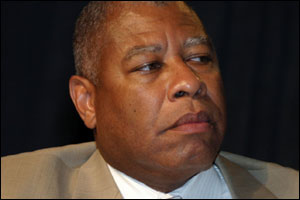
Christopher Bates is a unique breed in today’s political milieu. He’s an openly gay Black man who is at the center of the Bush administration’s AIDS policy shop. As acting director of the Office of HIV/AIDS Policy in the Department of Health and Human Services, Bates often speaks for an administration that many feel is disengaged from and often openly hostile to HIV prevention. Bates rejects that characterization, arguing that the administration has broadened the way prevention is addressed, particularly when it comes to abstinence and accountability measures.
But Bates also speaks with remarkable candor on topics that aren’t usually associated with his boss in the White House: The need for open and honest dialogue about sex, the wellbeing of Black America’s next generation, and both the power and the challenge of being Black and gay in today’s culture. BlackAIDS.org editor Kai Wright caught up with Bates during the National HIV Prevention Conference in Atlanta.
BlackAIDS.org: Has prevention worked? Has what we’ve been trying worked?
Bates: I’m a big believer that prevention does work. I think where we are challenged in prevention is the level of intensity that is often times required to do this work. Meaning, a lot more individual activity has got to take place, rather than trying to do purely posters and public media blitzes.
You’re talking about one-on-one…
I’m talking about one-on-one or small group interventions. They are very, very effective, in those communities where they do that kind of work. In particular with young people, it’s effective. But we run up against things such as parental consent, support from school boards, that kind of thing. So it’s very hard to get to young people in the absence of that kind of support. Some kids don’t get the level of intervention necessary to modify their behavior. The president has put forth an initiative called ABC [short for “Abstinence, Be Faithful, use Condoms,” a prevention perspective that stresses abstinence until monogamous marriage, but still teaches about condom use as well] which I am a staunch believer in. I think young people, especially between 9- and about 16- or 17-years old, shouldn’t be having sex--even though, we know they do. But we have to give options to kids, and we’ve only been talking about abstinence in a very aggressive way in the last couple of years.
But what about the distinction between—there’s ABC and there’s abstinence-only. Now one of the criticisms is that all of the money in fact is going to abstinence-only.
All the money is not going to abstinence-only. Abstinence-only takes up some of the funding, but that’s generally not been a part of our prevention strategy. On the CDC side, that’s been part of a carve-out for a program for the Administration for Children and Families—there’s a component of the CDC that focuses on that. But all that’s youth-focused, and that youth focus is really between about 9-years-old and 16 or 17. It doesn’t include kids who are 17, 18, 19 or 20—the years that are most impacted by HIV right now, the older group. We’re not solely selling them on abstinence.
And beyond youth then, the other question is how do you do prevention with adults. Certainly, earlier in the Administration at least, there’s been a feeling that you have placed limits on it—that you don’t want words like “sex worker” in grant proposals and so on. Is that a justified feeling that people have?
Remember, Congress passed legislation back in the 90s that said no federal dollars could be used to promote sexual behavior, whether that sexual behavior was targeting gays and lesbians or heterosexual people. So any campaigns that are funded by federal dollars cannot even have the look of promoting sexual behavior, between consenting adults or others. That’s just the fact. It does not preclude communities form taking private dollars and other dollars to do sexually-explicit campaigns if they so chose.
But do you think that’s a good or a bad thing? I know the law exists but…
I don’t make a judgment about that. I’m a bureaucrat and I follow the leadership mandate.
Well, beyond the law, do you believe that sort of explicit sexual talk needs to occur?
I think that some is definitely important to our conversation, because I look at it this way: We have some segments in our community that are what I call sexually sophisticated. [Laughs.] Meaning their sexual explorations are not at a novice or virginal level, that they have had multiple sexual partners over many years of experience. And in that context, I think the approach to them needs to be far different than in a context of somebody who is recent to or considering sex. I think people who are considering
Well, beyond the law, do you believe that sort of explicit sexual talk needs to occur?
I think that some is definitely important to our conversation, because I look at it this way: We have some segments in our community that are what I call sexually sophisticated. [Laughs.] Meaning their sexual explorations are not at a novice or virginal level, that they have had multiple sexual partners over many years of experience. And in that context, I think the approach to them needs to be far different than in a context of somebody who is recent to or considering sex. I think people who are considering sexual behavior need to have more options than a condom. They should have options of finding a monogamous partner or choosing not to have sex until such time that they feel they’re prepared to emotionally and psychologically engage. And that could be a full adult! [Laughs.] This is not just for youth, because maturity is not something you get overnight.
It’s a point we often overlook! But all of these things imply—this sort of intensive prevention you describe doesn’t come cheap. Are we spending enough money on prevention?
I think we’re spending a lot of money on prevention. Enough? I’m not sure what enough is. But I can tell you that all communities are currently being challenged in many ways around their prevention interventions. One, they have to be science based--primarily based on a compendium of variables that we’ve identified, that have gone through some scientific rigor--so that we can talk about outcomes of interventions. Just because they make people feel good—they’ve gone to a session—doesn’t mean people walk away with skills and capabilities, and also have been psychologically convinced that they’re equipped to modify their behavior such that they don’t put themselves at risk. We need to know what any intervention’s ability is to impact behavior and we need to know that over a period of time. And until we study what we implement and hold it against some barrier of expectation, then we don’t know.
And you think we dropped that ball over the years?
I think we did in the past and we’re trying to correct it now. You can’t have interventions any more unless you can prove that you can monitor the outcomes and you can tell us the results. And that poses a problem for some people—particularly mom-and-pop, community-based prevention programs and initiatives—because they require more rigor and more skill sets. So that means we have to do far more training. But the people we train have to be prepared to receive the training. So, just anyone can’t step up to the plate.
You say “community-based,” but it’s also Black-focused groups. They’re often smaller when they’re focused on minorities, and they say, “Man, all of this new paperwork, all of this new rigor, I can’t do it all and compete for the grant and actually run my program.” What’s the solution to that?
Step up to the plate, or identify in your community people who can do it. I have been involved in this epidemic from the very beginning. I mean, Phill Wilson [the Institute’s executive director] was the person who trained me to do my first outreach—“Hot, Healthy and Horny.” [Laughs.] So I go back to the beginning. And I can tell you that a lot of good programs—in terms of how they look, how they sound and how people reacted to them—were promulgated through the early 80s and 90s. But can we tell you specifically how people modified their behavior? How they changed themselves so that they did not become infected? Could we tell you about the number of people who were not infected at the time we did the training and the number of people who got infected over a period of time? Or who remain uninfected to this day? No. But that kind of information is critical to our understanding whether or not interventions work. So we have to re-posture how we approach doing prevention.
I hear you, but what would your advice be to those who would say, “I’m stepping up to the plate. There’s just more than I can do.” What would you tell them?
At this point in time, it’s too critical. It’s too critical to let people off the hook with “it’s hard.” Keeping people alive is not the easiest thing in the world to do. And we’re up against not only people’s sexual and drug use behavior, but people have other issues in their lives. Some of their issues may be education, some of their issues may be employment, some of their issues may be as fundamental as housing and nutrition. And in the context of all of that, we’ve got to make sure that whatever we do around HIV or STD prevention gets in the psyche of people and competes on equal footing. And if it’s not competing on equal footing, then we’re not doing our job.
So we’ve got to create prevention interventions that impact people emotionally, and raise people’s level of consciousness about modifications of their behaviors that might lead to risk.
Does the administration get the racial implications of the epidemic?
Oh, I think we do. And I think the racial implications—and also the ethnic and the nationality piece, and then you couple that with religious norms and notions that people have—makes it very, very, very complicated to design interventions that can take all those factors into account. And that’s where our big challenge comes in. We’re not a monolithic society. We may speak English by and large, but we’re not monolithic. So it’s important that we keep community-based activities in place, so that they can design interventions in part around the indigenous psyche, value systems, norms and mores and connect with the people we’re trying to speak to. That challenges us both technically, in terms of bringing the right people together to design the right interventions, but also monetarily, because it means we need so many layers and so much diffusion of interventions that often times communities can’t respond.
A lot of people—the Black AIDS Institute included—were very up in arms at the vice presidential debates, when the vice president made this comment that he didn’t know the stats about Black women and HIV. Has too much been made of that? That’s part of why I’m asking about whether the administration gets the racial dynamics, because what came out of that was this outcry: “They don’t get it!”
No, I don’t think we’ve made too much of it. It was a very important point to be made. I think it was very important in the conversation about domestic HIV and AIDS. But I also think that was a purely political arena where that took place. I would challenge the average person, even who works in public health: Do they really know the impact of HIV on the various racial and ethnic groups in their own communities? And I would venture to say that most don’t. They may say, ‘Well, I think it impacts mostly Black people.’ But what does that mean? Who among Black people? So unless you’re working this, you generally don’t know how the epidemic unfolds, as it impacts a specific racial or ethnic group.
A lot of folks feel like the administration doesn’t take prevention seriously. What about the administration don’t we know? Do you think it’s a bad rap?
First of all, I think it’s a bad rap that the administration doesn’t take it seriously. They do. HIV is not the only area in the budget that gets cut. A lot of health programs across the budget have gotten cut. So we’re all sort of sharing the burden of the war and domestic security and other things like that. I think that people thought that the Administration was going to come in and dismantle our AIDS apparatus that has developed over the last 25 years. That has not happened.
So clearly there is support. I think what we also see … is a feeling of normalizing HIV, and not keeping it in a glass bubble, if you will. There are other conditions and diseases that people die from in America that are very comparable to HIV—if not surpassing. I mean, we still have cancer, and all forms of cancer challenge us nationally. Black people suffer from cancer at a rate that’s disproportionate. We can talk about hypertension and heart disease and things of that sort. So, is one illness more important than another? I say no, all illness is important. I fight for HIV. I believe in our responses to HIV. But I can’t also ignore the fact that there are other health conditions that are challenging people. And many of those other health conditions are challenging people with HIV….
This is not easy. There are few people who present with HIV and that’s their only challenge. When we look at poverty, we look at HIV. When we look at education, we look at HIV. And no matter what we have done in the past in terms of giving people information about HIV, sex is a real powerful thing in people’s lives. And I think the challenge we have is not that people won’t use a condom, it’s that every time sex has the potential to occur condoms aren’t available and people make decisions about what risks to subject themselves to. And it’s at that point that we find out whether or not our prevention messages were powerful enough.
So ultimately there are limits to prevention, there are limits to what we can accomplish?
Well, there are not limits to prevention; there are limits to people’s capacity to consistently respond to the messages we have given them. I think we have empowered people with the messages. I think we get challenged by how people interpret the message and incorporate it into their lives as a whole. That’s a bigger challenge.