From POZ magazine By Kai Wright Jerry is the quintessential streetwise New Yorker, Midnight Cowboy’s Ratso Rizzo reborn: He’s jittery but sure, charmingly disarming as only a true salesman can be. Jerry (not his real name) lost his front teeth years ago, having stumbled off a subway platform while nodding out on heroin. But he still flashes a wide, boyish smile —- especially when telling war stories about the hustle, that precarious dance that keeps you afloat when you’re strung out, or even just broke, in unforgiving New York City. So when Jerry heard he could hawk his HIV meds on the street, he jumped. It was 1999, and he had tested positive a year earlier. “I had a drug problem. I was desperate,” he explains, now clean for just a few months after 30 years of using. “I always needed money. One of my friends approached me and told me about the ‘non-control guy’ —- a guy you could sell your HIV meds to, or any kind of medication to, and get cash.” And though he funded a fair degree of heroin use over the next few years doing so, his intake was small change compared to the larger underground economy it is feeding. Since the late 1990s, the city has hosted an explosion of open-air pill markets, where dealers move the oxycodone-based painkillers popular among heroin and cocaine users. But “non-control guys,” or just “non-men,” use the same markets to buy up non-controlled pharmaceuticals from Medicaid and AIDS Drug Assistance Program patients for a fraction of their list price then resell them at fantastic profits. It’s unclear whether this black market exists nationwide. Providers serving injection-drug–using or low-income HIVers in four other major cities told POZ they’d never heard of it. But in New York, it’s routine. Law enforcement officials still don’t fully understand the trade’s resale end. They do know that small local pharmacies, struggling against corporate chains, buy up a lot of the pills at sub-Medicaid prices, then bill Medicaid for them at full price. They also speculate that the meds are resold overseas —- a practice far harder to halt. Fraud is a four-letter word in New York’s health-care politics. The state’s ADAP is one of the country’s strongest, but the $42 billion Medicaid system is the nation’s most expensive, and cash-strapped state lawmakers are demanding change. As Medicaid watchdogs become aware of the trade in HIV drugs, they are coming after the link in the chain they can control: the doctors who write the prescriptions and the pharmacies that fill them. One HIV specialist, who spoke anonymously, says that Medicaid’s fraud unit told her last summer that it had caught patients using fake prescriptions in her name. Now, under a law that allows the state to scrutinize any doctor whose patients are suspected of fraud, she must call Medicaid every time she writes a script for one of the 300 HIVers she sees a month. “Next, they’re just going to make it more difficult for patients to get medicine,” she says. Both doctors and advocates for Medicaid users fear that such access restriction will escalate, making it impossibly difficult for clinics that treat large numbers of poor patients to operate. Gay Men’s Health Crisis’ Laura Caruso, part of a coalition of New York groups that lobby lawmakers on behalf of Medicaid users, asks: “Where do you draw the line?” One recent afternoon on Manhattan’s West Side, discreetly accompanied by a POZ reporter, Jerry leaves his pharmacy in the Hell’s Kitchen neighborhood with a month’s supply of drugs acquired with his Medicaid card. The area, lined with hospitals, pharmacies and methadone clinics, hosts a vibrant pill market. “You seen non-control?” Jerry yells brazenly, needling through the cluster of addicts who connect buyers and sellers and clamber for a cut. Eventually, one connects him. The transaction takes just seconds. The non-man never stops walking, never looks directly at Jerry. He darts down a cross street before grunting, “What you got?” Jerry keeps his antiretrovirals (he stopped selling them when he got clean) but sells some Percocet, a controlled painkiller, and the Marinol, or “pot in a pill,” he needs to get an appetite. The buyer checks that the bottles haven’t been opened—he won’t buy anything that’s not straight from the pharmacy —- and shoves $80 in Jerry’s gut before disappearing. Such deals aren’t just occurring in Hell’s Kitchen. “In the South Bronx, it’s a big, big thing,” says Hector Torres, who heads HIV peer counseling at Montefiore Medical Center. The buyers in his neighborhood are often small grocery stores, called bodegas, that double as pill markets. “When you see the police do raids, they pull these guys in the corner and open their bags. They used to take out bundles of drugs,” Torres says. “Now you see bottles and bottles of meds.” In some areas, buyers actively recruit sellers, targeting likely candidates leaving pharmacies or methadone clinics. “They actually used to swarm you, and they’d argue with each other about who was there first,” says Esmeraldo, a Queens HIVer, whose sunken cheeks and cane have made him an easy mark. “I’m visibly ill, you can see. They approach people like that.” Kaletra and Combivir are the big black-market draws; you can get as much as $250 for a month’s supply—roughly half to a third what Medicaid pays. But with other drugs, a patient’s profits tank. “A month’s supply of Viracept —- they’d only give you $20,” scoffs Jerry. “And you’d take it.” The black market for AIDS drugs is as old as the drugs themselves. Kevin Ryan, of the state attorney general’s Medicaid Fraud Unit, says resellers have many MOs. Sometimes, shady pharmacies will even fill a prescription, buy the meds back from the patient at a cut rate, then bill Medicaid the true price for the inventory. “AIDS medications are very expensive,” Ryan explains, hence “highly desirable.” A Queens pharmacy convicted of fraud last November offers a typical scenario. It paid an undercover cop $800 over six months for Combivir prescriptions, then billed Medicaid $5,000 for them. All told, the pharmacy overbilled an estimated $750,000 worth of pills—largely antiretrovirals —- over two years. In the Bronx, narcotics detectives raided four bodegas last summer. “I uncovered over $200,000 worth of prescriptions,” including HIV meds, says NYPD Detective Lawrence Burke, part of an expanding investigation that is putting undercover cops behind pharmacy counters. Of all the hustles that drive New York’s off-the-books economy, Medicaid scams may be the most common. The Medicaid card offers one-stop shopping for public assistance—food stamps, cash aid and health care —- and thus a portal to immediate cash. Only the largest scams percolate up to the tabloids and police. But for the most part, the system’s monitors and their quarries play an incessant game of cat and mouse. Indeed, the pharmacies are simply adapting an old scam in which bodegas would pay, say, $70 for $100 worth of food stamps. Ryan’s unit asserts that fraud eats about 10 percent of Medicaid’s yearly budget. But he acknowledges a point made by advocates for Medicaid users when criticizing restrictions on patient access to drugs: Most of that figure springs not from drug diversion but from nursing homes and hospitals that bill for services they don’t provide. City health officials say they’ve only just learned of the HIV-med market. The health department told POZ it is “deeply concerned,” but added that the city sees it largely as the problem of the state attorney general and pharmacy board. In the five years during which Jerry sold his meds, he says he dropped from a boxer’s build to “120 pounds soaking wet.” That’s just what Lloyd Bailey, MD, whose Hell’s Kitchen clinic treats about 1,500 Medicaid and ADAP clients, is tired of seeing. “So many of my patients have concerns around homelessness and violence. HIV is so far down on their list of today’s priorities that they can very easily rationalize why they don’t need the medicines today,” Bailey laments. “And a T-cell count of four -— as long as I’m well today—doesn’t enter very prominently into the thinking.” About a year ago, Bailey began noticing that patients’ stable lab numbers had worsened without explanation. He asked around, and patients slowly clued him in to the trade. The knowledge puts him in a tough spot between treating his patients’ HIV and protecting his clinic from being a party to fraud. Moreover, he sees primarily poor people of color, many of whom mistrust doctors. Bailey fears he’ll further alienate them by invoking his right not to prescribe in suspicious cases. “I ask people, ‘Are you selling your medicines?’ And of course, they say no, and I have to check myself,” he says. Patients may have real adherence troubles or problems absorbing the drugs into their bloodstream. “I have to figure out in which cases am I doing something to help and in which cases am I doing something to destroy the relationship.” Taking their cue from methadone clinics and other facilities that make patients take street-valued meds on the premises, HIV caregivers are finding ways to keep patients off the resale racket. Bailey limits walk-ins to two-week prescriptions, harder to resell because the pharmacy must crack open a bottle. Jay Dobkin, MD, medical director of New York–Presbyterian’s HIV clinic, says his doctors used to hear about drug-using patients selling meds—but not since the clinic began distributing its own meds. The Hell’s Kitchen market near Bailey’s clinic is tame compared to the booming trade uptown in Washington Heights—where, several sellers told POZ, they fetch the best prices. It’s where Mary (not her real name) sells hers. While Jerry is an addict with more immediate problems than falling T cells, Mary is fed up with what she calls a losing battle against HIV. At 36, Mary has been in treatment for about ten years -— and has sold meds off and on from the start. She says that since testing positive in 1995, she’s had PCP nine times. Today, she has three T cells and a viral load of 98,000, but she feels healthy and says she’s through with meds. “They don’t work,” she says, scowling. “When they find a cure for us people who are suffering, then OK. But as long as they don’t have anything, they’re just using us as lab rats.” Sober for 13 years, Mary recently tried taking a regimen of Kaletra and Combivir. “[They] don’t do nothing but make me throw up,” she says. “So what’s the use in taking them?” And why waste them when they can bring her $250 a month? Bailey worries that as law enforcement kicks in, he’ll have to jump through hoops to get meds to his many patients —- that’s what happened when Medicaid clamped down on nutritional supplements, which became popular in a similar black-market trade in the 1990s. “I’m just very, very concerned,” he says, “that this is going to lead to restrictions.” The New York state attorney general’s office and the Bronx narcotics unit share many observers’ suspicion that overseas resale, especially in the Dominican Republic, may be just as significant as domestic pharmacy abuse. With an HIV rate of 2.3 percent, the DR has one of the most intense epidemics in the Americas, but treatment programs there are just launching. “There are [lots] of poor people who are not getting medication,” says Rafael Rircart, the Santo Domingo–based director of Aid for AIDS, which ships unused HIV meds to Latin America. So far, the evidence of a link between the New York and DR black markets is circumstantial; investigations are ongoing, so neither the attorney general’s office nor the NYPD would elaborate. Whatever’s driving New York’s trade, local care providers can’t abide their most vulnerable patients’ paying the price. “I really do see this as my patients being the victim,” says Bailey. “I see drug addiction as a disease. And once you’re addicted, your ability to make choices is greatly diminished.” As long as street buyers exploit that weakness, they’ll trump doctors or cops. As Jerry says: “Everybody’s got a hustle. Everybody’s out there trying to make a dollar to survive.” Kai Wright is editor of BlackAIDS.org. This article originally appeared in the Feb/March 2005 issue of POZ magazine.
By Keith Green I admit it. I bought the “down low” hype, in part because I thought I was a “down low” brother myself. I have had sex with a woman who had no idea that I was HIV positive--because I chose not to tell her. Thinking unrealistically big of my own little world, I made the assumption that lots of other men must be behaving in equally shallow ways. So it made sense when the media, and everyone else, kept telling me that Black men who have sex with other men behind the backs of their female sex partners are the primary cause for the alarming rates of HIV infection among Black women. But in an attempt to shed some light on the true threat men on the down low present to Black women, a team of African American researchers from Atlanta--Greg Millett, Dr. David Malebranche, Byron Mason and Dr. Pilgrim Spikes--have compiled a report entitled Focusing “Down Low”: Bisexual Black Men, HIV Risk and Heterosexual Transmission. The report examines previous research on the behaviors of “down low” men, in an effort to clarify what actually we do and do not know about this mysterious group. Much of what they discovered should alter our thinking about the DL boogeyman. I was privileged to spend a weekend with Dr. Malebranche at a recent retreat that I helped to organize for African American gay and bisexual men living with HIV. The retreat was held on the sacred grounds of Camp Ronora in Watervliet, Michigan. It has always been a place that sparks incredible epiphanies within me, and this visit was no exception. Dr. David, as I call him, was more than eager to discuss his research. His passion about the report that he and his colleagues have developed is palpable, and refreshingly so following the startling statistics concerning African Americans and HIV that were released at the National HIV Prevention Conference this month—-we now represent half of all people living with HIV. The first thing that Malebranche made clear was that Focusing “Down Low” should not be confused with a new CDC study about the down low that was presented at the National HIV Prevention Conference. Headed by CDC researcher Rich Wolitski, the study aimed to identify down low men in order to assess their behaviors. Wolitski and his team surveyed 455 men of various ethnic backgrounds in 12 cities, 150 of whom were Black. Similar to existing reports, Wolitski and his colleagues found that Black and Latino men were more likely to identify as down low than were white men. Of the 150 Black men in the study, 65 considered themselves to be on the “DL,” as it is known. Importantly, however, a quarter of the study’s Latino men and 7 percent of its white men did the same. However, Malebranche argues, a key flaw in the study is that the participants were not given a clear definition of what their claim to being DL means. Researchers simply asked the men if they were familiar with the term. If they responded that they were familiar with it, they were then asked if they thought it applied to themselves. The problem with this method, and with studying the DL in general, becomes clear when you notice one particularly incongruent stat from the study: A third of the men who said they were on the “down low” said they were gay as well--which, at least according to the media-driven definition of the term, means they can’t also be on the DL. Kenneth Jones, the African American co-author of the study, had not responded to requests for comment as of press time. The CDC study is one of a growing number to make claims about the behaviors of down low men. The truth of the matter is that the very nature of the so-called down low—-clandestine at all costs—-will not allow someone living the lifestyle to tell you who he is. So we must remove our focus from the label and place it on the behavior that is being blamed for the rise in HIV infection among Black women. Focusing “Down Low” does just that. The authors explore the existing research on homosexual and bisexual behavior among Black men, in order to develop a clearer picture of the behaviors that bisexual men engage in. One of the really interesting things that Focusing points out is that, while Black men are both more likely to be bisexually active and less likely to tell others about it, they form a tiny portion of the Black male population. One study estimated that only about two percent of all Black men ages 18 to 49 engage in bisexual behaviors. (Malebranche acknowledges this estimate’s imperfection, but says that it’s the best available data because it polled a general population rather than finding people at gay-identified places.) At the same time, research shows that nearly 30 percent of exclusively heterosexual Black men have unprotected vaginal or anal sex with their female partners. Together, these findings force us to take a closer look at the amount of risk that Black men who engage in bisexual activity actually pose to Black women. But to avoid venturing further down the blame-shifting path, my discussion with Dr. David looked into the future. He is currently working on a report with Larry Bryant, of the Morehouse School of Medicine, that looks at the role masculinity plays in the HIV-risk behavior of Black men who engage in homosexual sex, including those who do not identify as gay. Through this qualitative study of a small sample of Black men, Malebranche and Bryant are exploring the interaction between Black male views of masculinity and gay identification, as well as the sexual networks and sexual behaviors of Black men. “There are so many reasons why Black men have trouble with labeling themselves as gay,” says Malebranche. “But more important than that, everybody’s individual life experience is different.” For him, HIV prevention loses its way when it starts grasping at broad theories and building caricatures like the DL man. “We know that high education levels regarding HIV and condom use do not translate into safer sexual practices among many ethnic populations, not just Black men,” he explains. “I think we should focus our prevention efforts more directly on how to package an HIV prevention message that resonates with a person’s individual life experience, rather than lumping folks into certain categories and creating a mass product for consumption.”

Breakin' it Down: The Complicated Made Simple
For a decade now the CDC has been saying the same thing about HIV infections: We log 40,000 new ones a year. Everyone accepts the figure and moves on. But the reality is it's an incredibly broad estimate, and we can say with little confidence whether it's wildly inflated or deflated. At the National HIV Prevention Conference in Atlanta earlier this month, the CDC announced plans to change that troubling fact. Before offering shocking new estimates on the virus' spread--over a million infected, roughly half of them Black; half of all Black gay and bisexual men likely positive--CDC number cruncher Dr. Jeff Greenberg spelled out the agency's plan for finally drawing a detailed, accurate portrait of HIV in America. By this time next year, he pledged, public health will have far more insight into the virus' movements. The new knowledge could both drastically reshape how we view the epidemic and overhaul how the federal government hands out prevention and care dollars. From the beginning, public health's ability to track the AIDS epidemic has been hamstrung by its broader social and political implications. It was, after all, originally known as "Gay Related Immune Disorder--at a time when this month's Gay Pride celebrations were still considered radical. Spend a few days below the Mason Dixon line today, and it's clear that infection still carries massive stigma. AIDS and gay activists alike have worried--and still worry--that collecting too much information about those getting tested will drive away the people who most desperately need one. An untidy compromise public health made with this social reality was to collect data only on diagnosed AIDS cases, rather than on those who were infected but not actually in immediate danger of illness. In late 1997, after new drugs drastically prolonged the time between testing positive and developing AIDS, CDC officials first began publicly musing about the need to track HIV infections instead--and to do so by using the name-based reporting system employed to keep up with other communicable diseases. The idea ignited a hot debate in the AIDS world Slowly, however, most states gave in to the inevitable. While the CDC never made name-based HIV reporting mandatory, the agency made clear its intention to build a national surveillance system anchored on names reporting. It didn't take local officials long to realize Washington would ultimately use that system to divvy up resources, and that states not meeting its standards risked getting short-changed. Today, 32 states monitor new infections by collecting names; the remaining states use some combination of coded identifiers and names. With that glacial revolution now in irreversible motion, the CDC has launched a multi-pronged plan to more closely examine the much-cited 40,000 figure. As a result, you'll be hearing a lot of new numbers in the coming years, some of which are bound to be controversial. With our minds on that proverbial demon lurking in the details, we give you a brief snapshot of how the CDC's gonna do its math. What they want answered: How'd you get it? The system will track people who fit three behavioral categories: Men who have sex with men, injection drug users and what the prevention wonks have started calling "high risk heterosexuals." Yes, the scintillating CDC jargon is distracting, but try to focus--this is the important part. In alternating 12-month cycles, researchers will focus in on one group and study their behavior, so that they'll get a fresh batch of information on each group every three years. They will draw their subjects from the same cities each time, in order to create clean data on trends over time. Men who have sex with men drew the short straw and went first. CDC has already completed research on them for the 2004-2005 cycle, in which researchers interviewed over 14,000 men at 17 cities in 13 states and territories. The information released in Atlanta came from five of those cities, and the full report is expected by year's end. What they want answered: How many are infected each year and who are they? Half of the 34 sites have already launched the new system. The other half are expected to begin next month, so that by December CDC will have six months of complete data and, by this time next year, we'll hear something more precise than 40,000. In Atlanta, Greenberg also cited the CDC's ongoing HIV Case Surveillance network as working in tandem with this new model. CDC will continue to draw its overall estimate of the national HIV case load from the 32 states that track new HIV infections by recording the names of those who test positive. What they want answered: What's the total number of infected? In Atlanta, Greenberg updated the current estimate, saying that CDC believes between 1,039,000 and 1,185,000 Americans were living with HIV as of 2003. He also estimated that anywhere from 24 percent to 27 percent of those folks didn't know they were infected. It is the first time CDC has put the positive tally above one million, meaning more people are living with HIV today than ever before. Greenberg also noted the long-standing AIDS Case Surveillance system will continue to be a tool for building this sort of big-picture data. This is the original surveillance system, which tallies the number of newly diagnosed AIDS cases and deaths reported by all states each year. As of 2003, around 400,000 of the one million positive folks Greenberg cited had advanced to an AIDS diagnosis. What they want answered: If you're positive, how are you doing in treatment? So researchers have selected 26 sites in 21 states from which to pull medical records of those in care and ask some questions. They’ll get demographics, lab results and history of antiretroviral use, among other things. They will then do interviews with both people who are in care at those sites and those in the area who are not. In the interviews, they’ll add questions about access to health services and HIV-risk behaviors. The project is to begin this summer.
How they'll answer it: The National Behavioral Surveillance System. This system, already up and running, generated the most shocking stat to come out of Atlanta: 46 percent of Black men who have sex with men may already be infected, and two thirds of those folks don't know they've got it. The idea is to take a closer look at those who are most statistically at-risk, asking what they are doing and how they are interacting with services that public health has set up to help them stay well.
How they'll answer it: The HIV Incidence Surveillance System. This is the agency's tool for getting past its annual 40,000-newly-infected estimate. CDC has chosen 34 sites around the country to focus on each year. In those places, researchers will drill down on every newly-diagnosed infection to get, among other things, the person's demographics and clinical info on that person's virus. Importantly, they will also run newly-developed tests to determine how recently the person has been infected. This last bit will be key to deciphering where in society the virus is speeding up and slowing down, thereby allowing CDC to target prevention resources in a way that has not been previously possible.
How they'll answer it: HIV Prevalence Estimates. Again, nothing new. CDC takes data from the 32 states using name-based HIV reporting systems, runs it through two statistical modeling processes to factor in those who may be positive but have never been tested, and comes up with its total number.
How they'll answer it: The Morbidity Monitoring Project. CDC not only wants to know how people who are in treatment are faring, it’s also curious about what’s happening to those who are not in treatment—why aren’t they there and are they doing something harmful to themselves or others while they’re on the outside of the care bubble.

Column: Dispatches from Black America
By Phill Wilson
Whether you noticed or not, something happened this week that ought to change your life. It should rank among those lifelong milestones, the ones where you always remember what you were doing when you found out. And no, I’m not talking about Michael Jackson’s acquittal. On Monday, June 12, the U.S. Centers for Disease Control and Prevention announced that African Americans represent about half of all people living with HIV in the country. Half! We’re only 13 percent of the population. We already knew three quarters of new female infections are among African American women, who are getting HIV largely through sex. It gets worse. CDC also revealed a study—the first in a series that the agency hopes will give us unprecedented specifics about the number and nature of HIV infections in America—suggesting that half of all Black homosexual and bisexual men are already positive. Meanwhile, improvements we once saw among youth are reversing. After declining by 30 percent throughout the 1990s, the number of new HIV infections among young men of all races shot up 41 percent between 1999 and 2003. For more than two decades now, AIDS activists have rightly asserted that this is not just any other disease. It’s a virus that preys upon the most marginalized in our society. As a result, infection continues to carry great deals of stigma. It is, after all, a sexually transmitted disease, and one that is most likely to affect those who are having anal sex or using drugs. But on June 12 we entered a new era. We can no longer afford to trifle with the politics of America’s culture wars, whether they come from the left or the right. It is time that everyone, particularly African Americans, take responsibility for this monster’s longevity. Individuals, community organizers and policymakers must all begin to hold themselves accountable. As individuals, two things are clear. First, every African American who does not know whether he or she is HIV positive or negative has the ability to find out. Free, confidential testing is available in any every part of this country. Go find out your status. Be accountable. Second, every one of us who know we are HIV positive have the ability to stop the virus’ spread, to not allow ourselves to be a link in the insidious chain. Similarly, everyone who is negative has the ability to stay that way, by taking responsibility for your own health. Be accountable. The community organizers who have rightly taken the lead in HIV prevention to date must also accept the new reality. We can no longer afford to spend our limited resources on initiatives that just make us all feel good. Our prevention campaigns must be accountable to scientific standards; if we can’t show they work then we need to put our resources into what does. But accountability doesn’t stop there. Individuals and communities need support in their efforts, and government—at both local and national levels—must be a far more responsible partner than it has been so far. The White House is pushing a $4 million cut to the CDC’s HIV and STD prevention budget for the coming fiscal year. That comes after two previous years of cutting an already measly budget. This, as Washington prepares to hand out yet another round of billions of dollars in tax cuts to the wealthy. Meanwhile, religion and politics rather than science continue to guide the federal government’s role in prevention. An early 1990s regulation prevents the CDC from funding any prevention campaign deemed to “promote” sex. Rightwing legislators have repeatedly used the bizarre rule to browbeat any community group trying to develop innovative interventions that speak honestly about what is, I repeat, a sexually transmitted disease. Washington has also begun shoving aside the school-based comprehensive sex education that has proven effective, in favor of unproven abstinence-only curricula—which forbids any discussion of how to use a condom or avoid STDs once you are sexually active. Politicians must get out of the way and let science rule the day, and we must hold them accountable when they don’t. We have dithered too long. The awful data the CDC revealed on June 12 is unassailable proof of that fact. So what now? It’s time for all of us to take responsibility for stopping this slaughter. Phill Wilson is the executive director of the Black AIDS Institute. His monthly column also runs on the NNPA News Service and its website, BlackPressUSA.com.
The National HIV Prevention Conference
By Mark Stringfellow
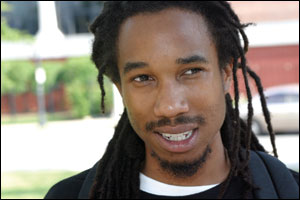
ATLANTA, Ga. -- Notty Morton “damn near cried” when he received his negative results last fall. This was the face of a then 22-year-old Black male who’d never taken an HIV test. Now at 23, this small-framed, dreadlock-wearing Baltimore native recalls that day, in which his entire view on life changed. “When I got my results…it changed my perspective. I was like, ‘I really need to watch what I’m doing here,’” Morton says. New research released at this week’s National HIV Prevention Conference suggests that Morton’s story is sadly unique among Black college students. A report, authored by Nanetta Payne, a graduate student at Jackson State University in Mississippi, indicates troubling misperceptions about HIV among young African Americans, who are at higher risk for the disease compared to other racial groups but are unlikely to realize it. Payne surveyed 151 African American male and female students enrolled in Jackson State during the 2005 spring semester. She asked about their attitudes toward HIV. Initially, 70 percent of the sample said they were not at risk. But after answering questions about their sexual activity in the past three months, Payne saw discrepancies. “I found that when you ask the students if they see themselves being at risk for HIV, many respond, no. But then you have dialogue with them. ‘Have you been having unprotected sex these last 90 days, whether it’s vaginal or anal?’ Then they’re honest. ‘Yes, I have.’” Payne also found few students voluntarily getting HIV tests. Less then half had been tested, and the majority of those who had been tested only did so as part of a pap smear or in routine prenatal care. Payne acknowledges that, when you think about it, the average person doesn’t want to feel like they’re engaging in risky behavior. But new data released at the Atlanta conference on June 12 shows a hike in risky behavior among young African American males. The U.S. Centers for Disease Control and Prevention told the meeting that from 1994 to 1998 HIV diagnoses among young men overall declined by 30 percent. But that improvement was offset by a 41 percent increase from 1999 to 2003. The CDC said the increase among young men was driven by a 47 percent rise in diagnoses among homosexual and bisexual men ages 20 to 24, 60 percent of whom were Black. In contrast, in the same 10-year period infections among women and girls aged 13 to 24 dropped by 20 percent. The data includes information from only the 25 states that used a method approved by the CDC to track HIV during the study period. Twenty-year-old Morehouse finance major H. Rick Jordan says he’s HIV savvy. He’s heard about HIV’s impact on gay and bisexual men and is aware that he can acquire the virus by having sex with women. “It don’t take but one to spread it,” the confident Jordan warns. Still, he doesn’t always use a condom. “I can count how many people I’ve had sex with on my hands,” he explains, “and I used condoms with all of them—except one.” Terrance Brown similarly sees the importance of using protection, but unlike Jordan he says he uses condoms 100 percent of the time. But he also illustrates the tension between perception and reality that Payne’s study suggests. Brown said he believes he can tell whether his partners are positive. “I know you can’t tell from facial features,” he offers, “but you can tell by the way they act.” Asked if he ever asks his sexual partners about their HIV status, Brown says, “If I do, it’ll be jokingly!” Tuskegee University student Tiffiani Watson, 20, says that’s not good enough. “Me and my partner always talk about sexually transmitted diseases. We never go straight into it and we’re always open about it,” she brags. “I knew somebody with an STD and I’m a lot more cautious now.” Payne says that all it takes to get the ball rolling on prevention is just that sort of communication, adding, “Not talking about this epidemic is not going to make this go away.” Payne suggests that the reasons students refuse to believe they are at risk are related to how society markets HIV. “This is not like a person saying they’ve been diagnosed with cancer,” said Payne. “If a person opens up and says ‘I’ve been diagnosed with HIV,’ you get a totally different response. In order for someone to admit something like that, they have to feel safe and not like society will close them off.” Aspiring Morehouse student Morton offers art as the approach to counter this stigma. “If there were more shows involving music and art, it might attract that audience. Then if you pass little statistics and facts out, you’re able to educate while entertaining.” Mark Stringfellow is a contributing writer for Ledge, the Black AIDS Institute's biannual magazine produced by and for Black college students.