Newsmaker Interview
Since same-sex marriage catapulted sexuality back into the forefront of America’s culture wars last year, African American clergy have often served as the public face for the religious right’s anti-gay movement. Millions More Movement march organizer Rev. Willie Wilson’s homophobic sermon last week was just the most recent – and now high-profile – example. But as some Black ministers ally with political forces that have long been associated with not only anti-gay but anti-Black agendas as well, other Black faith leaders are working to foster inclusiveness in the church. Rev. Alvin O. Jackson is a prime example. As a nationally-celebrated leader in the Disciples of Christ, he has moved from running his own ex-gay ministry to counseling other Black pastors on how to embrace and support their gay congregants. Jackson’s advocacy for diversity cuts all ways: He recently stepped down as pastor to Washington, D.C.’s famed National City Christian Church because white gay congregants – among others – objected to changes the church faced as more people of color, of all sexualities, became members (largely attracted by Jackson). Last week, as the controversy surrounding Wilson and the Millions More Movement grew, Jackson spoke with BlackAIDS.org editor Kai Wright about his personal journey from fear to acceptance. BlackAIDS.org: Let’s just start from the beginning. How did you start talking about these issues? Rev. Jackson: Well, you know, I grew up in the Delta of Mississippi, and in a very small rural community there – conservative, pretty much everything is in black and white. The two worst things that one could be called was a nigger or a sissy, and I think I spent a lot of my life trying to prove I was neither. And although I knew people who were gay growing up, it was just considered abnormal. Even after going through college and seminary, for years I preached sermons about homosexuality being a sin. I guess it was probably about my 10th year in ministry in Memphis [Miss.], at Mississippi Boulevard Christian Church, that I met a young man who was involved in music and who came to me for counseling, to share with me his struggle with homosexuality. And I counseled with him, prayed with him. He wanted to come out of homosexuality. He was out of the Church of God and Christ and just really struggled with it. So we went through all kinds of counseling sessions with psychiatrists, with the psychologists and we even started an ex-gay ministry in Memphis for people who wanted to move out of that. And it just became clear to me, from my relationship with him and with others who were struggling, that it was not a choice for them. That this was basically who people were, this was the essence of who they were. And so it was really through my relationship with this young man who was struggling, and with others whom I became acquainted with, that I started rethinking my position and really going back and doing some work with biblical scholars looking at scriptural text and really coming to the conclusion that my interpretation of those texts were off as well. What was your thought at that time? How did you think about the ex-gay ministries that you started? Did you feel like you were doing good? I thought it helped. But I was pretty directly involved with the group myself. And just going to those sessions each week with those basically young men who were involved, it was clear to me that this wasn’t something that was gonna change, and that the church needed to find a way to embrace those folks. I mean, we were really adding on to their frustration and struggle rather than helping them. I mean, it was over several years that I got there. And I felt good about it when we started the ex-gay ministry -- that we were really doing something. It was well-intended but misdirected. You say it became clear to you that this wasn’t a choice and the church needed another solution. What exactly was it that made you see that? Well, people would stop for a while, and would go through periods of really feeling good. They were coming to the Bible study sessions and coming to the counseling sessions and really feeling that they had gotten a handle on it. But then they found themselves back into the same place again. And, you know, it just seemed as if we were beating people further down rather than really helping them. So what happened at the moment that you decided that was the case? What happened then? That was really the last two years of my ministry in Memphis. Then, in 1998, I came to National City. So when I came to National City I was still struggling with this whole idea. And my biggest hesitation in accepting the call to come to National City was my wondering whether I could really be a faithful pastor to the gay community there. And it was a different context, of course, in Washington and at National City -- people were much further along than in Memphis. But it was my relationship with that community, and just being in conversation and relationship with folks, that really kind of moved me another few steps, to the point that I could just say I’ve got to very openly embrace this community and the church is really missing a tremendous opportunity if we don’t. I became a part of the task force of the denomination. Our denomination was struggling with this, and began a discernment process. And we developed a study guide for churches who wanted to work through this and understand this issue better. And so for two years I was a part of that discernment process, and that helped me along a great deal in terms of getting a better handle on what was going on. And when you say you were concerned coming to National City, do you mean because there was a large gay community within the church or because D.C. has such a large gay community? Because there was a large gay community in the church. I was still evolving in terms of my understanding there. And so I knew coming to the church that there was an expectation from the gay community that I would be pretty vocal and pretty supportive of that community, and I was really not there when I first came. And it took me a while. I owned up to it when I walked in the door. I said, "I’m open but I’m not sure how open I can be at this point. You need to kind of work with me on that." People were very patient. And I guess three years after I came there we started performing same-sex marriages and being pretty open and pretty vocal in terms of advocating for that community. And in terms of HIV, both in Memphis and at National City, did that play a role in your thinking? Yes. In Memphis, even with the ex-gay ministry and all of that, we got involved. Pernessa Seale [of the organization Balm in Gilead] was involved in a national HIV program -- this would have been in the late 80s in Memphis -- and we became involved. I was on that task force. We started getting other churches signed up to do an HIV/AIDS awareness kind of thing each year, and it became a fairly large thing – 40 or 50 churches in Memphis became involved, African American congregations. And they’re still going with that program there. So HIV you didn’t find difficult? No, not at all. It was very clear to me that that was a problem and the church needed to address it. Early on in my ministry at Mississippi Boulevard, I preached a sermon that I called “Behind Closed Doors.” After the Resurrection, Jesus appeared to the Disciples and they didn’t believe that it was really Jesus, particularly Thomas. It was when he opened his clothing and showed his wounds that they believed. And the point of the sermon was that we’ve got to be willing to be vulnerable and be open and to deal with the areas where we’re wounded. And it is only when we do that that we find healing and wholeness. And for me the whole issue of HIV/AIDS was an area that we could not afford to play around with in the black community. We had to be open about that and to deal with it, because too many of our young people were dying, too many folks were dying. But how did you reconcile that with your thoughts about homosexuality? Too many young folks were dying, and many of them were gay men. That’s why it’s striking that that wasn’t difficult for you. I mean, theologically, I guess when I started I was still at the point of thinking this was a choice, this was a lifestyle that they could change. But that didn’t prevent me from dealing with the problem we had before us. So even though I hadn’t worked through the whole thing theologically at that point, the whole HIV/AIDS crisis was growing in the community and that was there and we had to deal with it.
The story you tell is a remarkably brave one: that you could be open with yourself and where you were at, even as you go into a new church and so forth. I can imagine someone hearing this story and thinking, "I can’t do that." What helped you along? What gave you the bravery? I grew up in the Delta of Mississippi kind of as a nerd. I’m tall, so people see me and say, "Oh you play basketball." I never played basketball. I was tall and clumsy! And so I was kind of never an insider growing up. Kids teased me and made fun of me because I wore thick glasses and had big ears that stuck out. So I think that even when I viewed homosexuality as a sin, and something that was abnormal, I’ve always had empathy for people who were marginalized and ridiculed. So it was fairly easy for me -- even though I didn’t really understand everything intellectually, theologically -- emotionally it was easy for me to make that move, to stand with people who were in the margins, because I had experienced that as a child growing up. And, you know, growing up in the 50s and 60s in the Delta of Mississippi as an African American, I certainly knew what it meant to be in the margins. And when you minister to folks who are saying, "I’m not comfortable with this," what do you say to them? What is your advice? I try not to be overbearing about it. I try not to preach to people about it, because people don’t change that way. People have to have an experience themselves. They have to be willing to get beyond themselves, because the key for me was being in relationship with people who were different from me, and being able to see a part of their journey. So that’s not going to happen until people are willing to do a little stretching and get beyond themselves. I have many colleagues around the country who are really opposed and think I have completely lost my mind. But I remain friends with them, and when the opportunity comes up to talk about this I talk about it and share how I got where I am with it. And in some instances I know that I really can’t have this conversation with some folks, they’re just not even open to having this conversation. And so I don’t push. So it’s about meeting people where they’re at. It’s about meeting people where they are, right. I think that’s the key. I just look at our churches – you know, I’m out of the African American tradition and I love the African American church, but I see our churches and we’ve got our music ministries full of people who are struggling with their sexual identity and the leadership of our churches are just in complete denial about that. We love the music, and we love the gifts that they bring. But we really deny a large part of who they are. And I think that’s a pretty serious sin. A lot of folks say part of the problem with HIV is that Black gay men are so marginalized within our own community, and particularly within the church. Do you believe that’s true? I think so. I think that there is a lot of caring and loving going on. But I don’t think we’re really going to get a hold of it until we can get real about it and not be so in denial about who folks really are, because people are pushed even further into the margins and into all kinds of strange ways of dealing with their sexuality. And if we could let people integrate that and just be a part of the community and be who they are, it would work much better. So I do think we contribute to that in our denial of where folks are. It’s interesting. For years the pastor my church in Mississippi, where I grew up, is a man who is now in his mid-70s, who never married. He’s been single all of his life, and everyone knew that he is gay. But he’s not out, it’s never been acknowledged and of course I’ve never had any kind of discussion with him. He’s still serving the church he grew up in. But what kind of life is that to live? He’s been pastoring churches for 50 years. To live a life like that, and never be able to be open about who you are? And he’s a wonderful man, but I just know that has to be a miserable life. But there’s not room or space there for him to do anything else. I don’t know what would happen to him if he came out. He couldn’t. So he lives this life undercover. What he would have to give up to have more, maybe the price is too high. Yeah. Kai Wright is editor of BlackAIDS.org.
Add needle exchanges to the list of HIV and AIDS programs that have fallen on hard times in the 21st Century. According to a U.S. Centers for Disease Control and Prevention study published last week, both the total number of syringe exchange programs nationally and public funding for them has dropped for the first time in almost a decade. According to the new CDC study, published July 15 in the agency’s weekly report on disease in America, in 2002 researchers identified 148 syringe exchange programs, down from 154 in a 2000 survey – a nearly 4% decrease. In every previous survey, dating back to 1994, the number of operating exchange programs had steadily increased. The number of states and territories with needle exchanges also fell, down to 32 in 2002 from 35 in 2000. Forty percent of all Black AIDS cases diagnosed through 2003 were attributable to dirty needles. And the nation’s exploding Hepatitis C epidemic – an estimated 2.7 million people and counting with chronic infections – is primarily driven by needle sharing. The CDC found that public funding for needle exchanges dropped by a whopping 18% between 2000 and 2002, down to $7.3 million from $8.9 million. Overall budgets, however, increased as a result of private funding. The vast majority of exchanges still in operation reported larger budgets, and their total funding went up to $13 million, from $12.1 million in 2000. But needle exchanges have always operated on shoe-string budgets, and last week’s survey showed a handful of large programs fairing well while the majority struggled. The median budget for the programs surveyed in 2002 was just over $53,000. More than a quarter ran on less than $25,000. All public funding for needle exchange comes from state and local governments, as federal law continues to ban federal dollars for such campaigns. That ban stems from a long-standing concern that pumping clean needles into neighborhoods with high rates of drug use will only make the problem worse. At least eight government-funded studies, dating as far back as 1991, have however concluded the opposite -- that exchange programs effectively reduce the spread of HIV without increasing drug use, and that they in fact can be excellent tools for getting users into addiction treatment. “There is conclusive scientific evidence,” wrote Surgeon General David Satcher in 2000, “that syringe exchange programs, as part of a comprehensive HIV prevention strategy, are an effective public health intervention.” The CDC’s July 15 study did offer some bright spots for the state of the nation’s needle exchange network. While it is shrinking in overall number, those programs that are still running are larger than ever. Fueled by private cash, the existing programs exchanged nearly 25 million syringes in 2002, an increase of more than 10% over 2000. But as with many things in the AIDS epidemic, reaping the benefit of those gains depended on living in the right place. Just 11 programs accounted for half of all syringes exchanged in 2002, and more than two-thirds of the existing syringe exchange programs were in just seven states. FAST FACTS Where the needles are. Seven states accounted for more than two-thirds of the existing syringe exchange programs in 2002: California (25), Washington (15), New Mexico (14), New York (12), Wisconsin (eight), Massachusetts (six), and Oregon (six). Overall, 102 cities in 31 states and the District of Columbia had exchanges of some sort. The money divide. Syringe exchange programs reported annual budgets ranging from $0 (nine programs) to just over one million dollars. Almost two-thirds of the programs ran on less than $100,000 a year, and more than a quarter had less than $25,000 a year. In a year’s work. The programs offered more than just clean needles. Seventy-seven percent made referrals to addiction treatment programs, 72% did HIV testing and counseling and 23% provided medical care on-site.
Column: Dispatches from Black America By Phill Wilson Ok, I admit it. I've been in denial. AIDS is in fact a conspiracy to kill black people. I finally realized the truth in June, when the U.S. Centers for Disease Control and Prevention reported that African Americans represent about half of all people living with HIV in the country. We’re only 12 percent of the population. If that fact is not enough to get you thinking, also notice that 69% of new female HIV infections are among African American women and, most horrifying, that a new five-city study found 46% of black gay and bisexual men already infected. With numbers like that, there's got to be a something fishy going on. The question, however, is whose conspiracy is it? Following the CDC's announcement of all of this alarming new data, a few activist, including myself, tried to shake black people into realizing that we’ve entered a new era — one which the AIDS epidemic simply cannot be ignored. A handful of news outlets even covered the story. But then...nothing. To my knowledge, no black media followed-up to jumpstart discussion. No civil rights organizations marched in the streets. No black celebrities sponsored relief concerts. Indeed, there wasn't even a call to action from a black gay organization. What other than a conspiracy of silence could explain this collective shrug at such terrible information? Let's put this into perspective. AIDS rates of this magnitude are close to what scientists have called the “tipping point,” or the stage in an epidemic where it cannot be stopped. As for black gay and bisexual men, nearly 50% is downright genocidal. Look at the hardest hit parts of sub-Saharan Africa: Swaziland, with the highest HIV rate on the planet, has an adult HIV prevalence of nearly 40%, followed by Botswana with 37% and Zimbabwe with 22%. All these countries face decades of stalled economic development, families gutted of entire generations and deep, irreversible tears in the social fabric. And yet, none suffer from infection rates on par with those that the CDC cited among America's black and gay bisexual men. Sure, the high rates among gay and bisexual men won’t carry the same society-wide ramifications as the rates among all adults in hard-hit African countries. But rationalizations of that sort are exactly what have kept us in denial. We always find a way to wall off reality by thinking of AIDS as happening to someone else — gays, drug users, Africans. But will we dither until rates among drug-free heterosexuals catch up with Africa? And are we really willing to write off half of our gay and bisexual brothers and sons? There are many reasons why our community hasn't yet responded to the new CDC data. But maybe a young man I was speaking with recently boiled it down to the bitter essence when he said, "Nobody cares about us -- including us."
South African police forces opened fire with rubber bullets and tear gas on a group of several hundred protesters demanding a faster roll-out of state-financed HIV medications last week. At least 40 people were injured, 10 of whom were treated for gunshot wounds, according to news reports. On Tuesday, July 12, the Treatment Action Campaign (TAC) staged a march at Frontier Hospital in the Eastern Cape city of Queenstown. The organization said it planned the demonstration after six months of negotiations with local health officials on a range of HIV treatment concerns proved fruitless. Around 700 marchers, primarily women and many living with HIV, gathered in what organizers insist was a wholly peaceful protest. “We were expressing our anger in a peaceful, dignified and assertive manner,” declared a TAC statement distributed a day after the clash. “We will continue to use peaceful mass mobilization.” Police spokesperson Superintendent Gcinikaya Taleni told Reuters that the marchers had broken into the hospital and blocked doctors and nurses from treating patients. Taleni said the hospital contacted police and asked them to disperse the crowd. “We used minimum force to remove them – rubber bullets and smoke grenades,” Taleni said. But activists painted a starkly different picture. “The police started beating people … then shooting at them,” TAC Deputy Chairperson Sipho Mthati told Reuters. “It really was excessive force – it’s not like they were burning tires or throwing stones, it was a peaceful protest in a hospital.” TAC has posted video clips of the demonstration and the police action against protestors on its website. None of the protesters were arrested or charged with crimes. The international human rights community has joined TAC in decrying the police action. In a written statement, UNAIDS called the police forces’ behavior “unacceptable,” adding, “UNAIDS has long supported and will continue to support the freedom of assembly and association for people living with HIV.” Human Rights Watch urged the national government to launch an “immediate investigation” into the methods police used to disperse the protesters, noting that their actions appear to violate UN-established international standards on “the appropriate use of force by police.” In November 2003, after years of bitter legal wrangling and pressure from the global community, South Africa’s national health department unveiled a plan to provide universal access to HIV treatment through public hospitals and clinics, with each of the nation’s provinces responsible for spearheading the local roll-outs. Since that time, AIDS activists watching over the process have often charged that the pace is moving too slowly and that the national government is failing to provide enough leadership. As of January 2005, just over 32,000 people had entered the publicly-financed treatment program, according to health department numbers provided by TAC. Last week, the health department released a 2004 study that estimated at least 6.29 million of South Africa’s 47 million residents are HIV positive. The estimate comes from HIV tests conducted at pre-natal clinics around the country. The latest UNAIDS estimate for South Africa, from July 2004, puts the HIV case load anywhere between 4.5 million and 6.2 million. Frontier Hospital serves a sprawling territory that includes smaller districts around Queenstown. TAC asserts that an estimated 2,000 people in the area need HIV treatment, but fewer than 200 have received it. Only 10 have been enrolled in treatment programs this year. Meanwhile, TAC charges, more than 50 people have died while on the hospital’s waiting list for treatment. Queenstown is in the Eastern Cape province, which is one of South Africa’s poorest and has been a particular hotspot for disputes between government and advocates for expanded treatment. Before President Thabo Mbeki’s government agreed to launch a universal treatment plan, the global aid organization Medicines Sans Frontieres dramatized the stalemate by launching its own treatment program in the Eastern Cape. Mbeki and others — notably, those in the U.S. government — had argued that the complexities of HIV care were too profound to allow for a successful antiretroviral program in poor regions like the Eastern Cape; the MSF initiative aimed to prove that assertion wrong. About 3,700 people in the province are currently getting publicly-financed treatment. But late last year, according to TAC, the provincial health department put the breaks on new enrollees. In a December 29, 2004, memo quoted by TAC, an Eastern Cape Health Department official ordered, “No new clients should be admitted on [antiretroviral drugs] until further notice. Continue sending those already on treatment to Frontier Hospital.” TAC's demonstration at the hospital aimed to draw attention to this enrollment cap. TAC introduced itself to the world with a raucous march through downtown Durban during the 2000 global AIDS conference -- the first to be held in an African nation, or any developing world country. Activists from around the country wore t-shirts with “HIV Positive” emblazoned across the chest, a move intended to combat stigma around the virus but that doubled as a political jab at President Mbeki. At the time, Mbeki was vocally suggesting that HIV may not be the cause of AIDS, and thus that AIDS drugs may not be the answer to the nation’s spiraling death toll. The march galvanized an international treatment access movement, centered in South Africa but spreading across the content and the globe. “It transformed people in poor countries from recipients of solidarity and recipients of other people’s concerns into agents for our own right to life, our own health, our own dignity,” TAC founder Zackie Achmat said in a recent interview with BlackAIDS.org. “And, it set the agenda in a very different way. Instead of the outrage of individuals, it sought to build a movement locally and globally.” In response to the July 12 police action, TAC now plans to stage a “mass demonstration” in Queenstown next Tuesday, July 26. “We will march to enforce our constitutional rights to life, dignity, freedom to demonstrate, equality and access to health care,” declared last week’s TAC statement. Compiled by BlackAIDS.org with additional reporting from news wire services.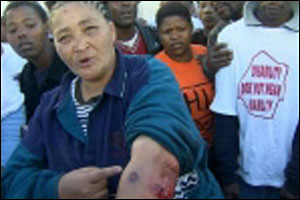
VOICES from... Chicago, Ill.
I am first and foremost a Black girl from the south side of Chicago who lost a lot of her friends to AIDS. That is the energy that I bring into my work -- politely, consistently and correctly. Kevin’s Room, a short film about brothers in the life, was generated by the spirits of two friends of mine, both named Kevin, who passed away from AIDS-related complications. They were both tremendously complex brothers with a lot of love. I remember going to one of their funerals and not a single person acknowledged that he was gay, let alone how he had died. It was such a sad and empty experience. I was so angry that I felt a need to get revenge, so I started writing. There is so much power in writing for me. What started out as a simple short story in honor of my friends, transformed into this huge platform with the potential to give voice to the lives of so many Black men who were dying in silence. Even greater than that, though, was the potential Kevin’s Room had to educate so many people, young and old, gay and straight, Black or white, about HIV and AIDS. So it was a big deal. It had never been done before. There was never a show about Black gay men on television during prime time. So many people had their own idea of what it should look like. I collaborated with several brilliant Black gay men, who served as overseers of the script, to ensure that their lives were truthfully represented. Overall, it was a success. We got some criticism, but mostly rave reviews -- and lots of excitement. We are finishing up the series with Kevin’s Room 3, which is in the works. I like to keep my hands in a lot of social marketing. That is the way of the future. One of the biggest obstacles that we face in this sort of work is the limited imagination of the people that are doing it. People are limited by fear of what they cannot do. I hear people say all the time that money is an obstacle, but I don’t believe that. Just as we have money to build bombs and wage war, we have money to find a cure. We must use our creativity and imaginations to do more. As told to