News 2007
Presidential Campaign
By Sharon Egiebor
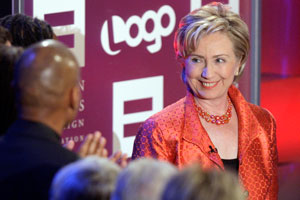
Read the transcripts Sen. Barak Obama The Democratic presidential candidates barely covered the topic of HIV/AIDS as it relates to the Lesbian Gay Bisexual Transgender (LGBT) community during the first televised debate on gay rights issues Thursday evening. Ill. Sen. Barack Obama answered a question on homophobia in the black community and discussed equal rights. Ohio Rep. Dennis Kucinich advocated a not-for-profit health care system, single payer, and universal Medicare that would include coverage of AIDS patients. Former Alaska Sen. Mike Gravel responded to a question about the nearly 50 percent of black, gay and bisexual men in some of America's urban cities who may already be infected with HIV with a long discourse on legalizing drugs and black male incarceration. Phill Wilson, executive director of Black AIDS Institute, said he was disappointed that the dialogue on HIV/AIDS as it relates to various communities, especially its disproportionate impact on black men who sleep with men, was not addressed in a broader way. “Out of this debate, we still don’t know if any of the candidates have a plan to end the AIDS epidemic or if any of them are thinking about ending the AIDS epidemic. In this debate, we got no more direction on whether any of them are committed to creating a national AIDS plan, and so while the evening may have been a love fest, it clearly missed the mark in being a substantive conversation beyond issues that are of unique import to LGBT people.” The Visible Vote '08 forum was presented on live television and by webcast Thursday evening by LOGO Television, a lesbian and gay network that is a division of CBS’ MTV, and the Human Rights Campaign Foundation, a civil rights organization working to achieve gay, lesbian, bisexual and transgender equality. Participants included Sen. Hillary Clinton (D-NY); Former Sen. John Edwards (D-NC) Former Sen. Mike Gravel (D-AK) Rep. Dennis Kucinich (D-OH); Sen. Barack Obama (D-IL); and Gov. Bill Richardson (D-NM). The moderator was Margaret Carlson. Panelists were Jonathan Capehart, Washington Post journalist; Melissa Etheridge, singer-songwriter; Joe Solmonese, president, Human Rights Campaign. Candidates from both political parties were invited to attend. Only six of the Democratic presidential contenders accepted the invitation Delaware Sen. Joe Biden and Conn. Sen. Chris Dodd said they had a scheduling conflict. “I was actually surprised that there weren’t more questions about HIV/AIDS,” said Denis Dison, a spokesman for Gay and Lesbian Victory Fund, a group that seeks to help openly gay candidates get elected. “This is not our specific issue. [However], it is one of those issues that seems to be falling off the gay agenda in the United States, whether that is from the perspective of straight elected officials or gay groups, it is hard to say. You don’t hear them say that much about it. It is amazing because gay people are still dying from this disease.” Dison said his group has not endorsed a presidential candidate because there is no openly gay person seeking the office. “One of the thing we require to endorse a candidate is that they have demonstrated views on HIV funding and HIV prevention. We can tell our donors that they are on the forefront of these issues and LGBT issues in general and choice issues,” Dison said. "There was a question prepared for each candidate regarding HIV/AIDS. Due to the length of time it took most of the candidates to answer questions, unfortunately time ran out. The fast freewheeling nature of the event prevented us from getting to a number of key issues. While AIDS/HIV issues, including issues pertaining to the African American GLBT community were addressed, they weren't addressed to our satisfaction either." Jasmyne A. Cannick, a nationally syndicated pop culture, race, and social critic, said she wondered why Gravel was the only candidate asked a specific HIV/AIDS question as it relates to black Americans. “I’m wondering why he went from answering the question to talking about America’s war on drugs, and legalizing marijuana? Legalizing marijuana isn’t going to bring the number of Black men with HIV and AIDS down nor is decriminalizing ‘hard drugs.’ And for the record, Black people aren’t the only ones smoking marijuana and using cocaine,” Cannick said. Most of the questions centered on gay rights to marriage. Bishop-Elect Tonyia Rawls, pastor of Unity Fellowship Church Charlotte in Charlotte, N.C., said African Americans must create their own forum for the candidates to respond to HIV/AIDS questions in a more detailed way. “I like that the fact that Obama stepped out with it and talked about some of the work he has already done and his willingness to bring up the issues on the forefront,” said Rawls, adding that she was impressed with the historic nature of the debate. ”In that sense, I thought it turned out well. I would have loved to have heard more questioning around the HIV/AIDS pandemic, not only in terms of the domestic situation but when you’re talking about presidential candidates, I’d like to hear their view on the international HIV/AIDS issues.” Rawls said she Gravel offered the most succinct answers to issues in the African American community. “Gravel through a little wrench on me. I was actually pretty impressed with many of his responses. I am not that familiar with him,” she said. “The senior statesman that he is, he cut straight to the chase. What senior statesman would volunteer legalizing marihuana and addressing issues of over incarceration and the failure of the war on drugs? Those are things as an African American and African woman of faith that I found very compelling.” The Gay and Lesbian Vote Record "The Visible Vote '08," a presidential forum presented by LOGO and the Human Rights Campaign Foundation. Participants: Sen. Hillary Clinton (D-NY); Former Sen. John Edwards (D-NC) Former Sen. Mike Gravel (D-AK) Rep. Dennis Kucinich (D-OH); Sen. Barack Obama (D-IL); and Gov. Bill Richardson (D-NM) Moderator: Margaret Carlson Panelists: Jonathan Capehart, Washington Post journalist; Melissa Etheridge, singer-songwriter; Joe Solmonese, president, Human Rights Campaign Location: Los Angeles, California Time: 9:00 P.M. Edt Date: Thursday, August 9, 2007 MR. SOLMONESE: You have said in previous debates that it is up to individual religious denominations to decide whether or not to recognize same-sex marriage. And so my question is, what place does the church have in government-sanctioned civil marriages? SEN. OBAMA: Well, it is my strong belief that the government has to treat all citizens equally. I come from that in part out of personal experience. When you're a black guy named Barack Obama, you know what it's like to be on the outside. And so my concern is continually to make sure that the rights that are conferred by the state are equal for all people. That's why I opposed NOMA in 2006 when I ran for the United States Senate. (Applause.) That's why -- that's why I am a strong supporter not of a weak version of civil unions, but of a strong version, in which the rights that are conferred at the federal level to persons of -- you know, who are part of the same sex union are compatible. Now, as a consequence, I don't think that the church should be making these determinations when it comes to legal rights conferred by the state. I do think that individual denominations have the right to make their own decisions as to whether they recognize same sex couples. My denomination, United Church of Christ, does. Other denominations may make a decision, and obviously, part of keeping a separation of churches and state is also to make sure that churches have the right to exercise their freedom of religion. XXXX SEN. OBAMA: Right. MR. CAPEHART: So how are you going to talk to the black community about that, both as candidate and if you are elected to the White House as president? SEN. OBAMA: You know, I have already done so. I mean, some of you saw at the Howard debate, a -- Tavis Smiley had organized, I specifically raised the homophobia in our community as an impediment to dealing with AIDS issues. You know, I'm somebody who talks about LGBT issues not just before HRC. I was with Harold Ford. He organized a forum of black ministers in Tennessee. And I specifically talked about the degree to which the notion of gay marriage in black churches has been used to divide, has been used to distract. I specifically pointed out that if there's any pastor here who can point out a marriage that has been broken up as a consequence of seeing two men or two women holding hands, then we -- you should tell me, because I haven't seen any evidence of it. And -- (applause). And the black community, I think, has a diversity of opinion, as you and I both know. There are people who recognize that if we're going to talk about justice and civil rights and fairness that should apply to all people, not just some. And there are some folks who, coming out of the church, have, you know, elevated one line in Romans above the Sermon in the Mount. And so my job as a leader, not just of African-Americans but hopefully as a leader of Americans, is to tell the truth, which is this has been a political football that's been used. It is unfortunate. It's got to stop. And when it stops, we will then be able to address the legitimate and serious concerns that face the black family. XXXX SEN. OBAMA:The one thing I guess I would say about my candidacy, and something you should think about, is I don't just talk about these issues where it's convenient. I mean, there's a reason that I spoke about the importance of gay and lesbian issues in a -- the most important speech of my life. I didn't have to. There's a reason why, in my announcement, I talked about these issues. There's a reason why I talk about gays and lesbians and transgender people in my stump speeches. I'm somebody who I think is willing to talk about these issues, even when it's hard, in front of black ministers. I'm willing to talk about AIDS at Saddleback Church to evangelicals and talk about why we need to have condom distribution to deal with the scourge of AIDS. So do you think we should have this law for the whole country? What is your stance on that? REP. KUCINICH: Well, four years ago, when there were raids in California, I, as a member of Congress, objected to that. And, of course, it's a matter between doctors and patients. And if doctors want to prescribe medical marijuana to relieve pain, compassion requires that the government support that. And so, as president of the United States, I would make sure that our Justice Department was mindful that we should be taking a compassionate approach. I want to go one step further, because this whole issue of drugs in our society is misplaced. I mean, drugs have infected this society, but I think we need to look at it more as a medical and a health issue than as a criminal justice issue. (Applause.) We really -- and let me say one step further, for those who do or whose friends may suffer from AIDS, I'm the only person in this race who is standing for a not-for-profit health care system, single payer, universal, Medicare for all, where long-term care is totally covered. People should not be locked into these higher premiums, co-pays and deductibles, which are destroying people's economic capabilities. So under the plan that I have, if someone has AIDS, they're totally covered. Under the plan that I have, if anyone needs long-term care for any kind of an illnesses, they're totally covered. And the fact of the matter is, we already are paying for a universal standard of care; we're just not getting it. Other candidates are talking about maintaining this for-profit health care system, and anyone who has ever had a loved one who has needed medical care and couldn't get it because they didn't have the money understands the urgency of having someone not just in the race but in the White House who's ready to rally the American people in the cause of not-for-profit health care, Medicare for all. And I'm doing that. XXXX This is Robert Armstrong from Morristown, New Jersey. He said, I'm living with AIDS and speak regularly to students in high school. The kind of AIDS prevention outreach is no longer eligible for Ryan White funding if it includes frank talk about gay people. Will you reinstate AIDS prevention as a category in Ryan White funding? And how can you bring Congress along, given that you're perceived as being on the -- in the left wing of the political -- on the left wing of the political spectrum? REP. KUCINICH: Well, you know, I mean, I'm the co-author of the bill that creates a -- first of all, the answer to your question is yes. And I'm the co-author of the bill that creates Medicare for all. I see -- you know, this is a very serious health issue. And through our education system, a president must help the country, and help our children, in particular, learn the kind of conduct that promotes health. And that also means sex education. We also need a president who is ready to embrace people with AIDS in a real, meaningful way that says that, look, we want you to receive all the care that you need by having a not-for-profit health care system so you don't have to worry about working a lifetime, having AIDS, and then losing everything you've ever worked for and not being able to give it to your partner, for example, or to share it with someone you love. This is something that, to me, the challenge of AIDS relates to not just funding, but it relates to having a president who's wise enough and courageous enough to take this issue on in a very direct way and do it without any fear whatsoever. MR. CAPEHART: Governor, as a guest on the Don Imus show, Imus in the Morning, in March 2006, you were asked by Imus in a gag on a staffer if that staffer were a, quote, "maricon," which as you know is Spanish for faggot. In your response, you repeated the epithet. But you've since apologized and now you question -- I've seen you question the timing of this issue coming up. Do you not believe that you should be held responsible, held accountable, for using that word, repeating that word? GOV. RICHARDSON: … I was there at the United Nations, too. You know, we should talk about human rights around the world, the Iraqis that are being discriminated and targeted today. We should talk about international issues relating to HIV and AIDS. I was there. I have fully funded in my state HIV, AIDS initiatives across the board. In her 30-second summary: But I come to these issues, you know, not as a senator or as a lawyer or as a presidential candidate, but as a friend of a lot of members of the LGBT community who have, as my -- who are my age, who have suffered through a long period of, you know, coming out, of having to face families, of having to deal with all of the issues that we know occur. And I want to be a president who can clearly say to the American people, you know, these are our friends, our children, our parents; these are people who we want to support as they live the best lives they can. So it's very personal for me. And we are not going to agree on everything, but I will be a president who will fight for you, will work to end discrimination in the employment area, end "don't ask, don't tell," finally get hate crimes through, do a lot of what we need to do on HIV/AIDS and so much more. And I really hope that we can be partners in trying to make our country a little bit better and a little more progressive for all of us. MR. SOLOMONESE: I'm wondering if you can comment on a statistic. The Center for Disease Control and Prevention estimates that nearly 50 percent of black, gay and bisexual men in some of America's urban cities may already be infected with HIV. I'm wondering what can we be doing a better job of to tackle this problem. MR. GRAVEL: Of -- of course, the obvious answer to that, Joe, is that we need to do a better job on health care. We need to do a job -- a better job with respect to how we treat Americans. I think Dennis mentioned a little bit of it. I feel very deeply -- and I don't know, I couldn't hear Dennis all that well, but I -- some – a few issues, a few back, I made the point that we have to address the whole drug issue. I see no reason between marijuana and booze or alcohol, and there's no reason why you shouldn't be able to go to a liquor store and buy marijuana. (Applause.) And it has recuperative powers. And the next thing: With hard drugs, it's hard drugs -- what you should do is you decriminalize it. You turn around and treat it like a health issue that it is. And so people who want hard drugs -- let them go to a doctor; let them get a prescription. Then we can record them and be ready to help them when they -- when they're ready to be helped. The way it is now, we fill up our prisons. It's the shame of this country that we have 2,300,000 human beings in prison. Half of them shouldn't even be there. Is there anybody within the sound of my voice that doesn't know the social failure of prohibition in the '20s that criminalized our society, that turned around and caused people to lose respect for the law? And that's what we're doing all over again. And it's been 25 years that we've been waging this war on drugs, and it's an absolute failure. And is there anybody prepared to join with men and say -- and even Obama, he was talking about he's going to do something for the inner cities. What's ravaging the inner cities? It is the drug war -- not the drugs, the drug war and all of the activity that gets on there. (Applause.) And where is the leadership to end this? FDR had the guts to end it back in 1933. I will end it now. All you got to do is make me the next president of the United States. (Applause.)
Sen. Dennis Kucinich
Gov. Bill Richardson
Sen. Hillary Clinton
Sen. Mike Gravel
MR. CAPEHART: Senator Obama, you've gotten some praise for taking to the pulpits of black churches and telling the black community, talking to the black community, about its responsibilities. Now you and I both know that there's a homophobia problem in the black community.
His 30 second summary:
MS. ETHERIDGE: Many people in our community with AIDS and HIV, and then many people in general with cancer -- I myself one -- have benefited, especially here in California, one of 11 states who have legalized medicinal marijuana. And it relieves the symptoms and many, many things. And we are completely at odds with the federal government, and they even have come into California and have raided our medicinal marijuana shops, and it's quite bad.
MS. CARLSON: (Laughs.) Congressman, I have a viewer-generated question for you, or of the people with the -- from the same -- who have the same aspirations as you do.
Awareness
By Sharon Egiebor
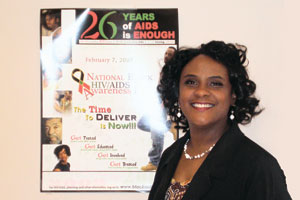
DALLAS – Three years ago, Dona Gassaway Mitchell heard the news that 50 percent of the new HIV infections in teenagers were among blacks, and that the HIV rate was especially high in teenagers who lived in two Dallas zip codes. “It touched my heart,” said Mitchell. “My deal was to get busy and to start using the talent that God gave me. I starting writing plays on HIV/AIDS for children and young adults.” This month, Mitchell and Reach Out Lift UP Family Ministry are producing a three-week HIV/AIDS campaign that will target African American youth, men and women. The event kicks off Aug. 12 with a diaper and wipe drive for Bryan’s House, which provides care for children infected with HIV/AIDS and children affected by HIV/AIDS. Other activities include two youth rallies are scheduled, a Man2Man Talk Show with free haircuts, a drama production and a Black Woman AIDS Summit. “We’re trying to raise awareness of the African American community so there will be no more excuses,” said 41-year-old married mother of two. “The excuses include, ‘I don’t know anything about it,’ ‘No one told me.’ My goal is to educate the African American community so they can become safe." Within five years, Mitchell’s goal is to decrease the rate of HIV/AIDS in African Americans while increasing the awareness of the disease and the participation by HIV/AIDS agencies in more programming. Mitchell, who has a degree in computer science and business management, has written more than 10 plays. She holds auditions at an urban shopping mall and encourages teens and young adults with limited or no acting experience to join the cast. “We have a group of youth and adult volunteers from all across Dallas. These are typical kids who are not drama majors or anything. We open up the audition citywide at the Southwest Center Mall and we do our casting from there.” Mitchell produced her first AIDS play in December 2004. Play titles include: · AIDS in the Hood · The Rising Star · The Broken Bride · HIV AIDS Rise Among our Children, Part 1 and Part 2 · AIDS Goes to College. · Eyes on Heaven The HIV/AIDS-issue plays are part of her organization’s social issue drive. Other topics include mental health, homelessness and suicide, she said. “I can’t do my AIDS plays all the time because it would stretch me thin,” she said. “August taps into the summer time. I wanted the kids to be aware of the right choices to make when school starts.”
August 12-31: Baby AIDS Pamper and Baby Wipe Drive, contact Dona Mitchell for drop off locations at 972-748-4648 or email August 13: Youth Rally Against AIDS, 11 a.m.-noon, Lake West Family YMCA, 3737 Goldman St, Dallas TX 75212, Free Admission, AIDS Drama, AIDS Educator, Entertainment and Door Prizes August 14: Youth Rally Against AIDS, 11 a.m.-noon, Martin Luther King Recreation Center, 2901 Pennsylvania Avenue Building E, Dallas TX 75215. Free Admission. AIDS Drama, AIDS Educator, Door Prizes August 18: Man2Man Talk Show, 2-4p.m., Tommie Allen Recreation Center, 7071 Bonnie View Rd, Dallas TX 75216. Free Admission. AIDS Drama, Keynote Speaker: Former Mayor Pro Tem-Don Hill, I Won’t Complain Ministry Testimony, Free Men Hair Cut Giveaways, By DeZine Entertainment. August 21: AIDS Drama Explosion, 6-9 p.m., African American Museum at Historic Fair Park, 3536 Grand Avenue, Dallas TX 75315. Free Admission. Drama Explosions-series of plays, poetry and monologues, entertainment, and MOSAIC Services. Sponsored in part by The Dallas African American Museum. August 30: Black Women AIDS Summit, 6:30-8:30pm, Paul Quinn College, Grand Lounge-Student Union Building, 3837 Simpson Stuart Road, Dallas. Free Admission, Keynote Speakers: Dallas City Council Member District 7 -Carolyn R. Davis, and UT Southwestern Assoc. Professor Obstetric and Gynecology- Dr. Barbara Cambridge, AIDS Drama, SAAVED Ministry, Women Praying For Christ Ministry, St. Luke AIDS Ministry, entertainment, and door prizes. Sponsored in part by Paul Quinn College Health and Wellness Services.
· HIV and AIDS on the Rise Among Our ChildrenCalendar of Events
Privileged Gardener
By Deneen Robinson
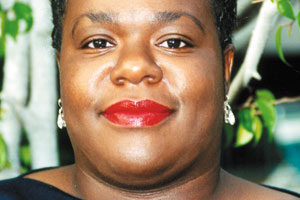
A privilege is a right or advantage gained by birth, social position, position, effort or concession. It is an advantage or source of pleasure granted to a person. Privilege is never equated with HIV. I consider it a privilege to use my gifts to share information on HIV disease and be part of the solution, not the problem. My name is Deneen Robinson and my columns will offer a first-person perspective on HIV and the African American community. I have been living with HIV for 15 years. It has been a journey of ups and downs in which I am learning so much about myself. The most important lesson so far is that I am an overcomer. I have survived being homeless, a single parent, being lonely, sick, exhausted and afraid. I have survived all these things while learning how to live with HIV. When I found out that I was HIV-positive, I had just found my way back from a bad marriage and 65 days of homelessness in two cities. It was supposed to be an up time. I was returning to the University of Texas at Austin to finish my social work practicum. I had two small children, and I was suddenly ill. Instead of a classroom, I ended up in the hospital for about 30 days with strep pneumonia. I remember being so sick during this time and the hospital staff could not figure out why I was not getting better. They could not break my fever so they tested me for HIV as part of a protocol before moving on to other rare diseases. At the end of the 30 days, a series of test, lung surgery and several HIV tests, doctors confirmed my HIV positive status. I remember the doctors saying they were sorry about my having HIV. This was the early days of HIV treatment when risk assessments were taken. I was not in a risk group so initially they did not test me. When they finally had no other explanation for my continued illness, they tested me for HIV. We were all surprised when the test came back positive. “My babies! What is going to happen to my babies?” I remember asking how long I had to live. Finally, I remember resolving to “plant seeds so my daughters would remember me.” You see, they told me I had six years to live, based on the information they had at the time. That was Aug. 30, 1992. It is more than 15 years later and I am still here. I consider it a privilege to be able to educate my community on HIV disease. The information I have learned has been the difference in my being well and still here. I want to share what I have learned with you. The information provided in this column will serve to educate. It should not take the place of a conversation with your physician. Understand that educating oneself is a privilege that cannot be measured. Remember, we must plant seeds and nurture the ground so we can experience a harvest.

Presidential Debates
By Staff Reports
At least seven of the eight the Democratic Presidential Candidates will participate for the first time in a forum that will speak to a Lesbian-Gay-Bisexual-Transgender (LGBT) television audience. The Visible Vote 08: A Presidential Forum in Hollywood, Calif., will air live 6 p.m. PT/9: p.m. EDT on Aug. 9 on LOGO television. Just like the most recent debates, audience participation is being sought. Black AIDS Institute wants to be sure we keep the issue of HIV/AIDS in the African American community before the candidates. What AIDS question would you like to ask the presidential candidates or what comment would you like delivered to the presidential candidates? During the June 28 Democratic Presidential Debate hosted by Tavis Smiley, the candidates were asked to outline their plan to stop and to protect young, African Americans HIV/AIDS. Send your question today Aug. 1 to Candidates expected to appear include: New York Sen. Hillary Clinton, Ohio Rep. Dennis Kucinich, Connecticut Sen. Christopher Dodd, Illinois Sen. Barack Obama, former North Carolina Sen. John Edwards, New Mexico Gov. Bill Richardson and former Alaska Sen. Mike Gravel. The forum will be moderated by commentator and journalist Margaret Carlson, with questioning from a panel to include Joe Solmonese, president, Human Rights Foundation, , Washington Post writer Jonathan Capehart and singer Melissa Etheridge. The candidates will be interviewed sequentially over the course of approximately two hours, each discussing issues of importance to the LGBT community.
Be the Solution
By Staff Reports
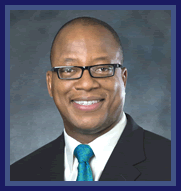
Kaiser Family Foundation will host a live, interactive webcast on kaisernetwork.org to discuss racial disparities in HIV/AIDS, with a focus on the African- American community. African-Americans account for more people estimated to be living with AIDS and HIV-related deaths than any other racial/ethnic group in the U.S. The webcast will be held on Thursday, Aug. 2 from 1 p.m., EDT. Questions can be emailed to “I really hope that people are thinking outside of the box. One of the advantages of having an opportunity like this is that you’re not writing a script for someone else to approve or disapprove. We did not pre-cook this,” said Marsha Lillie-Blanton, Kaiser’s senior advisor on race, ethnicity and health care. “We have a real problem and we need to seriously think about what more we can do.” However, Lillie-Blanton said it would best to send the questions prior to air time to better ensure their inclusion. Lillie-Blanton, based in Kaiser’s Washington, D.C., office, will moderate the session. Panelists are Dr. Kevin Fenton, director for the National Center for HIV/AIDS, Viral Hepatitis, STD, and TB Prevention, the Centers for Disease Control and Prevention; Jennifer Kates, Kaiser’s vice president and director of HIV Policy; and Dr. Phill Wilson, Black AIDS Institute executive director. The show will air a pre-taped interview with Gloria Reuben, whose role as television’s first HIV-positive character in a regularly occurring role. Reuben also stars in HBO’s “Life Support,” which tells the story of an HIV-positive Brooklyn woman, played by Queen Latifah. “We first want to lay the groundwork of what is occurring and then move to the next level of what next can be done,” she said. “We don’t plan to focus a lot of time on the problem itself. We’re trying to look at what are key sectors are now doing. It is appropriate to bring in those with major responsibility of prevention to talk about what is happening.” Fenton will discuss prevention from the federal level. Kates will provide statistical data. Wilson will speak from the position of community prevention. “The medical care delivery system will not be well represented on the panel, but people will call in and Dr. Fenton and others can talk about treatment and how treatment can impact the disease,” Lillie-Blanton said. She said the emailed questions will be asked during the show. “We want people to write in and share their thoughts about the problems as well as what can be done,” said Lillie-Blanton. For more information, visit www.kff.org . If you have never viewed a webcast before, please test your media player in advance of the live webcast.
Snapshot of the Epidemic
• Although black Americans represent only 12 percent of the U.S. population, they account for half of all AIDS cases diagnosed in 2005. Blacks also account for a disproportionate share of HIV/AIDS diagnoses in states/areas with confidential name-based HIV reporting. • The AIDS case rate per 100,000 among black adults/adolescents was 10 times that of whites in 2005. The AIDS case rate for black men (95.1) was the highest of any group, followed by black women (45.5). By comparison, the rate among white men was 12.1. • HIV-related deaths and HIV death rates are highest among blacks. Blacks accounted for 55 percent of deaths due to HIV in 2003 and their survival time after an AIDS diagnosis is lower on average than it is for other racial/ethnic groups. In 2004, black men had the highest death rate per 100,000 men aged 25-44 at 39.9; it was 5.5 for white men. The HIV death rate among black women aged 25-44 was 23.1 compared to 1.3 for white women. • HIV was the fourth leading cause of death for black men and the third for black women, aged 25-44, in 2004, ranking higher than for their respective counterparts in any other racial/ethnic group.