News 2007
Column
By 'Rolake Odetoyinbo
Having a child was always my desire. I prayed, fasted and wept my eyes out as I pleaded with God to have mercy on me. He heard my prayers in 1996 when I had got pregnant during my honeymoon. I lost the baby, and spent the entire of 1997 waiting. It seemed even longer each month because my neighbors scrutinized me. Some even offered kind advice, such as telling me to buy fruits for all the children in the neighborhood so the god of the children will be appeased. Because I grew up believing and seeing saara (appeasement) as a fetish thing, I discarded that counsel. When a few close friends dared to ask what my husband and I we were waiting for, the answer was always that we had decided to wait one year after the wedding before trying for a baby. Nine months after I got married, I lived in the same house with someone very concerned and anxious to be a grandmother. It wasn't easy to act unperturbed. Together we did the hospital rounds and I visited with a specialist, who ordered all the tests in the books. Finally, we got a zillion possible reasons why the pregnancy wasn't forthcoming and it was decided that tubal surgery was the solution. I traveled to Lagos for the surgery, which was scheduled for 5th March, 1997. However, the doctor couldn't admit me because he was waiting for my period. He wanted five clear days after my period so he wouldn't mix up menstrual flow with post operation hemorrhage. Finally, on the day of my surgery, we all got tired of waiting. We ordered a pregnancy test. It returned positive. I was six weeks pregnant! Sadly, a few months later, the scan reported fetal heartbeat negative. The baby had died in my womb and had to be evacuated. In 1998, my husband and I tested HIV positive. The baby issue became complex because some part of me didn't want to have a child while another part of me wanted to belong and be seen as a “real” woman. I saw a new gynecologist who said my child would have AIDS. I was scared stiff! I fluctuated between wanting and not wanting. Sometimes I got confused and prayed for a miracle but often I wasn't sure if I was praying for a baby or my healing. I'd start out praying for one and would catch myself praying for the other. Every month when my period came, my stained pants sneered at me. I felt no better than a leper because I was failing in my God-given role to bear children.
I went to Lagos from Kaduna in 1999. I had been attending a religious camp. I was there when the G.O dedicated September Holy Ghost service to women believing God for children. I went with faith in my heart and I waited and waited but the child didn't arrive. As things got worse and everything including my marriage fell apart, my desire for a child got stronger because HIV had stopped being a source of worry and concern. I was and still am very sure I can never die of AIDS but I couldn't say the same for babies. I feared I would die old and childless. The chances of having a baby got slimmer as I got older. I didn't stop hoping. Since babies didn't miraculously jump on women, my dilemma worsened. Now I started wishing that one could conceive a child like an air borne infectious disease so I could get exposed and contact it. That was wishful thinking because it didn't happen.
The hardest part of having a baby for me was the fact that I had to face and acknowledge that my child could be HIV-positive, even if I did all I knew to do. I understand there is a 2 percent chance the baby might be infected and I battled with taking that chance. I eventually had to accept that HIV-positive or -negative, I wanted a child and I was willing to take the chance. I have been told life is all about chances and we can't always be assured everything will go on fine. My counselor said some women die in childbirth and with every pregnancy; there is always a small chance that the baby could have a birth defect. Those being the case and it being common knowledge, women still go ahead and have babies. I decided to listen to my heart and go for it. I didn't want to wait till menopause (I have a few years left) and later spend the rest of my life regretting not having a child. I'd rather try and fail to have a child than know I was too afraid to take the risk. Most importantly, I had to answer the question of what to do if my baby ended up HIV-positive. What message will I be sending to the very many women I counsel? Will I feel forever guilty knowing I infected my baby? Can I love the child still and not feel pity for him knowing what he'll have to contend with for the rest of his life? I wasn't sure, but as soon as the doctor handed that child to me in the theatre, as soon as I set my eyes on the most beautiful baby in the world, I knew the answer to my questions. I can never stop loving this child whatever his HIV status. I can never regret the decision to have this baby, I feel like this is the very best thing I ever did with my life and I am forever grateful to God for the joy and gift of a child. I bless and thank the Lord daily for choosing me and giving me the privilege of taking care of one of his very special gifts, and I vowed not to let God down. The question of loving and wanting the baby was settled forever. On Monday, 15th January, my mom took the baby to the Nigerian Institute of Medical Research for a PCR test. This test looks for viral DNA and not antibodies like the regular screening we do. It doesn't make sense to test babies younger than 18 months for HIV antibodies because you will most certainly find it there if the mother is positive because all babies carry their mother's antibodies. The only way to know for certain the status of a child born to an HIV infected woman is by doing the PCR and that was what we did. I was far away in school in Los Angeles but I was totally useless the entire day. LA is 9 hours ahead of Lagos so at 9 a.m. when they were in the lab getting tested, it was midnight my time and I couldn't sleep a wink.
All day I was a nervous wreck. I slept throughout class that Monday and I guess it was my body's way of refusing to process what my brain was churning out. All my classmates told me not to stress because the baby would be OK, but I still stressed and I think the longest part of it all was waiting for the results. When I returned home, I went to the clinic for my appointment and I asked for my baby's result but the doctor said it hadn't come in yet. I tried all day to read their faces and gestures because I wasn't sure if they were serious or just afraid to tell me. I forced my doctor to promise to call me as soon as the results arrived. He never called and I was too afraid to make the call. Finally, I got my body and head together and called a week later. He told me he still didn't know the results. This time I knew he had to be kidding. I was sure he had the result but didn't know how to tell me. He promised to go to the lab right away and call me in 20 minutes but HE DID NOT CALL!
Well, my two wonderful doctors didn't call me after 20 minutes and still didn't call after 2 hours so I gave up and decided never to return to NIMR. I don't want to know the result. No lab result can reduce my love for this child and I don't care what anybody says. My son is fine and so am I. Later that evening, my mother led the family in prayers and thanksgiving and I knelt in total surrender to the will of God, knowing that He loves me too much. My son is fine, his test returned HIV negative! He does not have HIV! Praise our God Forever! The doctor's version of the story: He was scared to go to the lab. He called his colleague who was originally my doctor until I got pregnant and transferred to ANC. He confided in him that if the baby was positive, he would run away and not show his face anywhere. They both decided to act like the men they were even though they didn't feel like doctors anymore and went to the lab. If you have ever had the fortune of managing me clinically, you would understand I'm not your everyday, easy patient. They both had every reason to be scared. Eventually when he got the results, he was so happy to know there's no cause for alarm that he allowed himself to get distracted and left me waiting.
Mobilization
By Sharon Egiebor
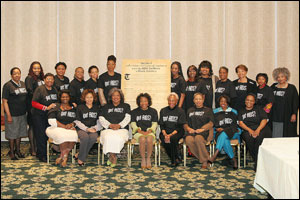
Fifty-four women’s organizations, representing 4 million African American women across the U.S., have pledged to take action to reducing the impact of HIV/AIDS on the black community within five years. The organizations made the commitment during the second annual “M.E.E! (Mobilization, Education, Empowerment) Sistahs Getting Real About HIV” conference held recently in Los Angeles. According to the pledge, the groups – both national and based in California – will make HIV/AIDS in black women a top three agenda item, will personally encourage HIV testing and education among its members, and will participate in letter writing campaigns to local, state and national politicians asking them to increase the level of HIV/AIDS funding beyond the federal Ryan White Care Act. The groups signing the pledge included sororities, medical associations, civic societies, education bodies and religious organizations. “It is important to keep this issue in front of African American women, who represent 70 percent of new HIV cases among women in America,” said Cheryl Cooper, president of the National Council of Negro Women. “Until we change those statistics dramatically, we need to keep these statistic in front of our women, along with the new technology, new treatment and other tools available to help African American women protect themselves from this disease. Once they have contracted the disease, we want them to live a quality life.” Cooper said NCNW officials would meet to develop an internal strategy before developing specific community programs. The Black AIDS Institute, the National Council of Negro Women, and the National Coalition of 100 Black Women jointly hosted the conference. “African American women cannot afford to stay out of this fight. It is killing us disproportionately and we have to educate ourselves so that we can save ourselves,” Cooper said. According to the Centers for Disease Control and Prevent, AIDS remains one of the leading causes of death for African Americans in the United States. With regard to Black women in the U.S: AIDS is the leading cause of death for Black women between the ages of 24-34; Black women account for 69 percent of new HIV/AIDS cases among women; and Black women are 19 times as likely as white women to have HIV/AIDS and 13 times more likely to die from the disease. The conference, held at the Omni Hotel from Feb. 7-11, targeted leaders from women’s organizations. The sponsors included MAC AIDS Fund, amFar and the U.S. Office of Women’s Health. “This conference is important because it is the only conference of its kind that commits four days to educating, exploring and then processing and leaving participants with critical next steps in how we address HIV and AIDS as an opportunistic disease in our community,” said Grazell Howard of the National Coalition of 100 Women. “Along with the other challenges we have in our community that is around sex, power and access. We spent four days on the topic in a way that people could leave the conference with tools, in some cases turnkey tools,” said Howard, conference co-chair. Topics ranged from the do’s and don’ts of HIV medications and prevention strategies to panel discussions with heterosexual men and the role they play in spread or preventing the spread of this disease to youth speaking to older generations. “One of the great things this year was this intergenerational discussion on sex, sexuality, and HIV/AIDS, as well as socialization and parenting,” said Howard, who sat at a table with 14-year-olds during the discussion. Alabama State Rep. Laura Hall, D, whose 23-year-old son died in 1992 from complication of AIDS, was on a panel with other mother’s whose children had or have the disease. “We suffered in silence until three months before his death. When he realized he wasn’t going to get any better, his request for me and his dad was that we do everything so that no one else will suffer,” said Hall. ”Once we told people, friends and family members, everybody just rallied around him. He realized at that point how much better it would have been for us and him if we had that support the whole time.” Hall, who is a Black AIDS Institute board member, said she and her husband spend a lot of time participating in AIDS awareness programs and that a
With her insistence, Alabama’s AIDS Drug Assistance Program funding increased from $150,000 in 1998-99 to $6 million in 2006, she said.
The role of religion and the religious community Religion in the fight against HIV/AIDS also were discussed during the conference. “The faith-based communities really are our lynchpin and they are not engaged in a way that can be impactful and effective,” said Howard. “If the church put the issue on the forefront of the agenda, that would help immediately and you would have the removal of stigma, you would have people speaking testaments and you would have another vehicle for spreading accurate information around prevention.” Yvette Heyliger, a New York poet and playwright, presented two sessions on “What Would Jesus Do.” The plot centers on an unfaithful husband and a praying wife. The wife attends a conservative church that struggles to respond to her emotional and spiritual needs. At the end of the play, the church hosts its first HIV/AIDS prevention program. “The play challenges the church to do more with HIV/AIDS; to challenge convention, to openly discuss sexuality issues, which are not discussed in the church period. It really challenges the church to do more,” said Heyliger, who produces the plays with her twin sister Yvonne. “I know that it is set in the church but not just Christians can appreciate the play. Anyone in life can appreciate the message.”
54 Women's Organizations Issued a Call to Action during the M.E.E.! Sistahs Getting Real About HIV Conference held in Los Angeles, Calif. from Feb. 7-11, 2007.
National Organizations:
National Council of Negro Women
National Coalition of 100 Black Women, Inc.
Alpha Kappa Alpha Sorority
Auxiliary of the National Medical Association
Beta Pi Sigma Sorority, Inc.
Chi Eta Phi Sorority
Chums Inc.
Continental Societies
Delicados Inc.
Delta Sigma Theta Sorority, Inc.
Eta Phi Beta Sorority, Inc.
Gamma Phi Delta Sorority
Grand Temple Daughter of Elks
Iota Phi Lambda Sorority, Inc.
Ladies Auxiliary, Knights of Peter Claver
Ladies Auxiliary, National Dental Association
Lambda Kappa Mu Sorority
Las Amigas, Inc.
Les Gemmes, Inc.
National Associationof Fashion & Accessory Designers
National Association of Negro Business & Professional Women's Clubs
National Association of University Women
National Black Nurses Association, Inc.
National Grand Chapter, Order of Eastern Stars
National Sorority of Phi Delta Kappa
National Women of Achievement, Inc.
Pi Omicron Rho Omega Sorority
SCLS Women
Sigma Gamma Rho Sorority
Tau Gamma Delta Sorority
The Charmettes, Inc.
The Women's Convention auxiliary of the National Baptist Convention
Top Ladies of Distinction, Inc.
Trade Union Women of African Heritage
Twinks Social and Civic Club, Inc.
Woman's Home & Overseas Missionary Society, AME Zion Church
Women's Missionary Society, AME Church
Women's Missionary Council, CME Church
Women's Lawyers Division, National Bar Association
Zeta Phi Beta Sorority
Local Organizations:
Los Angeles Bind
Los Angeles Branch of Women of the NAACP (WIN) Los Angeles Chapter of the National Coalition of 100 Black Women Inc.
The National Association of Black Women Physicians
Los Angeles District, United Methodist Church
National Association of University Women
MU Lambda Omega chapter of Alpha Kappa Alpha
Black Nurses Association
Coalition of Mental Health Professionals
Association of Black Women Lawyers
Southwest College
Black Women's Network
Black Women's Forum
Rolling Hills Chapter, Delta Sigma Theta Inc.
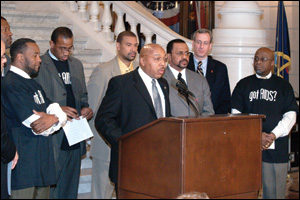
Legislators at the national, state and local levels recently wore black “Got AIDS?” T-shirts as part of a campaign to raise awareness of the AIDS epidemic in the black community. The Black AIDS Institute, a national policy organization based in Los Angeles, delivered the T-shirts to legislators with the question “Got AIDS?” on the front, and the response “How do you know?” on the back. The elected officials were asked to take photographs wearing the shirts to raise awareness of the impact of HIV/AIDS in the African-American community. The campaign coincided with the observance of National Black HIV/AIDS Awareness Day. Participating states included Alabama, California, Colorado, Illinois, Louisiana and Pennsylvania. Sen. Vincent Hughes, a Democratic Pennsylvania state senator, was one of the members of the state’s Legislative Black Caucus who participated in a press conference wearing the “Got AIDS” T-shirts. “I had a resolution passed commemorating the day. I put on my shirt while I was on the floor of the Senate while I was speaking on the resolution,” Hughes said. “Then afterwards, we had a press conference on the rotunda of the state capitol. About half of the members of the Black Caucus were able to participate in the press conference wearing their shirts. We had some other Caucasian members join us.” The Pennsylvania House also passed a resolution by a unanimous vote of 203-0 declaring Feb. 7 as National Black HIV/AIDS Awareness Day, Members of the Oklahoma Legislative Black Caucus also participated in a photo opportunity wearing the “Got AIDS” shirts in observance of National Black HIV/AIDS Awareness Day, with the photo distributed to media outlets throughout the state. “We wanted to become the voice of the African-American community,” said Jesse Harris, state facilitator of the Oklahoma Comprehensive Health Awareness and Maintenance Campaign. In addition, Sen. Constance Johnson (D) and Rep. Anastasia Pittman (D) introduced legislation to fund HIV/AIDS awareness activities. “We’re using the Feb. 7 date as a kickoff for an ongoing awareness campaign,” Harris said. Upcoming activities include an HIV/AIDS awareness day geared toward African-American women and girls on March 10 and HIV/AIDS programming during an annual health forum in April at Langston University, a historically black university in Langston, Okla. “The data itself speaks volumes. To ignore the data is to minimize the crisis we’re confronting,” he said. Raising awareness is also a priority in the Oakland, Calif., area, said Karen Stevenson, spokeswoman for Mayor Ron Dellums. Although Stevenson said she could not confirm if Dellums received or had an opportunity to wear the “Got AIDS” T-shirts, she said the mayor plans to partner with the Alameda County Public Health Department to raise awareness on HIV/AIDS. “The mayor absolutely has health as a priority issue. He has a huge awareness of HIV/AIDS, both here in this country and on the African continent,” Stevenson said. “We are early on in our administration, but we hope to partner with the public health department and raise the profile of health issues through the city, but that’s going to take some time.” While Oakland and other communities across the country are in the process of organizing HIV/AIDS awareness efforts. Philadelphia is one city that has taken a proactive stance on the issue, Hughes said. In December, the state legislature announced an initiative to increase the availability of rapid-results AIDS testing in Philadelphia. “In Philadelphia, about 40 to 60 percent of people don’t show up to get their results for the traditional tests. And that kind of reflects nationally -- nationally the average is about 30 percent,” Hughes said. “Once they get that consciousness to go ahead and take the test, they need to know [the results] immediately.” State officials are also expanding educational and testing initiatives at two of Pennsylvania’s historically black colleges, Cheyney and Lincoln universities. The initiatives are in part a response to a recent incident in which a prostitute solicited sex from at least 10 individuals on Cheyney’s campus during a two-day period, Hughes said. “When she was apprehended, it was discovered that she had medication for HIV and admitted that she was HIV-positive,” Hughes said. “We’ve had a major effort in terms of education and testing on campus.” Philadelphia’s African-American churches are also involved in awareness-raising efforts. Enon Tabernacle Baptist, one of the city’s mega-churches, will host a special event on March 6 during the national Black Church Week of Prayer for the Healing of AIDS. The event will include a performance by Hughes’s wife, actress Sheryl Lee Ralph, who starred in the original Broadway production of the musical “Dreamgirls.” Hughes added that raising awareness of the impact of HIV/AIDS on African-American communities among his colleagues in the Pennsylvania General Assembly, especially those who do not represent predominantly Black districts, is an ongoing challenge. “We have got to step up first -- Black leadership, brothers and sisters in neighborhoods and communities have got to step,” Hughes said. “When decide to step up for ourselves, it legitimizes our demand that others step up.”
Event
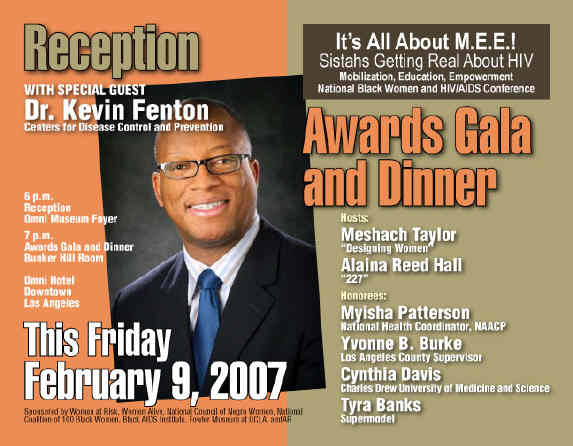
Click here for M.E.E. Conference Gala Tickets and Registration. Prior to becoming director of the National Center for HIV, STD, and TB Prevention (NCHSTP), Kevin Fenton, MD, PhD, served as chief of CDC's National Syphilis Elimination Effort—a position he had been appointed to in January 2005. Since 1995, he has worked in research, epidemiology, and the prevention of HIV and other STDs. At the age 18, Dr. Fenton entered medical school in Jamaica. His first epidemiologic investigation involved collecting data for a case-control investigation of an outbreak of typhoid in western Jamaica. Following a series of pre-and post-graduation medical assignments in Jamaica, he earned a scholarship to pursue a master's in public health at the London School of Hygiene and Tropical Medicine in 1992. In 1995, after completing a clinical practicum in infectious diseases, he was appointed as a lecturer in HIV epidemiology at the Medical Research Council Coordinating Center for the Epidemiological Study of AIDS at the Royal Free and University College Medical School (RFUCMS). In 1998, he was appointed a senior lecturer and honorary consultant epidemiologist, specializing in HIV, STDs, and behavioral surveillance at the Communicable Disease Surveillance Centre. In 2002, Dr. Fenton became the director of the Health Protection Agency HIV and Sexually Transmitted Infections (STI) Department. He also worked as an investigator on the second British National Survey of Sexual Attitudes and Lifestyles (Natsal 2000), and implemented a range of national studies on ethnic variations in sexual health outcomes. Dr. Fenton has directed and established a number of research programs and forums related to HIV/AIDS and sexual health. He has also served on the boards of a number of charitable organizations and government committees related to HIV and STD prevention and sexual health research. Content Source: Office of Enterprise Communication
February 2007
The mission of National Black HIV/AIDS Awareness Day (NBHAAD) is to build the capacity and increase awareness, participation and support for HIV prevention, care and treatment among African Americans. February 7, 2007 marks the seventh year of this annual event. Click here to read Milestones in the Black HIV/AIDS Epidemic. The primary goal of NBHAAD is to motivate African Americans to get tested and know their HIV status; get educated about the transmission modes of HIV/AIDS; get involved in their local community; and get treated if they are currently living with HIV or are newly diagnosed. NBHAAD dates back to 1999, when the Centers for Disease Control and Prevention's (CDC) Division of HIV/AIDS Prevention (DHAP) funded five national non-profit organizations known then as the Community Capacity Building Coalition (CCBC) which are: Concerned Black Men, Inc. of Philadelphia; Health Watch Information and Promotion Services;Jackson State University - Mississippi Urban Research Center; National Black Alcoholism & Addictions Council; and National Black Leadership Commission on AIDS. On February 23, 2001, the CCBC organized the first annual National Black HIV/AIDS Awareness Day. The date was changed to February 7 the following year (2002) and is now recognized on February 7th of each year. A major inspiration for NBHAAD is Louis E. Harris (1947-2003) who passed away in January 2003 due to complications with bladder cancer. He served as the Executive Director of Concerned Black Men, Inc. of Philadelphia during NBHAAD's conception. His work and dedication will be missed along with his kind smile and warm words of encouragement. It is hoped that NBHAAD will continue to build the capacity of community based organizations (CBOs) as well as community stake holders to increase awareness, prevent HIV and get those who need treatment into care. Currently, NBHAAD is directed, planned and organized by a group known as the Strategic Leadership Council who partners with the Centers for Disease Control and Prevention to mobilize communities and address specific issues in regards to local epidemics and best practices that are science based and will influence the course of HIV in Black communities across the country. Calendar Events XXXXXX Feb. 8 noon
Feb. 3 –-1 p.m.-3 p.m.
Dallas Awakening: Resounding The Alarm presents “AIDS In The Hood” at the Tommie Allen Recreation Center, 7071 Bonnie View Rd., Dallas, Texas 75241. The play, written, directed and starring Dona Gassaway Mitchell, is kid-friendly. Activities include entertainment, health screenings and college recruitment. The event is sponsored by MON The Gazette Newspaper. For more information, Dona Mitchell at 972-835-4748 or email
AIDS Arms, Inc. and the Resource Center of Dallas are hosting a luncheon and national speaker, Dr. Debbie Hagins, MD, in commemoration of National Black HIV/AIDS Awareness Day. The luncheon is free to the community and will be held at the Top of the Cliff Club located on the top floor of the Bank of America building at 400 Zang and 12th Street in Oak Cliff. Free parking is available and the location is on a direct bus line. RSVP is required as seating is limited to 125 people. For reservations, please contact Sheila Jones at (214) 521-5191 x 318 or Sheryldine Samuels (214) 528-0144. Hosted by AIDS Arms, Resource Center of Dallas and sponsored by Gilead.