News 2005-Older

Breakin' it Down: The President's AIDS Plan
By Kai Wright
There it was, wedged into an otherwise unsurprising litany of Bush administration priorities in this year’s State of the Union: the President’s wholly unexpected acknowledgement of the epidemic raging among African Americans. “Because HIV/AIDS brings suffering and fear into so many lives,” President Bush told Congress, “I ask you to reauthorize the Ryan White Act.... And as we update this important law, we must focus our efforts on fellow citizens with the highest rates of new cases, African American men and women.” Since then, the AIDS world has waited on edge to hear what exactly the Bush administration would recommend doing to “update” the feds’ primary AIDS funding vehicle. On July 27, the administration finally released those much awaited recommendations. [See document on Housing Works AIDS Issues Update.] The list of reforms is packed with explosive ideas that have quickly turned up the heat on an already boiling pot of controversy surrounding this fall's reauthorization. First passed by Congress in 1990, the Ryan White CARE Act is a complex web of regulations governing the national network of programs that serve poor people living with HIV/AIDS. State and local governments directly oversee the programs, working in conjunction with a legally-mandated board of community members to decide how the money Washington allocates each year gets spent. Since the CARE Act is not an “entitlement” program like Medicaid or Social Security, Congress must reauthorize it every five years. The act’s third renewal is due in September, and its passage is a foregone conclusion. But for the first time in its history Ryan White is likely to undergo significant changes this time around. Southern states, which now boast six of the ten highest AIDS case rates, are clamoring for reforms. They argue the current structure leaves them unable to compete for resources with large northeastern and western cities. As a result, southern advocates conclude, their overburdened network of programs is unable to deal with the South's exploding epidemic and is rapidly collapsing. Meanwhile, large cities long seen AIDS’ ground zero complain that Washington’s commitment has waned during the war years, leaving them struggling as well. They warn that help for the South can’t come at the expense of now-struggling urban centers. Both sides agree that the main problem is there’s not enough money to go around. Since 2001, Ryan White funding has remained all but level, even as the Centers for Disease Control and Prevention has reported the epidemic’s steady growth. In June, CDC announced that more people are living with the virus today than ever before -- more than a million, half of whom are Black. If Congress accepts the CARE Act funding proposal for next year that the White House submitted this winter, spending on the $2.1 billion program will have gone up just $276 million since 2001. The gulf between that number and what advocates say Ryan White actually needs is awe inspiring: another $513 million this year alone. With these disputes as backdrop, here’s a primer on the administration’s most controversial reform ideas – and how AIDS activists above and below the Mason Dixon line are likely to react to them. Drugs come first. The recommendation that will likely draw the most universal disdain calls for a new rule mandating that 75% of Ryan White dollars be spent on “core medical services.” What’s a core medical service? The recommendations are vague on that point, noting only that “some [services] are clearly life prolonging and essential to maintaining physical and mental health; others are not,” and suggesting that a definitive list of each be drawn up –- presumably by Washington. The rumor mill’s been abuzz with anticipation of this idea for months, and care providers have uniformly cringed at it. They fear services like transportation assistance, food banks and support groups won’t make the “essential” list. But doctors treating the sorts of low-income patients who depend upon CARE Act programs note that these things, more than the meds themselves, make the difference between sick and well. “The irony is, yeah, we’ve got your $10,000 worth of drugs for the year, but we can’t help you with the $15 cab fee to help you get here and pick ‘em up,” says Dr. Laurie Dill, who treats patients at Montgomery AIDS Outreach in southeast Alabama. “And I have patients that literally don’t have food in the house and can’t take their medicines on an empty stomach. The food bank helps fill in those gaps.… It’s real clear to me that the people who are least adherent [to their treatment plans] are the people who are least able to be adherent, because of all these other problems.” Send the money south. The most controversial recommendations undoubtedly are those that pit North and West vs. South in the scramble for scare resources. Ryan White hands out money to every state and territory based on the size of its statewide epidemic. But it then gives additional money to states that are home to one of 51 metropolitan areas deemed to be in a state of “emergency” due to the size of their localized epidemics. Southern and rural activists complain that this formula ignores the emerging reality of today’s epidemic, where in many places AIDS is no longer concentrated in one urban area but rather is dispersed in pockets all over the state. Moreover, they argue, the states with one of the 51 “emergency” cities are double-dipping, because the AIDS cases in those cities are included in the state’s overall count as well. The administration agrees, though its recommendations do not spell out exactly what a new formula would look like. Of course, the cities deemed in crisis argue that, well…they’re in crisis. Cutting off their funding may marginally help states with more dispersed epidemics, they point out, but it will come at the cost of retarding decades of progress in urban centers. "Our nation's AIDS budget cannot be balanced on the back of poor people of color -- whether in urban or rural America,” said Alandra Mitchell, an HIV-positive New Yorker, in a Housing Works statement reacting to the Bush proposals. Be the last to pay. The CARE Act, like Medicaid and other social safety net programs, was conceived as a “payer of last resort” – meaning it’s only supposed to be for people who can’t get care through any other route, be it public or private sector insurance. Keeping with conservative politicos’ focus on eliminating fraud in social programs as a path to efficiency, the administration is convinced Ryan White programs have been too ready to care for people who have other options. So it recommends tougher auditing and reporting requirements to ensure the money’s being spent appropriately. Free government from the community. Currently, law requires that states and cities maintain community boards that work in conjunction with health departments to spend the money feds give them. The administration is convinced this communal input has unnecessarily limited the “flexibility” of all-knowing bureaucrats who, freed from the pesky requirement, could efficiently end AIDS – or something like that. In any case, one recommendation sure to spark universal anger would allow state and local officials to cut the community boards out of the planning process and relegate them to a purely advisory role. Kai Wright is editor of BlackAIDS.org
Column: In Times Like These...
By 'Rolake Odetoyinbo
Editor's note: It is our great pleasure to introduce you to 'Rolake Odetoyinbo -- a gifted, dedicated and fierce Nigerian woman. As part of her wide-ranging activism in her home country, Odetoyinbo writes a regular column for the popular Nigerian newspaper The Punch, where she boldly talks about her life as an activist, a mother, a lover and, simply, a Black woman living with this virus. Starting this week, she will share those provocative, insightful and entertaining columns with us at BlackAIDS.org as well. We couldn't be happier! Odetoyinbo may write from West Africa, but her personal journey is instructive to Black women everywhere. And her columns help all of us understand the universality of this epidemic. But more than that, they defiantly give the lie to the phrase "AIDS victim," instead illustrating exactly how we all, be we positive or negative, can and must live on despite -- and because of -- this epidemic's assault on Black people everywhere. Growing up, I was a tomboy who wore trousers, climbed trees, scaled fences, rode bikes and played football with the boys. No boy my age could beat me in a fight, and my neighbor, the late Nigerian basketball player Timi Alakija, taught me to box. In secondary school, I was a bully ever ready for a fight. I wore my hair short, walked with a bounce and always got male roles in school plays. I was a late starter -- tall and flat as a beanpole, my breasts and periods didn’t make an appearance until around age 14. Then, overnight, everything changed. I went home for long vacation and everything grew wings and sprouted so fast I was embarrassed to return to school after the holidays. That was then; this is now. One of the things I now love best about ‘Rolake is the fact that she’s a woman -- and I won’t trade that for the world. As a teenager and young adult, I dreaded menstruation. Now I just love those things we call peroids. Every month, God reminds me that he has given me the honor and privilege to conceive. The joy of feeling a baby grow inside of you is heavenly as you carry this fast-growing, round stomach around for some months, during which everybody treats you like an egg. Strangers give up their chairs for you. People invite you to the front in long queues. Fighting and cursing “area-boys” allow you drive in to buy fuel during scarcity. Molue drivers, who never stop long enough at bus stops, come to a complete halt to allow you to get off the bus as the conductor makes the special call of “o’loyun, o p’onmo,” just for you. While pregnant, you’re allowed to be cranky. Your man and male colleagues run circles around you and allow you to have your way. After these nine months of bliss, you endure labor to bring forth this baby. And while Oga gets a handshake and a pat on the back, all envelopes and gifts come to you. O.K. ladies, don’t skin me alive -- I agree pregnancy isn’t easy and the birthing process can be hell. But you’ll agree all those memories recede as you hold that precious child in your hands, watch the envelopes grow and look forward to the next time! If the man is the head, then a wise woman is the neck that turns the head whichever way it desires. Don’t get me wrong, I love the brothers and I’m an unrepentant "man-liker." But I just don’t envy them. I can wear assorted colors in trousers, dresses, skirts, wrappers -- and even my shocking pink undies are considered sexy. But my dear brothers are stuck with sober "male colors" in clothes and shoes. They have to wear trousers every single day of their God-loving lives, while I have endless dressing options open to me. As women, I think we should take time out to look inwards and celebrate that sweet, adorable girl on the inside of us all. Let’s examine the woman we’ve become, get to know her, love her and, most importantly, strive to make her someone we can give our unreserved respect to. In the years that I’ve worked on HIV and AIDS, I’ve met some amazing, openly-positive women who are real trailblazers. These ladies have dared to challenge discrimination in the court of law, in the health institutions, in schools when their babies were denied education, in their communities and, most importantly, in their everyday lives. So I’d like to celebrate my special sisters, who are my heroines in the fight against HIV and AIDS. Georgianna, Abigail, Yinka, Lucy, Julie, Mary, Doris and Jumai, here’s to you – you daily challenge and inspire me! ’Rolake Odetoyinbo is a member of Nigeria’s Positive Action for Treatment Access and a fellow of the Institute’s African American HIV/AIDS University. Her column appears monthly in BlackAIDS.org.
By Kai Wright
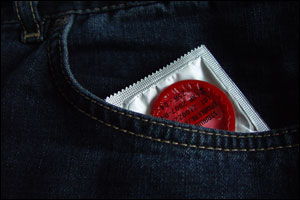
How does a device as simple as a rubber dredge up such complicated debates? Condoms are, after all, among healthcare’s most basic tools: a simple latex sheath to unfurl over an erect penis before inserting it into someone else’s orifice. With that uncomplicated act, countless sexually transmitted diseases are slowed, if not stopped. Or, so say most folks -- and that’s the rub, so to speak. Critics on both the left and right wing of the sexual culture wars say HIV prevention’s condom-mania dangerously oversimplifies sex. Those on the left complain that public health’s use-a-condom-every-time mantra does little to address the difficult emotions that drive decisions about risk-taking in bed (disclosure: I have made this argument in other publications). Those on the right, meanwhile, charge that public health vastly overstates how much protection condoms provide from both the physical and emotional dangers of sex. But given the current political landscape, it’s the right-flank attack that’s causing the most headaches for HIV prevention’s condom promotion efforts today. Throughout the early summer, Lester Crawford’s nomination as Food and Drug Administration commissioner sat captive in the Senate, pinned in by the small-scale turf battles that preoccupy both sides of the sexual and reproductive health wars. Any Senator can place a “hold” on a nominee once it hits the chamber floor, effectively blocking a vote until 60 Senators call for one. Conservative Republican Sen. Tom Coburn (Okla.) placed a hold on Crawford’s nomination in June, demanding that he promise to enforce a law Coburn shepherded through Congress in 2000 that would change warning labels on condoms. (Democratic Sens. Hillary Clinton of New York and Pat Murray of Washington State also put a hold on the nomination, asking for a prompt decision on nonprescription sales of emergency contraception, known as “morning after” pills.) Currently, condom packages must carry a label stating, “If used properly, latex condoms will help to reduce the risk of transmission of HIV infection (AIDS) and many other sexually transmitted diseases.” Coburn’s 2000 law orders the FDA to expand this requirement to include more information about their “effectiveness or lack of the effectiveness in preventing STDs,” according to the Associated Press. Coburn, who is a medical doctor, lifted his hold on Crawford in mid-July. A spokesperson told the Washington Post that Coburn cleared the way only after receiving a guarantee from Crawford that the FDA will act on the law, though it remains to be seen what specifically the FDA will do. The Senate overwhelmingly approved Crawford the next day, on July 19. Coburn’s goal is to highlight abstinence promoters’ argument that condoms do not provide absolute protection against STDs. Rightwing researchers most commonly cite herpes and HPV (or human papillomavirus) as examples, because they are transmitted via skin-to-skin contact in areas a condom doesn’t cover. “Condoms may provide moderate protection from some sexually transmitted diseases (e.g. HIV/AIDS, and Gonorrhea) but are likely to be much less effective for others (e.g. Chlamydia, Herpes, and HPV),” reads an explanation on 4parents.gov, a controversial abstinence-promotion website set up by the Bush administration’s Department of Health and Human Service. “Condom effectiveness in protecting from diseases such as Hepatitis B and Syphilis has not been well studied.” Mainstream researchers angrily object to such statements. They argue that Coburn and his ilk have manipulated the facts to drastically overstate their case. “A federally funded Web site should present the facts as they are, not as you might with them to be,” wrote Rep. Henry Waxman (D-Calif.) in a letter to the administration after a study he commissioned found several inaccurate or misleading statements about condoms and STD prevention on 4parents.gov. The site was not developed by a federal public health agency, but rather by the National Physicians Center for Family Resources, a group that has been closely associated with efforts to ban abortion and promote homosexuality as a disease. The Senate Appropriations Committee has added a stipulation to its funding bill for Health and Human Services that orders an internal review of the site, and the department is now accepting applications from various groups seeking to take over the site, according to a Washington Blade report. Mainstream researchers concede that condoms do not in fact provide 100 percent protection against STDs. But recent research has aimed to nail down just how far shy of that mark condoms fall. A 2001 National Institutes of Health panel, convened at Coburn’s request, found that, when used properly and consistently, condoms do reduce the risk of HIV transmission to nearly nil and drastically cut gonorrhea transmission. But the panel found wide disparity among then-published studies on condoms’ effectiveness in stopping a range of other STDs. In June of last year, however, a group of Washington State-based researchers published a follow-up study in the Bulletin of the World Health Organization, looking at research done since the NIH panel’s review. The researchers looked at studies published in English since June 2000. They found “condom use is associated with statistically significant protection of men and women against several other types” of infections, including Chlamydia, type 2 herpes and syphilis. The Washington researchers, however, found there's still no evidence in the literature of condoms protecting against HPV infection. What neither study discussed in depth was why condoms may fail to stop STDs. In some cases, they simply don't block the route of transmission -- like in cases where infections are passed through skin contact with parts of the genitals condoms don't cover. But most defenders of public health’s focus on condoms note that the problems with their effectiveness lie not in the device itself but in how they are used. People cause tears when opening the packages or putting them on; they use oil-based lubricants that break down the latex, rather than the recommended water-based ones; they penetrate vaginal and anal openings at some point prior to putting condoms on; and more. The solution, defenders thus argue, is to spend less time questioning the device and more time tutoring the user. Kai Wright is editor of BlackAIDS.org.
By Kenyon Farrow Wake up Black people! Lock your windows and doors! Lesbians are coming -- and they’re taking over the Black community! You haven’t heard? Apparently you missed Rev. Willie Wilson’s recent sermon at Union Baptist Church in Washington, D.C. I wish this were a joke. In fact, I wish it were even funny. But Rev. Wilson -- who is, ironically, the executive director of the Millions More Movement march -- actually said in a July 3 sermon, entitled “You’ve Got to Fight to be Free” and first reported by the Washington Blade on July 15, that “lesbianism is about to take over the community.” Wilson took the hot mess that was his sermon and sent it further down the gutter. He went on to say “women falling down on another woman, strapping yourself up with something, it ain’t real. That thing ain’t got no feeling in it. It ain’t natural. Anytime somebody got to slap some grease on your behind and stick something in you, it’s something wrong with that. Your butt ain’t made for that. No wonder your behind is bleeding…The Bible says God made them male and female.” Despite outcry from Black LGBT leaders and local elected officials, Wilson has refused to apologize for the outburst. Black LGBT activists planning to participate in the October Millions More march say their efforts have been ignored by march organizers for six months now. It’s hard to know where to even begin in considering Wilson's “sermon.” But I am at the least surprised by his detailed familiarity with homosexual sex acts — I’d certainly like to see the history on his web browser. What is more shocking than his window-view into the sex lives of gay men and lesbians, of course, is the recklessness of this speech, particularly for someone leading a high-profile community-mobilization march. Today, even the most raging homophobes use sophisticated, sound bite-friendly language like “protecting the sanctity of marriage” or the “Contract with Black America on Moral Values.” Wilson’s statements have the subtlety of government-sponsored films on the dangers of homosexuality from the 1950’s. This isn’t the 1950’s, but the fact that Wilson’s congregation is heard shouting its approval throughout the sermon is proof that his thoughts on homosexuality still have great currency in the Black community in 2005. While Wilson may not consider himself a part of the white-led religious right, his homophobia certainly makes him their accidental ally. In 2004, an unprecedented number of Black ministers (well-funded by religious right think-tanks) closely aligned themselves with the sorts of individuals and organizations that have long worked diligently against Black political interests, all in the name of demonizing LGBT people — I need not remind you of Chicago’s Rev. Gregory Daniels, who boldly declared, “If the KKK was opposing same-sex marriage, Rev. Daniels would ride with them.” What do statements like Daniels’ and Wilson’s mean for the daily lives of LGBT people in the Black community? For starters, they both foster and encourage attitudes that literally put our lives at risk. The hate speech coming from our churches has had a dangerously paralyzing influence over our community’s response to the AIDS epidemic. Pastors like Wilson exploit and amplify the same bitter divisions within Black America that have too often stood in the way of communal self-preservation. Moreover, Wilson and his ilk also drive too many Black gay and bisexual men into an unhealthy, schizophrenic existence. “I don’t think we’re really going to get a hold of HIV until we can get real about it and not be so in denial about who folks really are,” says Washington, D.C.’s Rev. Alvin O. Jackson, in a recent conversation with BlackAIDS.org. Jackson says pulpit-driven homophobia not only slows our response to HIV, but also puts people at risk for contracting it because “people are pushed even further into the margins and into all kinds of strange ways of dealing with their sexuality. If we could let people integrate [their sexuality into their lives] and just be a part of the community and be who they are, it would work much better. So I do think we contribute to [the epidemic] in our denial of who folks are.” Today, many Black LGBT people also live daily with the real threat of violence. Just the perception of gender variance can mean verbal or physical assault. In 2003, 15-year-old Sakia Gunn was murdered in Newark, N.J., when she refused the advances of a man, explaining to him that she was a lesbian. This past June, 32-year-old Dwan Prince was verbally harassed by two young men in his largely Black neighborhood in the Brownsville section of Brooklyn. When he was so arrogant as to speak up for himself, his attackers viciously beat him nearly to death. He remains in a coma. A few months later, when a Black youth was attacked by white men in Howard Beach, Queens, it made front page news and many prominent Black leaders loudly denounced it. Rightly so. But none of them have said a word about Dwan Prince. Since February, we in New York City have also been witness to four murders of members of our community, including Rashawn Brazell, Marvin Paige, Kenmoore Thomas and Jamal James. It is not clear that any of these murders were “hate crimes” as we currently define the term, but each murder bore the hallmark of antigay attacks: extreme, over-the-top violence. In Brazell’s case, police found his body dismembered and discarded in trash bags that were ditched on subway tracks and at a recycling plant. Whatever the motives, there remains a stony silence from our community and religious leaders about the clear rash of deadly violence Black LGBT New Yorkers are currently enduring. That silence further emphasizes how little our lives matter to the larger Black community. So, what are we to do about this? Personally, I am sick and tired of conjuring the names of Audre Lorde, James Baldwin, Angela Davis, Alice Walker and, our new favorite, Bayard Rustin as proof that Black folks “in the life” are a value and an asset to the community. That kind of awareness building has its place, but it is woefully insufficient. Knowledge is power, but fear can override all common sense – and, as Rev. Wilson has sadly demonstrated, common human decency as well. Black gays, lesbians, bisexuals and transgender folks, as well as those in the community who stand with us, have got to publicly challenge the institutions and individuals that continue to add to our oppression. Thankfully, this very thing is happening all over the country. Black LGBT people of faith held the second Souls a’Fire! conference in Chicago in June. In New York City, several organizations and have come together for a campaign mobilizing Black LGBT people of faith. We are challenge Black clergy to work toward ending violence in our community. We will host REVIVAL!: Victory Over Spiritual Violence Through Grace on July 31, 2005, from 4 p.m. to 7 p.m. at Riverside Church in Harlem. It will be both a worship service and our first community-mobilizing tool. The sponsoring organizations — Gay Men of African Descent, New York State Black Gay Network, Soulforce and Empire State Pride Agenda’s Pride In the Pulpit — encourage you to attend – or, better yet, to begin your own movement in your city! It is often said that if every churchgoing Black person “in the life” did not go to church one Sunday morning, many congregations would simply be incapable of having service. (They certainly would be without the tenor section!) Whether or not Wilson, as leader of the Millions More Movement, recognizes our worth and our power, we ourselves must remember that we, too, can move millions! And we can do so by taking a lesson from the title of Wilson’s sermon: You’ve got to fight to be free. Kenyon Farrow is co-editor of the anthology “Letters from Young Activists: Today’s Rebels Speak Out,” due out this November with Nation Books, and the communications and public education coordinator for New York State Black Gay Network. To learn more about REVIVAL!, email him or call (212) 828-9393 ext. 138.

Breakin' it Down: How the Supreme Court Matters to AIDS
By Kai Wright
Few of Washington’s rituals get the nation’s blood up like a Supreme Court nomination. And in times like these – with the left vs. right ideological divide as deep and raw as ever – a battle over the highest court in the land has the potential to make even the Florida recount look down right civil. It comes as no surprise, then, that President Bush’s tapping of D.C. Circuit Court Judge John Roberts to replace retiring Justice Sandra Day O’Connor has generated fevered analysis from advocates of everything from the spotted toad to states’ rights. So what about AIDS? The experts (and the progressive advocacy groups that want to scuttle any Bush nominee) are still culling through Roberts’ background, looking for signs of how he may rule on a range of issues. But when it comes to AIDS, the primary legal questions for the Supreme Court have been those dissecting anti-bias laws for people with disabilities. Here’s a quick primer: The background. The most relevant legal question for people with HIV/AIDS has been and remains the definition of “disabled.” The Americans with Disabilities Act (ADA), passed by Congress in 1990, protects people with disabilities from discrimination -- like being denied employment, housing or healthcare because their boss, landlord or emergency room nurse has an issue with their health status. But the question courts have struggled with since the law’s passing is what makes for a disability under the law? The agreed-upon standard is that a condition must substantially limit a “major life activity.” The debate. AIDS has always met the legal standard for disability – meaning that from Medicaid and SSI programs to the ADA, people with a full-blown AIDS diagnosed have always been covered. Not so for HIV. But AIDS legal activists have long worked to expand these systems and protections to include people who have tested positive for HIV but not developed AIDS. Just because you’re not yet sick, they argue, doesn’t mean you can’t be discriminated against and don’t need healthcare. Those who argue for a more narrow reading of the law in general and the ADA in specific counter that, while it may be a tough world out there for people with HIV, they aren’t technically disabled and Congress has not written any laws to protect them. The case. This debate finally percolated up to the Supreme Court in 1998, through a case known as Bragdon v. Abbott – the Roe v. Wade of disability law. In 1994, Sidney Abbott walked into a dentist’s office in Maine and asked to have her cavities filled. She was HIV positive. The dentist, Randon Bragdon, refused and directed her to the public hospital. Abbott sued. The settled law of the land? In a tight 1998 ruling, a slim majority of justices sided with Abbot. By a 5 to 4 vote, the Supreme Court declared that HIV is in fact a disability because it limits the “major life activity” of reproduction. “Reproduction and the sexual dynamics surrounding it are central to the life process itself,” wrote swing-vote Justice Anthony Kennedy, who penned the majority opinion. “Conception and childbirth are not impossible for an HIV victim but, without doubt, are dangerous to the public health.” And that, Kennedy declared, “impairs” HIV-positive folks enough to offer them protection under the ADA. Retiring Justice O’Connor, who has been touted as the court’s moderating voice, did not side with the majority in Bragdon. She wrote an opinion separate from both that of the majority and of the arch-conservatives who dissented, in which she stated that “the act of giving birth to a child, while a very important part of the lives of many women, is not generally the same as the representative major life activities of all persons.” O’Connor was onto something. Since the ruling narrowly declared procreation as the “major life activity” that HIV impairs, is it broad enough to stand up to future challenges? And while the ruling made clear that people with HIV could not be discriminated against in housing, work and healthcare settings, it remains to be seen if it will have broader impact. Does, for instance, it mean that federal programs like Medicaid that offer benefits to people with disabilities must open up to people with HIV as well as AIDS? These are legal questions that just may find their way back to the Supreme Court one day. Would Bush’s nominee Roberts vote for a more or less expansive reading of the law? So far, no one knows. Kai Wright is editor of BlackAIDS.org.