News 2010

Black AIDS Institute Announces First Team to Move to the Nationals
Congratulations to the Trump AIDS Atlanta Winners Charles Walters and Ray Harris
The Black AIDS Institute announces local Georgia residents Charles Walters and Ray Harris as the first champions to move on to the Trump AIDS National Tournament in Las Vegas November 2010.
Approximately 50 bid whist players, from local Georgia attendees all the way to New Jersey, turned up to play in the first Trump AIDS Tournament and Health Fair in Atlanta, GA over Martin Luther King Jr. weekend. Several Tournament players and their guests visited the onsite Health Fair, which included local health organizations Sister Love and AID Atlanta, throughout the day to get tested for HIV and Diabetes and to take advantage of free health education and information. Atlanta Trump AIDS media sponsors the Atlanta Inquirer, the Atlanta Daily World and Rolling Out magazine, Tournament players, their friends and families all participated in an overview on the state of AIDS in Black America and why it’s important to be educated and involved. Black AIDS Institute CEO and Founder Phill Wilson shared with the group how Trump AIDS can help bring awareness to the Black community. “The Black AIDS Institute has spent the last decade meeting Black folks where they are,” says Wilson. “Trump AIDS is a perfect example of identifying an indigenous pastime in our community and using it to deliver culturally effective messaging. Everything about this effort, from the date and city where we launch the campaign to celebrity co-chairs—Danny Glover and Jackée Harry—celebrate the Black experience.” Click here to visit the Trump AIDS website and find a local Tournament and Health Fair to participate in near you.
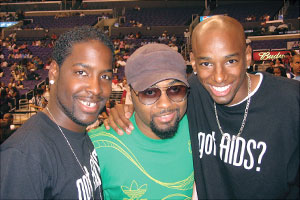
Black Youth Represent 70% of New HIV/AIDS Cases in U.S.
Clark Atlanta University To Host Annual LIFE AIDS Black Student Mobilization Summit February 5-7
Students from across the country representing historically Black colleges and universities will converge on the Clark Atlanta University campus on February 5 to 7 for the annual LIFE AIDS Black Student Mobilization Summit. The summit is sponsored by the Black AIDS Institute and the Magic Johnson Foundation in conjunction with the Act Against AIDS campaign, a CDC HIV/AIDS public awareness campaign.
The goals of the Summit are to increase awareness of the magnitude of the AIDS epidemic in Black communities; increase knowledge, decrease misinformation, and dispel myths about HIV/AIDS among Black college students; and to educate and train Black students to be AIDS activist and leaders on their respective campus. “In 2006, Black youth made up a shocking 70 percent of new HIV cases among youth in the United States. As far as I’m concerned, this frightening statistic says it all,” says Bridgette Brundidge, a sophomore at Virginia State University planning on attending the Summit. “If you are a Black student, what else do you need to know to attend this Summit?” The three-day event will kick off at 6:00 pm on Friday with a mini film festival and dinner held in the Cornelius L. Henderson Student Center on the AUC campus. The festival is free and open to any student with a valid college I.D.—reservations are required. The Summit will include workshops on social networking, planning and organizing AIDS awareness and testing events on college campuses, and working with the media. Students attending the Summit will also be provided with tools to help them integrate the Act Against AIDS campaign into their programs. “The LIFE AIDS Summit is an opportunity for young Black leaders to learn how to empower themselves and motivate their peers to get involved in the fight to end the AIDS epidemic in our communities,” says James Norris, a senior at DePauw University and one of the event organizers. On Saturday night, LIFE AIDS will sponsor a reception and special performance of Beyond the Diagnosis, a series of one-act plays, explores the predicament of HIV/AIDS patients and the struggles endured by their families, loved ones, caregivers and medical professionals. The reception and performance are free and open to the public. To RSVP, please contact the Black AIDS Institute at Sunday’s sessions will focus on action. Each student will be asked to make a personal commitment to do something on their campus to raise HIV/AIDS awareness on their campus and mobilize their peers. ”Peer to peer is the best way to organize and mobilize college students,” says Lenee Richards, LIFE AIDS conference organizer. “That is why the LIFE AIDS summit is such an important event.” Members of LIFE AIDS recognize that HIV/AIDS affects Black Americans at a disproportionate rate. In view of this fact, the goal of LifeAIDS is to mobilize Black college students in leading the fight to eradicate the disease. LIFE AIDS seeks to inform and educate Black college students on the causes and effects of HIV/AIDS; foster comfortable dialogue on issues germane to sex, sexuality and HIV; encourage members of our community to know their status; and finally to become involved in our various communities, leading others in the fight to eradicate AIDS. LIFE AIDS strives to insure that Black college students never become complacent thus remaining at the forefront of progressive movements benefiting the Black community in its entirety. For additional information about LIFE AIDS, to register for the conference, or to RSVP for the Friday night film festival and/or the performance of Beyond the Diagnosis, please contact the Black AIDS Institute at About LIFE AIDS LIFE AIDS (Leaders In the Fight to Eradicate AIDS), a mobilization initiative of the Black AIDS Institute, is the nation’s only HIV/AIDS collegiate mobilization network, maintained primarily by Black college students, and exclusively targeting Black college students. Founded in 2004, the mission is: “to educate college students on the causes and effects of HIV/AIDS, and to create a comfortable context for dialogues about sex and sexuality in order to eradicate the disease and restore hope in our community.” About Act Against AIDS The Centers for Disease Control and Prevention (CDC) has launched a national domestic campaign for HIV/AIDS called “Act Against AIDS” that aims to contribute to reducing HIV incidence in the United States.

Baltimore Planning Council Recognizes Public Official with a Greater Than AIDS Plaque
A Baltimore public official was recently honored with a Greater Than AIDS plaque during a swearing-in ceremony at city hall. The Baltimore City Commission on HIV/AIDS attended in support of the planning council's efforts.
The Baltimore Planning Council developed the Greater Than AIDS plaque to recognize leadership on AIDS. The awards given out last week consisted of a postcard-sized hardcopy of the Greater than AIDS image encased within a poster frame and surrounded by black matting. Printed on the back of each of the poster frames is a commitment statement: "As a community, we declare: BALTIMORE > AIDS." This declaration was surrounded by the signatures of community and council members in support of this community commitment statement. “The Kaiser Family Foundation and the Black AIDS Institute should be very proud of your team's work in the Greater Than AIDS campaign,” says Member of the Commission on HIV/AIDS for Baltimore City Cyd Lacanienta. “The concept is simple and powerful, its message particularly relevant for Baltimore where, in 2006, 89 percent of the new AIDS cases in the city were African Americans. We thank you for the remarkable banners that your team has designed and posted for sharing.” Click here for more information on the national Greater Than AIDS campaign. Visit Greater Than on Facebook.
Deadline is January 15, 2010
Take the International AIDS Conference Survey
The XVIII International AIDS Conference will be held this summer from July 18-23 in Vienna, Austria. An assessment of Black-serving community based organizations and constituents is being conducted to determine what programming, if any, would be appropriate to ensure that Black communities benefit from the conference.
Below is a link to a short survey that will help us in forming our programming. The surveys are confidential and Institute staff will not be able to link responses to respondents. The survey may take up to 10 minutes of your time. The survey must be completed by Friday, January 15, 2010 Your input is an essential part of our programming and we hope you find the time in your busy schedule to complete the survey. If you have questions or concerns please email Again, thank you for your time.
Congress Lifts the Federal-Funding Ban on Needle-Exchange Programs
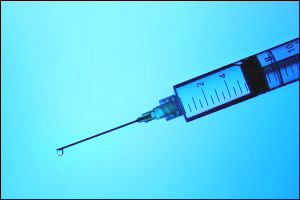
In December 2009, Congress lifted a 20-year ban against using federal money for syringe-exchange programs, increasing the nation's prospects of reducing HIV infections not only among people who inject drugs but also among their sexual partners.
"Yesterday's vote demonstrates Congress's continued commitment to science-based health policy," says Paul A. Kawata, executive director of the National Minority AIDS Council (NMAC). "In light of health care funding cuts in many states during the recent economic downturn, increased support for syringe-exchange programs will help agencies nationwide continue their work mitigating the impact of HIV, particularly in communities of color, which have been hardest hit by the AIDS epidemic since it began." Overall, about a fifth of all cases of HIV are transmitted through the use of HIV-contaminated needles, according to the Centers for Disease Control and Prevention. Hilary O. Shelton, director of the NAACP's Washington, D.C., bureau and vice president for advocacy at the organization, says that 40 percent of Black men contract HIV either directly from dirty needles or by having sex with someone who was infected by IV-drug use. The rate among Black women is 47 percent. Under the guise of protecting children, opponents of lifting the ban had tried to require a 1,000-foot barrier between exchange sites and schools and other places where children congregate, a restriction that would have effectively shut down most of the country's 200 existing programs. In urban centers like New York's Manhattan Island, 1,000-foot clearance between needle-exchange programs and such locations as schools, libraries, parks, colleges and video arcades would put programs out in the Hudson or East River. Places like Washington, D.C.--which has the highest HIV rate in the nation--and even Bangor, Maine, wouldn't fare much better. The 1,000-foot rule was proposed by Rep. Jack Kingston, a Republican whose southeastern-Georgia district contains no densely populated urban areas. "Far from promoting drug use, harm-reduction programs, like syringe exchange, help prevent transmission of HIV and its comorbidities, like hepatitis A and C, and offer injection-drug users a safe gateway to treatment," says Ravinia Hayes-Cozier, NMAC's director of government relations and public policy. "We're not offering needles with illegal drugs in them," says Shelton. "We know we have an AIDS epidemic in our community. If we want to end this scourge…we'll have to do it on several fronts." Needle exchange is among "the most inexpensive and commonsense approaches" to the problem, Shelton adds. Under the new legislation, local authorities can put programs where they can be effective and respectful of communities, and only local public health or law-enforcement agencies can contest a needle-exchange program's location. Nichele Hoskins is a health editor based in Birmingham, Ala.