News 2007
The 17th annual Divas Simply Singing!, benefiting the Balm In Gilead and Women Alive Coalition, will be held at 7:30 p.m., Saturday, Oct. 6 at the Wilshire Ebell Theatre, 4401 W. 8th St., Los Angeles, Calif. This year’s performers include: In 1990, Sheryl Lee Ralph established the Diva Foundation and created DIVAS Simply Singing! as a loving memorial to the many friends she had lost to HIV/AIDS. For 17 consecutive years, the DIVA and her friends have come together to raise their voices in song and commitment to HIV/AIDS awareness and prevention. Each diva performs one song with the sole accompaniment of a concert grand piano. It's like no other show you've seen. The lights, the mic, and DIVAS Simply Singing! Every cent of the millions raised through their efforts goes to help men, women, and children infected and affected by HIV/AIDS. AIDS affects us all. Make a donation of $25 or more to the DIVA Foundation and receive a copy of the 16th Annual DIVAS Simply Singing! DVD. See the show everyone has been talking about. Donations accepted online via PayPal. For tickets or more information, visit http://www.divassimplysinging.com/home.php.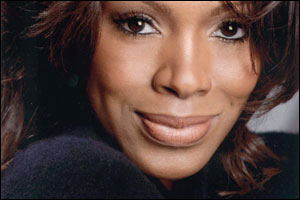

By Erv Dyer
CAPE TOWN, S.A. -- Actor and drama professor Jimmie Earl Perry sits in his small office at Stellenbosch University, Cape Town, South Africa. On the walls around him are posters and other reminders of his theater past in America and Europe. Perry last worked in Germany, but a new mission brings him to Stellenbosch, a spacious, manicured campus considered to be the Stanford of South Africa. Perry, probably most known for his role as a loving husband in the erectile dysfunction commercials, is here to teach drama, but his efforts take on more significance than simple entertainment. He tells visitors he’s creating theater as a tool to reach out to South Africa’s colored population, a demographic most often ignored when it comes to messages of prevention, awareness and inclusion regarding HIV/AIDS. South Africa’s tortured 46-year history of apartheid split the country apart. Under the discriminatory policies, white citizens created for themselves a world of privilege. Stuck at the bottom and forced to live in sprawling shantytowns were millions of native Black South Africans. Pushed into the middle were the nation’s “colored” citizens – the millions of Indian, Asian and mixed-raced people who had straight hair texture and didn’t consider themselves either black or white. Apartheid ended in 1994, with the election of Nelson Mandela as the first black president. But the race and class divisions did not. With the HIV pandemic, which struck hardest in sub-Saharan Africa, the world’s attention was focused on its devastation in black communities. Poorer, less educated and victims on already crippled medical systems, South African black people were easy targets for a sexually transmitted epidemic that spread like a fire through crowded urban districts and rural communities. Wealthier white communities struggle with HIV, too. But usually there is access to medicine in their communities. Nobody, it seemed was talking about health services and prevention to South Africa’s colored people populations. Until now. Here comes Jimmie Earl Perry. Recruited from Germany, where he was working in musical theater, Perry came to be director of educational theater and creative arts at the Center for HIV/AIDS Management at Stellenbosch. The center’s mission is provide graduate teaching, research and community services to address the HIV crisis in South Africa. In a post-apartheid Africa, “colored people,” Perry said, “were left out of the loop of funding and intervention. It seems as if the whole country buried its head when it came to them.” For a demographic that has illiteracy rates approaching 60 percent, Perry believes that music, dance and theater are perfect storytelling methods to raise awareness on HIV prevention and tolerance. Within three months on campus, Perry auditioned the colored students and founded a six-man troupe. A veteran of the musical “CATS” and “Pearlie,” he worked with an African American playwright and developed a 30-minute story that offers humor, facts and emotional messages on how HIV is contracted and how it can be prevented.
His program has been funded $1 million a year by a local tobacco company. The money helps with the play’s production, the creation of training manuals and DVDs. Funds also cover the expenses for the students to travel to neighboring nations, such as Namibia, to present the drama.
But in an area of Africa where the church and religiosity have strong cultural influence, Perry’s play took some criticism because it talks about using condoms. In the play, Lucky, a township playboy, becomes aware of the high rates of infection by listening to the radio. Lucky gets tested and discovers he is HIV positive. He is shunned by his best friend. It’s a bitter lesson, but Lucky then becomes a superhero of sorts by changing his ways and going around the township spreading personal messages of prevention and tolerance. Because he is popular, his influence helps to change people’s hearts, especially other young men. The play is presented in Afrikaans, a language native to South Africa, and in English. Perry is no stranger to HIV/AIDS. In 1972, his college roommate became infected. Ten years ago, his younger brother, an intravenous drug user, died of AIDS. His mother cared for the brother and Perry was called on to educate her. “Like most Americans, she was ignorant as hell,” he recalled. “She’d scrub down the toilet and wash up after my brother with scalding water.” So, now, once a year in South Africa, he reaches out beyond Stellenbosch University to educate the whole community: white, black and colored. Every World AIDS Day, he hosts a music concert that draws on the best singers in South Africa and abroad. Now, he’s brainstorming a presentation that will reach the Cape Town area farmers and vineyard owners, who are usually white and, in the recent past, did not think HIV was a problem. Now, so many workers, who are black, are sick with HIV that wine production is threatened. “The bottom line of our efforts,” said Perry “is to get people tested.” Right after the play, when patrons are most inspired, there is on-site testing. It’s one way to help battle the stigma that is such a large barrier to preventing HIV care. Perry grew up in the African Methodist Episcopal Zion church in Hamilton, N.J., so he does not try to ignore the churches’ messages. But he believes that an abstinence-only message is unrealistic. In South Africa, poverty drives young women into the arms of “sugar daddies,” older men who buy them food and pay for school fees in exchange for sex. There is also a prevailing myth that sex with a virgin will cure men of HIV, so forced intercourse with young girls is a too frequent problem that the country is working to address. “There are too many children and young ladies becoming pregnant and infected,” Perry said. “We have to talk about it.” Ervin Dyer is a writing living in Pittsburgh who covers African American health and spiritual issues.
Mobilization
By Sharon Egiebor
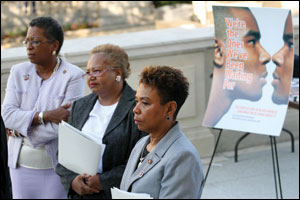
Open Congressional Letter WASHINGTON, D.C. (Sept. 25, 2007) The Congressional Black Caucus released an open letter calling for an end to the HIV/AIDS epidemic in Black America and for the creation of a national plan to fight the disease. Several congressional leaders and representatives from the Black AIDS Institute, The National Black Leadership Commission on AIDS, the National Newspaper Publishers Association, and the National Medical Association and the AIDS Council made the announcement during a news conference Tuesday on Capitol Hill. Representatives of The Balm in Gilead, which is part of the effort, could not be present. “We’re calling for a mass mobilization to end the AIDS epidemic in the African American community, calling for the testing of 1 million black Americans by the end of December 2008 and calling for a national AIDS plan for the United States,” said Congresswoman Barbara Lee (D-CA). “African Americans are getting infected and developing AIDS in a disproportionate rate and it continues. The unfortunate reality is that to be black in America is to be at a greater risk for HIV/AIDS.” Also on Tuesday, the Black AIDS Institute released its third report on the state of AIDS In Black America. “We’re the ones we’ve been waiting for,” detailing the disease’s impact on African Americans and comparing the lack of national support with the response to Hurricane Katrina in New Orleans. “While we have come a long way dealing with this epidemic, we are no where near were we ought to be,” said Phill Wilson, executive director of the Institute. “The report includes charts ... clip them, post them, and carry them with you as a resource to get this startling report out to our community.” Launched last fall by Black leaders representing elected officials, civil rights, faith, media and entertainment and business, this on-going campaign and Black AIDS Mobilization (BAM) is committed to ending the AIDS epidemic in Black America by 2012 by: • Cutting the HIV rates in Black America by 50 percent Debra Fraser Howze, president and CEO of the National Leadership Commission on AIDS, said her organization, the Institute, the Magic Johnson Foundation and the Balm in Gilead gave up some of their individuality to work collectively in 2006 to build the mobilization effort. “This mobilization brings together traditional black institutions from all sectors to end the AIDS epidemic in black America within five years. We set the bar high because we are exceptional,” said Howze. Lee said she and other congressional members, such as Maxine Waters (D-CA), are sponsoring legislation that would test federal prisoners for HIV, ensure their treatment while incarcerated and then to test them upon release.
U.S. Rep. Maxine Waters (D-CA) Statement
U.S. Rep. Barbara Lee (D-CA) Statement
U.S. Rep. Sheila Jackson Lee (D-TX) Statement
U.S. Rep. Al Greene (D-TX) Interview
National Medical Association Statement
”We Are The Ones We’ve Been Waiting For” Report
• Increasing the number Black Americans who know their HIV status by 50 percent
• Increasing the number Black Americans in appropriate early care/treatment by 50 percent
• Reducing HIV/AIDS stigma in Black America by 50 percent
Congresswoman Diane Watson (D-CA), said she is sponsoring a bill that would ensure paroles are tested once they leave the penal system and that they receive proper treatment upon their return to their community.
Rep. Donna Christian-Christensen said commitment needs to be followed up with more federal funding for the Minority AIDS Initiative. “We in the Congressional Black want to today to renew our commitment as we approach the 10th anniversary of the Minority AIDS Initiative, bringing the initiative back to its original intent and to make sure that the resources of the Minority AIDS Initiative in the black community and community faith-based organizations that it was intended to do,” said Christian-Christensen (D-V.I.), adding that smaller Caribbean countries, while poor, have national AIDS plans. Christian-Christensen and Congresswoman Sheila Jackson Lee (D-TX) both said they felt the current Republican administration is not doing enough to address the issue of funding for African American HIV/AIDS patients or research. “It is time now to call on this administration and successive administrations to find a vaccine and to find a way an immunization against the disease, not to affirm behavior we should not support,” Jackson Lee said. “We know the devastation that we are in with the Iraq War,” Jackson Lee said. “No one has to ask the questions of why we cannot address domestic issues when $120 billion is being spent on the Iraq War that is causing us to lose our way. So I must say, let us end that war and begin to address domestic issues such as research on HIV/AIDS and the cure for saving the lives of our young people, our families and our women.” Jackson Lee, who has been encouraging the hip-hop and gospel community in her district to get tested on a regular basis, said she didn’t want to get into a conversation on which diseases are more worthy, but she says she questions why some “comfortable” diseases garner so much money and research time. “What is the Centers for Disease Control doing? The National Health Institute? And why are they not engaging the black physicians in order to find a cure or vaccine for HIV/AIDS.” Dr. Mohammad Akhter, executive director of the National Medical Association, which presents 30,000 black physicians, agreed, saying it was time for a new strategy to fight HIV/AIDS. “What is it that reassessment means? Since 50 percent of the new cases of HIV/AIDS are in the African American community, where do you think the resources should be going? Shouldn’t they be focused on the African American community? And if the current system of providing services to our community isn’t working, shouldn’t we involve the African American community and the institutions in our community? The black church and the community-based organizations?,” he questioned. “We think it is time for us as a nation to reassess the HIV/AIDS strategy to redirect resources to focus on where the problem is and to work with our community to make sure we solve this problem.” Also at the new conference, Hazel Trice Edney, editor and chief of the National Newspaper Publishers Association, announced that a 25-series of opinion pieces will be published in 200 black weekly newspapers beginning next week. “We’re going to have people with national name recognition so that we will be sure to get our people’s attention. People such as Phill Wilson, Bishop T.D. Jakes, the Marc Morials and Jesse Jackson’s of our community, the Al Sharptons, the Danny Glovers and some of the esteemed congresswomen who are here today,” Edney said. “We are excited about this opportunity to save lives. Our people are dying, not knowing who will be the next one.” Open Letter from Members of the Congressional Black Caucus We have all read the harsh statistics about the impact of AIDS on Black America. Blacks represent 13% of the population, yet accounted for fully half of the AIDS cases that were reported in 2005. Blacks in the US get infected with HIV in greater numbers, get sicker faster, and die more quickly of HIV/AIDS than any other racial or ethnic group. And these unsettling disparities are becoming more pronounced over time. AIDS will devastate another generation of our people unless we take a dramatically new approach to addressing the epidemic, one that includes more energetic engagement of Black leaders and institutions and demands much greater accountability from our government. There are many explanations for the communal tragedy of AIDS among African Americans. For certain, the government response has never matched the magnitude of the health crisis among Blacks or other marginalized groups. Social agendas have too often stood in the way of implementing policies based on evidence of what works. But there is no solution to AIDS in the Black community that doesn’t begin and end with Black people. And despite numerous courageous examples of leadership, as a whole, we have not yet taken ownership of AIDS in our communities. We have failed to mobilize our powerful resources -- through our colleges and universities, our media organizations, our civil rights organizations, and our churches – to meet the challenge. Today a number of major national Black institutions are unveiling their own strategic action plans to address HIV/AIDS in their areas of influence. Specific, long term commitments are being made by some of the most esteemed organizations in the Black community, including the NAACP, National Urban League, Rainbow Push, National Action Network, the National Medical Association, the National Newspaper Publishers Association, T.D. Jakes Ministries and others. There are other important signs of change as well. AIDS was one of the most visible issues at the June Presidential debate at Howard University focused on African American issues. And HIV/AIDS will be front and center at this year’s Congressional Black Caucus annual legislative conference opening tomorrow in Washington, D.C. While the Black community has been particularly hard hit by the AIDS epidemic, America’s response to AIDS is failing people of all races. There is a new HIV infection in the US every 13 minutes and infection rates have not fallen in over 15 years. Over a million Americans are now living with HIV or AIDS -- more than ever before. But only half of those who have HIV disease in this richest nation in the world are receiving appropriate health care. Given the enormous impact on Black Americans, none of these troubling national statistics can improve markedly unless the Black community mobilizes its own resources more vigorously, and government programs reach Black people more effectively. We need nothing short of a national Black mass mobilization to end the AIDS epidemic in America. All major Black institutions – from traditional Black ministers and civil rights leaders, to fraternities and sororities, to civic and social organizations, hip hop artists and Hollywood celebrities -- must make fighting AIDS a top priority by making concrete commitments on what they will do to help reduce infection rates and increase access to care. And all of us need to combat the debilitating stigma against men who have sex with men, drug users, and others who are part of our community and need our love and support. Part of this mobilization also means calling on our government, and anyone who aspires to lead our country, to develop a national strategy to end AIDS in the US. It’s hard to believe, but 26 years into the epidemic our country still has no comprehensive plan to address AIDS at home. We are in urgent need of a truly strategic approach focused on maximizing the impact of public programs and leveraging the will of the American people to bring incidence rates down, increase access to care and reduce racial disparities. The AIDS epidemic need not decimate another generation of Black Americans, but it will unless we act. Many more organizations must follow the leadership of those making commitments today. This scourge will continue until the resources of our community are fully mobilized. Today’s new commitments must be only a first step in a renewed national response to AIDS in our own country, a response that demands steadily improved results for all Americans. [Email This Article To a Friend] WASHINGTON, D.C. – Congresswoman Sheila Jackson Lee, Whip of the Congressional Black Caucus, released the following statement at the Black AIDS Institute’s Press Conference on HIV/AIDS, urging for better mobilization to fight the spread of HIV/AIDS in the African-American community. “HIV/AIDS has grown into a pandemic and we are in a full blown war against the disease in the African American community. Often we are made aware of the dire situation of HIV/AIDS spreading through African nations, and while it is imperative that we immediately address those concerns, we must not be blind to the fact that the spread of HIV/AIDS in America is particularly acute in the African-American community. “We must mobilize the country to stop the spread of HIV/AIDS, which disproportionately impacts the African-American community. While African-Americans represent only 12.3% of the U.S. population, in 2005 they accounted for nearly 50% of all new HIV infections HIV/AIDS is now the leading cause of death among African Americans ages 25-44, making it more deadly than heart disease, accidents, homicide, and even cancer. “As Whip of the Congressional Black Caucus, I am working to ensure that we come together as a community to discuss the issues that face us, strategize to implement changes and put forth a concerted effort to bring about those change. Throughout history, we have come together as a people to fight for freedom, for equality and for justice; now we must come together to fight and win the war against HIV/AIDS.” [Email This Article To a Friend] WASHINGTON, D.C. – Congresswoman Barbara Lee (D-Oakland) and other members of the Congressional Black Caucus joined representatives from the Black AIDS Institute for a press conference on Capitol Hill today for the release of the institute’s new report on the state of AIDS in Black America. The following is her statement (as prepared): “Let me first begin by thanking Phill Wilson and the Black AIDS Institute for organizing this important press conference this morning. “The Black AIDS Institute has long been a leader in the fight against HIV/AIDS in our community. Their motto “Our People, Our Problem, Our Solution’ is a real testament to the fact that ultimately we can and we must control our own destiny when it comes to HIV/AIDS. “I’m proud to join the Black AIDS Institute, The National Black Leadership Commission on AIDS, the Balm in Gilead and all my colleagues in calling for: a mass mobilization end the AIDS epidemic; testing for one million African Americans by December 1k, 2008; national AIDS plan for the United States; and to announce the release of a new report on the State of AIDS in Black America. “As the new report form the Black AIDS Institute points out, among young people, among women, and among men, in the United States African Americans are the most at risk of getting infected with HIV, of developing AIDS, and of dying of this disease. “The unfortunate reality is that to be black in America is to be at greater risk of HIV/AIDS. “In my district in Alameda County over 6,800 cases of AIDS have been diagnosed since 1980, and nearly 4,000 people have died. Of those numbers African Americans represent well over 40 percent of the cumulative AIDS cases and AIDS deaths in the county. Latinos represent around 10 percent of all AIDS cases and about 9 percent of all deaths, and Asian Pacific islanders represent about 3 percent of all AIDS cases. “In 1998, after we saw the devastation that HIV/AIDS was causing, we became the first county in the nation to declare a State of Emergency in the African American community. “Unfortunately we still have much to do, and that’s why we are here today – to say enough is enough. “As a community we must band together to take care of ourselves but also to make our voices heard and to demand action on the part of our government. “Last August at the International AIDS Conference in Toronto, I joined Julian Bond, the NAACP, the Black AIDS Institute, and many others in signing the National Call to action and Declaration of Commitment to end the AIDS Epidemic in Black America. Together we all pledged to stand in solidarity and break the silence on HIV/AIDS in our community. “Now we must follow through on this declaration. “Already, earlier this year, the House unanimously passed a resolution I authored in support of National HIV/AIDS Awareness Day. “Our next priority is to ensure that we fully fund the Ryan White Care Act, and the Minority AIDS Initiative. We need to provide at least $610 million for the Minority AIDS initiative this year. “As a member of the House Appropriations Committee, I’ve been working with my colleagues to ensure that we get the highest possible funding level as we complete our appropriations work for fiscal year 2008. “At the same time, we’ve also got to go further and get at the factors that are ultimately driving this epidemic among the African American community. “Poverty and discrimination, lack of affordable housing, the disproportionate rate of incarceration among black men, poor access to care and limited cultural competency for health providers – all of these deserve our attention and deserve action. “We can start to get at one of these factors by ending the head-in-the-sand approach to HIV prevention that is turning our prisons into a breading ground for disease. “This week, we will move one step closer to that goal by passing Maxine Waters’ bill, the Stop AIDS in Prisons Act. “But we also need to pass my bill, H.R. 178, the JUSTICE Act, to allow condoms in our prisons and to demand accountability in stopping the spread of HIV and other sexually transmitted infections among incarcerated persons. “While we must do our part in Congress by passing these bills, we’ve also got to work with advocates and health providers in the community to do the basics – raise awareness, get tested, and get active in our communities. “The simplest thing that all of us can do is to get tested. When we get tested, we lead by example. That’s why last year I helped organize an HIV testing day where many of my colleagues in the CBC got publicly tested. “It’s simple, it’s quick, and it’s confidential, and all of us can do it. “This is not an ideological issue. It is a moral and humanitarian call for equality and justice, and all of us must do our part.” [Email This Article To a Friend] The National Medical Association (NMA) is the largest and oldest national organization representing 30,000 African American physicians and the patients they serve. With a national headquarters in Washington, D.C., the organization is comprised of over 100 local, state and regional NMA affiliates located in 46 states and member physicians; practices in 24 specialties areas such as Internal Medicine, Emergency Medicine, Obstetrics and Gynecology, Community Medicine and Public Health. For over 100 years, the NMA has remained committed to improving the health status and outcomes of minority and the disadvantaged through its membership professional development, community health education, advocacy, and research efforts, especially as it relates to HIV/AIDS. We all know the statistics; the National Center for Health Statistics 200 Report, indicates that HIV/AIDS is one of the top 10 leading causes of death for African Americans. African Americans also accounted for more than half (54 percent) of estimated new HIV infections in the United States. So where do w go from here and why has HIV/AIDS remained so rampant despite our best efforts? At no other times in history have I witnessed the vast political attention that is focused on the AIDS crisis in the developing world. However, challenges to adequate care and treatment for those living with HIV in resource limited settings remain daunting in the U.S. The urgent need remains for science to determine how best to provide and monitor antiretroviral treatment in resource poor populations and settings. Substantial investment is also needed in health care delivery systems to increase personnel, diagnostics, supplies, equipment, and facilities to sustain long-term care. But ore importantly, it will take our collective will to continually reinforce key messages on HIV/AIDS prevention, testing and treatment as well as the funding and resources to adequately put muscle behind the words. We can no longer simply attend HIV/AIDS meetings and develop papers on probably solutions – it is time for increased commitment and action. It is clear that African Americans are being ravaged by this disease. Public outcry over alarming death rates fro HIV/AIDS has not done enough to catalyze political action for our segment of the population. The formidable health care challenges and inconsistencies in HIV/AIDS prevention and treatment can no longer be used as an excuse to deny or delay increased access for our sick and dying community. We are past the critical stage; our communities just have the equitable resources to develop our own long-term, sustainable solutions to this crisis. Our brothers, mothers, sisters, children – our families are dying. We can not and must not rest until we have the resources in our hand and programs in place to stop this heinous disease. As long as HIV/AIDS remains unchecked it affects not only African Americans and other underserved minorities, it affects us all. [Email This Article To a Friend] WASHINGTON, D.C. – Today on Capitol Hill, U.S. (CA-35) congratulated the Black AIDS Institute for organizing a campaign to promote HIV testing among Black Americans. The Congresswoman sent the following prepared statement: “I commend the Black AIDS Institute for mobilizing to test one million Black Americans for HIV over the next 18 months. HIV testing allows people who are living with HIV to find out about their infection, begin life-extending treatment, and avoid spreading the virus to others. HIV testing is especially important among Black Americans. We account for half of the new AIDS cases in the United States, although only 12% of the population is Black. Black women represent 66% of new AIDS cases among women, and Black teenagers represent 69% of new AID cases among teenagers. AIDS is eh 4th leading cause of death for Black men and the 3rd leading cause of death for Black women between the ages of 25 and 44. However, HIV/AIDS affects everyone. Over one million Americans are living with HIV, and one quarter of them do not know they are infected. That is why I introduced H.R. 822, the Routine HIV/AIDS Screening Coverage Act, which requires health insurance plans to cover routine HIV tests under the same terms and conditions as other routine health screenings. I also introduced H.R. 1943, the Stop AIDS in Prison Act, which requires the Federal Bureau of Prisons to test all prison inmates for HIV upon entering prison and then test them again prior to release. I am proud to announce that this bill is scheduled to come up for a vote on the House floor today, and I expect it to pass. We all need to take this disease seriously. I urge people in our community to mobilize, and I urge all Americans to get tested for HIV. Get informed. Get tested. Get treated. Get involved. [Email This Article To a Friend] BA: How are you working to reduce the number of African Americans who are infected or impacted by HIV/AIDS? AG: In the 110th Congress I have co-sponsored several pieces of legislation aimed at raising awareness and reducing the number of individuals infected with HIV/AIDS. Among them are resolutions in support of "National Black HIV/AIDS Awareness Day," and "National HIV Testing Day" and several bills,including "The Routine HIV/AIDS Screening Coverage Act," which would require health insurers to provide coverage for HIV/AIDS under the same terms and conditions as other routine health screenings. With African Americans accounting for over half of all new AIDS cases, it is vital that individuals with HIV/AIDS who are not in high-risk categories to find out if they are infected, begin treatments if necessary, and avoid increasing the number of infected persons by spreading the virus to others. When I came to Congress in 2004, I realized the need to promote events in my Congressional District that provide free health services to the community. To help meet this great need, each summer I host an annual "Green Light to Healthy Living" health fair. This community event, held in the 9th Congressional District of Texas, is designed to promtoe healthy living by making a variety of services available. These services have included free HIV/AIDS tests, free blood pressure, glucose and cholesterol checks, free eye and dental exams, education on diabetes, asthma, cancer, Children's Health Insurance Program (CHIP) and medicaid applications. BA: Why are you participating in the news conference? AG: The Black AIDS Institute press conference will bring together members of the Congressional Black Caucus, African American organizations, and community leaders to raise awareness and encourage African American communities to join together in a united effort to fight the HIV/AIDS epidemic that is devastating black America. I plan to attend this important event to show my support for the vital work being done by organizations like the Black AIDS Institute that have dedicated themselves to leading this fight. BA: What are you doing to increase the amount of funding targeted toward African Americans living with HIV/AIDS (research, service organizations)? AG: As a member of Congress, there are several opportunities, partiacularly during the annual approparaitions process, to advocate for and actively support federal funding for agencies and organizations that work to combat HIV/AID. In March 2007, I added my signature to a letter in support of increased funding for the Minority AIDS Initiative in the 2008 Labor, Health and Human Services Appropriations Bill. The Minority AIDS Initiative provides funds to community-based organizations, research institutions, minority-serving colleges and universities, health care organizations, state and local health departments and correctional facilities to help them address the AIDS epidemic within the minority populations they serve. BA: What are you doing to encourage other congressional membesr to get behind this national movement to end the epidemic? The Congressional Black Caucus (CBC) has been united in our support for working to end this epidemic. I, along with other CBC members, have spoken on the floor of the U.S. House of Representatives about the devasting impact HIV/AIDS has had on African Americans in an effort to raise awareness and encourage action. Last year, I also joined several of my CBC colleagues in taking an HIV test on the grounds of the U.S. Capitol Complex. This event was aimed at reducing the stigma related to HIV testing and encouraging individuals, especially in the African American community to get tested for HIV/AIDS.
Our Problem
By Sharon Egiebor
Dallas area resident Shirley Smith’s 30-year-old-son Darrell is mentally disabled and has AIDS. Darrell, who has the mind of a 14-year-old, is unwilling to take his antiretroviral medication.
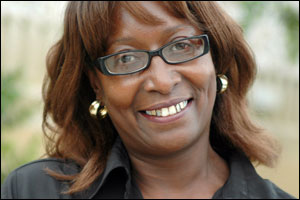
Smith, a substitute teacher who has a bachelor’s degree in social work, was a guest speaker recently at an HIV/AIDS Awareness Campaign at Tommie Allen Recreation Center sponsored by Reach Out Lift Up Family Ministry and Dona Gassaway Mitchell. Smith, 50, said she decided to go public with her story to help people understand that HIV/AIDS affects more than just the patient. Following is her story as told to BlackAIDS.org project manager Sharon Egiebor. Living with an AIDS patient is not a pretty picture. It is really ugly. My neighbors don’t know. My friends don’t know. Our church members don’t know what I am praying for when I bow my head. Most people are aware Darrell has cancer, but we didn’t tell them he had AIDS. The cancer is spreading throughout his body, but he cannot take chemotherapy because his T-cells are too low. Some people think we’re being negligent by not allowing him to take the chemotherapy. Cancer doesn’t scare people like AIDS does. My daughter has been dating a guy for two years and he doesn’t know. I told some of my siblings the last time Darrell was in the hospital and asked them to pray for him. People who do know don’t visit us. The beginning My mother died when I was 8 years old. When it came time for me to attend college, I had to work and save money to go. I was 19 years old when I enrolled in college. In that first semester, I accepted a date with a young man that I barely knew. He took me to an off-campus apartment and raped me. I didn’t tell anyone. A few weeks later, I had run out of money and decided to leave school. That’s when I discovered I was pregnant. I felt love for the child in my womb. Growing up, Darrell and I were very close. He liked to play soccer and football, but he struggled in school with math. Over the years, he seemed angry all the time. People kept telling me it was just a teenage phase, but I didn’t think so. A mother knows when there is something wrong with her child. When he was 18 years old, Darrell smoked marijuana laced with embalming fluid and his behavior became more erratic. He would wear headphones all day, pretending he was the radio disc jockey controlling the song plays on the radio. He was hearing voices and would wake me up at 2 a.m. and tell me to watch him on television.
The doctors diagnosed the bipolars in 2002. I believe he had it all along and that they were just noticing a progression of the illness. He also is schizophrenic.
In the middle of this, he had friends who did things. Once, he was in the car with a friend who was recently released from prison and on parole. The police stopped them. The other young man was carrying a gun. He gave the weapon to Darrell and told him to hold it. Now Darrell has a felony record for weapon’s possession. I can’t put a convicted felon on my apartment lease, nor can he get into federal Section 8 housing. We live underground, where Darrell isn’t on the lease. My adult daughter and I share a bedroom and the bath. Darrell stays in the master suite, where he has more privacy. Darrell wears adult diapers because of the tumors in his rectum and he has a colostomy bag that has to be changed. When a person has mental problems, they don’t think rational or normal. If they did, they wouldn’t be mental. Darrell became a crack head and started doing things to get the drugs. The diagnosis In 2003, I had taken Darrell to the doctor and across the way was the Dallas County Mobile Testing Unit. I had nothing but time on my hands, because his appointments would take forever. I got tested and when Darrell came out, I had him tested also. They told me within the hour that I was negative. They asked Darrell to come in and talk. I asked permission to go with him. They told him he was positive but that the he should visit the agency’s office on Stemmons Freeway to take another test. That test returned positive. Now he has full blown AIDS and lesions and tumors throughout his body. Nearly all of my time is spent taking care of him. I tried five years ago to put him in a residential facility. It costs nearly all of his Social Security payment to cover the bill. They said they were providing three meals a day, counseling and transportation to and from doctor’s appointments. They considered breakfast to be one of those 8 for a $1 package of Ramen noodles. Darrell was calling saying he was hungry all the time. I would carry him hamburgers. We eventually bought a refrigerator to put food in it. The staff said the other men would ask Darrell and he would give them all of his food. I lost my summer job at a department store because I kept taking off to take care of Darrell. They tried not to fire me, but I knew they were forcing me out when they moved my duties from sales clerk to warehouse stocking, lifting heavy boxes. They had young college-age people working there, but me at 50-years-old was in the back lifting. I left. During the school year, I work as a substitute teacher; something I’ve done for several years. Before my husband died of cancer 12 years ago, working as a substitute teacher allowed me to take off when he had vacation time without having to seek permission first. The substitute school system is automated. If you want to work, answer the telephone. If you don’t, don’t take an assignment when they call. Before school started a few weeks ago, the three of us were living on Darrell’s Social Security and my daughter’s pay from McDonald’s. Darrell receives $28 in food stamps and that will increase next month to $36 a month. Up until last week, I had an eviction notice. We went a week without electricity this summer. I borrowed the rent money from a relative and gave her a post-dated check in the amount of my entire pay check. Darrell’s medical caseworker gave me a list of about 100 agencies to contact for help. Some of them say we are out of the service area. Some don’t answer the telephone at all. Others say you have to call at 9 a.m. Monday, but when you do, the telephone just rings. The voice mail gives you an address but you can’t make an appointment when you walk it. So I have to start the process all over again the next Monday, hoping to catch a live person on the telephone. I can’t get help with the rent because Darrell isn’t on the lease. The Section 8 office told me I could appeal their denial. It seems like more help should be available. I’m not a lazy woman. I work and I’m willing to work two jobs. Some companies think I won’t stay on a job that pays $5 or $6 an hour. Other jobs that pay better are seeking more qualifications or experience. Even though I have a bachelor’s in social work, I don’t have my teaching certificate or other licenses and certificates for more professional positions. Darrell says he’s not angry at God. But it seems like he’s given up. He won’t take the medication, even though the doctors have explained that he shouldn’t miss a dose. I can see him growing weaker and losing a lot of weight. He might sleep two days at a time. The doctors asked what were we doing for pain. Darrell isn’t feeling it and that was my prayer. I don’t think I could stand it if he was in pain. I have been through so much. I am a good prayer. God is really listening and answering our prayers. God is a good God. He blesses people to be a blessing to other people. At some point, you’ve got to give somebody some food and pay some bills. I believe God helps in the times of trouble. The best advice I can give everyone is to get tested and get your household tested. This virus is taking your life away before it claims your body.
Our Problem
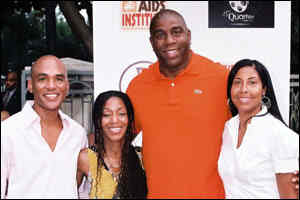
View red carpet photos of the event LOS ANGELES -- Robi Reed, producer and casting director, threw a star-studded birthday party that was attended by hundreds of America’s top entertainers and raised thousands of dollars to fight HIV/AIDS in African Americans. Judge Greg Mathis and his wife Linda Mathis hosted the 5th Annual Robi Reed Birthday Party at his exclusive Beverly Hills gated community. Eddie Murphy, Don Cheadle, Tracey Edmonds, Magic Johnson, Suzanne DePasse, Derek Luke, Hill Harper, Kimberly Elise, Heavy D, Malinda Williams, Niecy Nash, Nia Long, , Mekhi Phifer, Kim Porter, and Fonzworth Bently were just a few of the celebrities amongst the 300 party goers. Kym Whitley emceed the event. The Aug. 26 end-of-summer bash benefited the Black AIDS Institute, a nonprofit national black think tank based in Los Angeles. This is the second year that Reed has used her birthday celebration to raise funds for the Institute. “It’s an early birthday celebration and I opted that people not bring me presents. What I’ve asked people to do is make a meaningful donation to the Black AIDS Institute in lieu of gifts,” said Reed. “This is about bringing awareness to our community because AIDS is killing us. It’s the #1 killer of African American women between the ages of 25 and 34. That is ridiculous, and it’s because people won’t find out their HIV status.” Reed and others are collaborating with the Institute to encourage 1 million African Americans to take an HIV test and learn their status. The 18-month “1 in a Million Campaign” began earlier this summer when dozens of entertainers, athletes and civil rights activists, including Regina King, Jimmy Jean-Louis and Samaki Walker and the Rev. Al Sharpton, took public HIV tests. Screen Actors Guild, the American Federation for Television and Radio Artists, the Black AIDS Institute, Artists for a New South Africa, Palms/AACDI and the Beverly Hills/Hollywood branch of the NAACP co-sponsored the event with the Institute. Tony Wafford, a community activist and organizer who is spearheading the project, said the Institute is collaborating with the federal Centers for Disease Control and Prevention as part of the Heightened National Response to HIV/AIDS in African American communities to work with national civil rights agencies, entertainers and minor and major church organizations to encourage the testing throughout the United States.
Wafford, who did not attend the Reed party, said future events include a national press conference on Sept. 25 in Washington D.C. sponsored by members of the Congressional Black Caucus, and Sharpton’s National Action Network Convention will hold a testing event on April 4 in Memphis, Tenn., on the 40th anniversary of Dr. Martin Luther King’s assassination.
Actor Malinda Williams said she commends Reed for doing her part. "I commend Robi Reed for her continued dedication to the fight against AIDS in our community,” said Williams. “She is a true soldier fighting to increase awareness." The music, food and drinks stopped for about10 minutes while Phill Wilson founder and executive director of The Black AIDS Institute, delivered a message highlighting the staggering statistics on how HIV/AIDS is impacting the black community. The crowd stood captivated as Wilson impressed upon them the growing number of AIDS cases in the African-American community and the importance of getting tested. “Black folks are getting infected with HIV at greater rates, getting sicker, and dying faster from AIDS than anyone else,” said Wilson. “That’s the bad news. The good news is, it doesn’t have to be that way. We have the power to end this epidemic and black celebrities can play a critical role in that effort. Robi Reed is a hero in this effort. She is putting her money and her power where her mouth is.” Sponsors included TV One, Crown Royal, Tanqueray and 4th Quarter Films. Reed, one the most prominent casting director’s in the industry, recently cast “Mama I Want to Sing” starring Billy Zane, Ciara and Hill Harper and is in development on Kirk Franklin’s biopic where she will serve as producer.