Highlights from First Day of CROI 2017
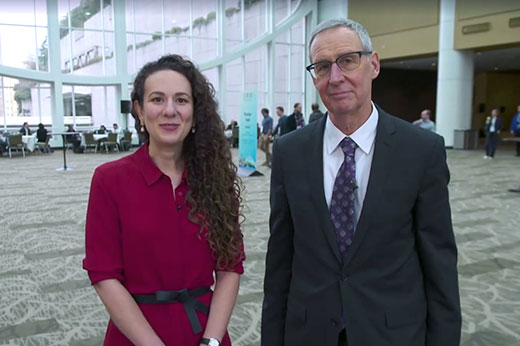
Anne Rancourt, Communications Section Chief, at NIH's NIAID chats with Carl W. Dieffenbach, Ph.D., the Director of the Division of AIDS at NIH's National Institute of Allergy and Infectious Diseases, on information provided on the first day of the Conference on Retroviruses and Opportunistic Infections (CROI) in Seattle
We reported from the 2017 Conference on Retroviruses and Opportunistic Infections (CROI) in Seattle sharing news and information about some of the important new HIV research findings and data being released. After the first full day of sessions, we held two Facebook Live sessions with senior federal HIV leaders to hear about what they saw as some of the key science highlights of the day.
First, we caught up with Dr. Carl Dieffenbach, Director of the Division of AIDS at NIH's National Institute of Allergy and Infectious Diseases (NIAID). Among the science highlights Carl pointed to were discussions of new technologies like gene editing and genomics being used to explore ways to tackle HIV and cancer. He also discussed how proven HIV prevention techniques are being applied to great effect at the community level in Uganda. To learn about these developments and more, watch his conversation with his colleague Anne Rancourt below or on the AIDS.gov Facebook page.
https://www.facebook.com/AIDS.gov/videos/10154986240692812/
We also spoke with CDC's Dr. Jonathan Mermin about some noteworthy new data about declining HIV infections in the United States that CDC shared at the conference. Dr. Mermin explained that annual HIV infections have declined 18% nationwide between 2008 and 2014. But that progress was not the same for all populations or areas of the country, he noted. Watch his conversation with Anne Rancourt below or on the AIDS.gov Facebook page to learn more. Read about the CDC data in this post.
https://www.facebook.com/AIDS.gov/videos/10154986427882812/
The annual CROI conference assembled over 4,200 HIV researchers in Seattle. The basic, translational, and clinical scientists from 90 countries shared and discussed the latest studies, notable developments, and best research methods in the ongoing battle against HIV/AIDS and related infectious diseases. Visit the conference website for abstracts, session descriptions, webcasts, and other materials being released over the course of the coming week.
By AIDS.gov
From AIDS.gov