AAHU Fellow Jeffery Edwards-Knight: We Need the Biomedical Background and Knowledge AAHU Provides
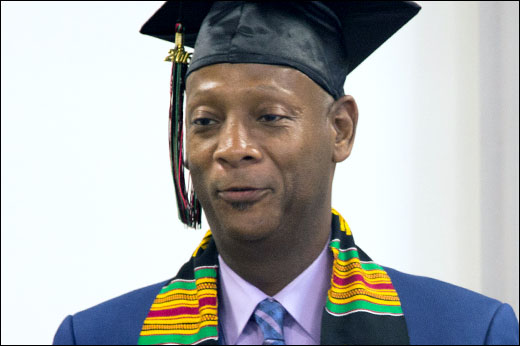
AAHU Fellow Jeffery Edwards
One in a series about recent graduates of the African American HIV University (AAHU).
From 1984 until 2006, Jeffery Edwards-Knight worked as an engineer for Duke Power (now Duke Energy) in North Carolina, but during those two decades with the company, he says, "I felt like I was not making a difference." So in 2005, in his early 40s, he decided to return to school to study something he enjoyed. "I went back to get my degree in criminal justice at the University of North Carolina at Charlotte. I wanted to work with inmates after they came out of jail and help them with HIV services," he says. Working with people living with HIV/AIDS (PLWHA) was important to Edwards-Knight because he'd been living with HIV since the late 1980s.
He was hired as an MSM health educator at the Metro Liner AIDS Project, an AIDS service organization in Charlotte. He worked there until the program lost its grant and he was laid off. Luckily, in 2007 Edwards-Knight immediately landed a position in the Mecklenburg (N.C.) Health Department and was eventually named supervisor of the HIV/STD Community Testing and Outreach Program, where he and his staff do HIV and STD testing, counseling and risk assessments in Black communities (69 percent of the 4,380 people living with diagnosed HIV in 2013 in Mecklenburg were Black).
Life-Changing Training
Edwards-Knight learned about the AAHU at a Black AIDS Institute presentation in Charlotte. His county health director talked to him about attending, and just one week before the program was set to start, Edwards-Knight discovered that the county was sending him. In the midst of planning his wedding, Edwards-Knight headed to the 30-day boot camp in Los Angeles for an opportunity that would change his life.
"I was really apprehensive at first and intimidated because the Black AIDS Institute is such a well-known organization, nationally and internationally. But the AAHU training that I received—especially the first 30 days on the campus of UCLA, when we studied with professors who had been working in the field—gave me a lot of knowledge that I haven't had before," he says.
Edwards-Knight had attended local trainings for Mecklenburg County, but nothing like what he received at AAHU. "Training like this, which, really, no one else in my department or in the county had ever received, built a lot of confidence in me. I was able to bring the information back to my colleagues and folks in the community. It was the most valuable training that I have ever gotten."
The Impact
AAHU had a huge impact on Edwards-Knight as a PLWHA. "For one, it helped me to understand a great deal about the HIV life cycle. I'd been taking medication for years, but I never understood how or why the medications worked," he admits. "Even though I have been diligent with my medication and the virus has been undetectable for all this time—it really helped me understand why I was taking that particular medication. I was also able to explain that to some of my HIV-positive friends. It was a real eye-opener for me."
Now happily married, Edwards-Knight, 53, says that the training also helped him become comfortable talking about being HIV positive. "I'm empowered and feel it's my responsibility to practice what I preach. I just can't talk about stigma and not be that individual who steps up and discusses my status."
Edwards-Knight believes that AAHU is important because African Americans need to be on the front lines ending the AIDS epidemic, which disproportionately affects Black people. "We need to have the biomedical background and knowledge that AAHU provides so that we can educate our Black community and build them up to be leaders and advocate for themselves."
Thanks to his AAHU fellowship, Edwards-Knight has been able to launch and co-chair a BTAN chapter in Charlotte—a crucial network to help end the epidemic in his community. "I will continue to be a fighter in the battle against HIV until I can no longer do it or until there is a cure," he says. "It is my responsibility as a Black man and as someone who is HIV positive."
LaShieka Hunter is a freelance writer and editor based on Long Island, N.Y.