SisterLove's Dixon Diallo Hopes This Conference Will Be a Game Changer
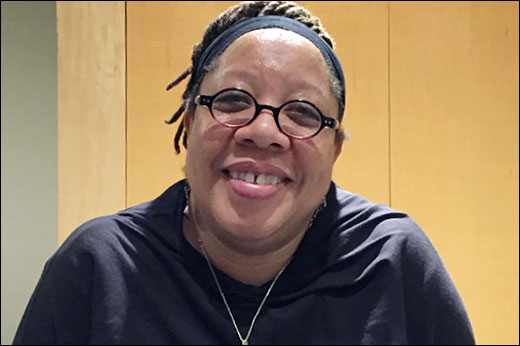
Women Now 2016! Summit chair Dazon Dixon Diallo after showing young women how to see their own cervix. Photo: Hilary Beard
It's been 16 years since the International AIDS Conference was last held in Durban, South Africa. As the world convenes in Durban once again July 18-22, 2016, reproductive-justice organization SisterLove Inc. founder Dázon Dixon Diallo reflects on how that year's conference was a watershed event, and how this year's can be just as important to the struggle to end the epidemic.
The issues that were at the forefront of AIDS 2000 were treatment, activism, advocacy and access, Dixon Diallo recalls. There was plenty of excitement around the promise of highly active antiretroviral therapy (HAART), yet there was an understanding that much more work needed to be done to ensure that PLWHA received the treatment they needed. "The science around HAART was four or five years old by the time we got to South Africa, and still most of the world did not have access to the therapies that now everybody has some access to," she says.
Parallels can be drawn to this year, she adds. "We are in that same position around biomedical prevention. We're at the same place now, where it's been four years since PrEP [pre-exposure prophylaxis] was approved, it's been five years since we've had [the results from HPTN] 052 and treatment as prevention, but are we getting access to where the people who need it the most are actually getting it?"
Dixon Diallo hopes that this is the year that biomedical prevention goes from being a concept that is widely discussed to a strategy that is widely put into practice. "I would hope that the same way that the International AIDS Conference in the year 2000 was a watershed moment for treatment, this year's conference will be as focused on prevention."
Of equal importance to Dixon Diallo is that the epidemic be viewed though the lens of race.
"There's been a huge focus to redirect conversation around key populations," she says. "My concern is that key populations are centered around identities of men who have sex with men, women who have sex with women, people who inject drugs, sex workers, and to some degree young women and girls."
The issue of race isn't getting the attention it deserves, she says. "It's not enough to only talk about men who have sex with men, but instead, men of African descent who have sex with men. Among women, it's Black women who are still most impacted."
Dixon Diallo points to the World Conference Against Racism (pdf), an international meeting that took place in 2001, also in Durban, as an example of the world coming together to address racial disparities.
"If the International AIDS Conference had a racial lens, how might it look differently, and how might it look more like that global race meeting that was held 15 years ago?" she asks. "I think that that needs to be a real important part of this year's conference."
Tamara E. Holmes is a Washington, D.C.-based journalist who writes about health, wealth and personal growth.