"More Options Are Coming": Josh Agee Reflects Upon CROI
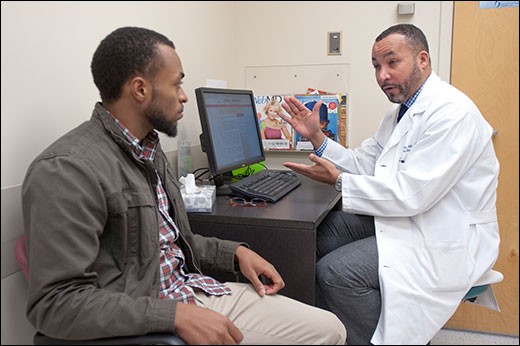
Joshua Agee (left) and Dr. Leandro Mena, associate professor of medicine in UMMC's Division of Infectious Diseases, discuss the best ways to educate Jackson residents who are at a high risk of contracting HIV. Mena relies on workers like Agee to recruit people with high risk behaviors to get tested for HIV and learn about preventative measures and treatment options.
CROI 2016 was truly an amazing experience for me. I had the chance to learn about new scientific advancements and tools that might expand the prevention options for my community. The new treatment and prevention strategies offer a level of promise that people are looking for since the current options aren't doing enough for us.
Sometimes I reflect upon where this epidemic has been and might be going. I think about the things that we once thought were beyond our grasp but now seem within our reach. I think about how we've progressed from AZT to PrEP to now potentially using broadly neutralizing antibodies (bNAbs), or HIV-neutralizing antibodies delivered through an IV drip, for prevention. Researchers first identified bNAbs in 2006 in a person living with HIV. These bNAbs were proven highly effective in neutralizing HIV in vitro and were able to neutralize over 90 percent of known HIV strains. Researchers now have begun testing bNAbs in clinical trials. The possibility that a combination of antibodies might be as effective as current treatment strategies was discussed. For example, one form of monoclonal bNAbs—those cloned asexually from a single individual or cell—might be combined with other monoclonal bNAbs to increase their coverage of known HIV strains. The only way to know if bNAbs will be an effective strategy is to test in a more real world setting. Future studies with bNAbs will include administering them to populations at high risk for acquiring HIV.
This particular research stood out to me because it is a different approach that sparked my curiosity to see where it might take the field. The need for another option could not have been clearer than after the CDC's new press release stating that 1 in 2 black MSM will acquire HIV in their lifetime. It is imperative that we not only broaden our prevention toolbox but also make it accessible to communities in need.
These staggering CDC data also prompted me to take more action in my community, as I realize the state of our emergency. I plan to do more innovative community outreach and education on HIV treatment and prevention, while keeping a close eye on options and making sure my community knows that more options to meet their needs are coming.
African American HIV University fellow Joshua Agee currently works as the PrEP coordinator for My Brother's Keeper, where he educates individuals about PrEP, assesses their risk of contracting HIV, and navigates insurance issues with patients regarding PrEP.