Black AIDS Institute Breaks "BAD" on the Beach at the USCA 2016
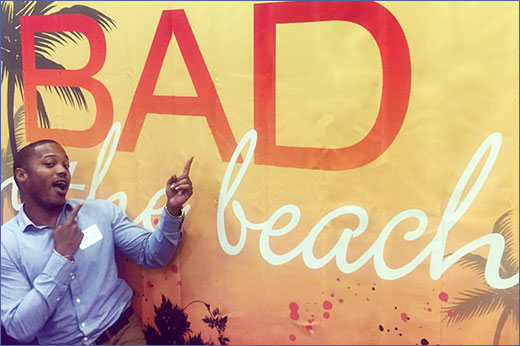
Christopher Wilson-Smith, Black AIDS Institute Prevention and Care Manager, being "BAD" on the beach
The Black AIDS Institute took the 2016 United States Conference on AIDS by storm in South Florida last week.
Six Insitute staff memebers and 31 members of the Black AIDS Delegation (BAD) converged on the conference from around the nation to attend sessions, present information and bring the latest strategies on ending the AIDS epidemic back to their local communities.
The Institute also helped train the next generation of social media journalists, co-sponsoring the USCA Social Media Fellowship Program in conjunction with AIDS.gov, FHI360, Human Rights Coalition and the National Minority AIDS Council. Designed to provide creators of online content from diverse communities with extensive social-media training, the Fellowship also offered networking opportunities and access to conference experts to help the fellows amplify HIV, health and wellness messages to diverse communities. Sixteen participants participated in the five-day program, which offered deep dives Facebook, Facebook Live, Twitter, Instagram, Snapchat and other platforms, including some of their powerful but less-used tools. Participants' posts appeared on FHI360's crowd hub, a curated clearinghouse for the digital content shared at the conference, in addition to their own social media feeds.
The Institute also sponsored a number of conference sessions, with director of programs Raniyah Copeland leading "First U.S. PrEP Learning Collaborative Boosting Southern PrEP Efforts". Mobilization coordinators Fatima Hyacynthe and Chi Huynh hosted "What's Missing from HIV Leadership? Achieving Universal Science Literacy". Hyacynthe says, "We recognized that we have the most important players in the HIV field at this conference, and we want to tap into that knowledge to inform the next steps in ensuring a fully knowledgeable workforce."
Mobilization manager Erica Lillquist led "Racial Solidarity in the Fight Against HIV/AIDS. "We realized that even we at the Institute, though we work within a race space, do not always have conversations on race itself," she says. "We started to do this as a staff earlier this year and we wanted to take this opportunity to talk about it as a workforce so that we can collectively maximize our impact." Lillquest also presented "Black Lives Matter: What's PrEP Got to Do With It?" on Sunday. "After 19 stops on the PrEP tour, it was important that we brought the content full circle. The national PrEP summit was held last year at USCA and this session is a summary of all that we learned throughout the year," she adds.
Following an electric performance by singer/dancer/songwriter and YouTube sensation and American Idol finalist Todrick Hall, Black AIDS Institute president and CEO Phill Wilson moderated the Friday plenary luncheon. Titled "Convergence: Forging the Path," the session featured Richard A. Elion, M.D., associate clinical professor of medicine at George Washington University; blogger, speaker and activist Ken Williams, who works under the social-media handle Ken Like Barbie and has been a spokesperson in the AIDS.gov #MyPositiveSpin and Greater Than AIDS #SpeakOutHIV campaigns; and professor, author and political commentator, Melissa Harris-Perry, Ph.D.
Invoking the memory of his deceased patients, Dr. Elion spoke about the convergence of prevention and treatment. Williams, who was also a 2015 Social Media Fellow, spoke about being diagnosed with HIV shortly after beginning a new job as an HIV prevention counselor, and his journey to overcome stigma and shame. Harris-Perry talked about the relationship between social justice and the movement to end HIV/AIDS. She reminded attendees of the question W.E.B. Du Bois posed in The Souls of Black Folk: "How does it feel to be a problem?", then challenged attendees to consider what she termed a DuBoisian definition of Blackness—one that includes other people who society considers problems, including other people of color, PLWHA, LGBTQ, transgender, sex workers and other marginalized groups.
The program closed with performances by the Mobile, Alabama-based dancers and reality stars, Prancing Elites.
After the session the social media fellows met with Williams, Elion and Harris-Perry, as well as singer/dancer/choreographer Todrick Hall.