We'll Always Have Cuba, Part 1
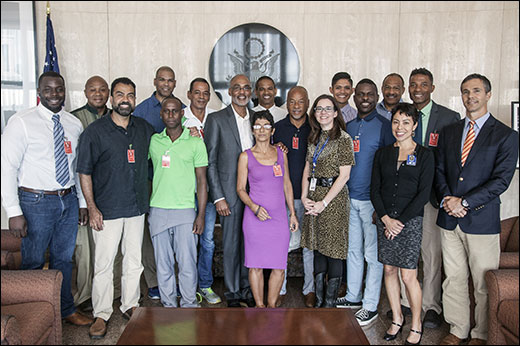
Cuba entourage
A round-table discussion with four members of the Black AIDS Institute Cuban delegation
Less than six months after the beginning of the normalization between Cuba and the U.S., a delegation of fifteen gay men (mostly) of color spent fifteen days in Cuba collecting and sharing information on innovations in HIV/AIDS treatment and prevention, sexual and gender identity, and the differences in responses to the AIDS crisis between a for-profit system and a government-controlled healthcare system.
The men of the delegation had diverse backgrounds and interests. The majority was black, with one Asian-American, and one white traveler. Two were retired, two worked in education, one in law, one in hospitality and the other nine professionals in various aspects of healthcare research and policy.
I spoke with four of the delegation participants after they returned to the U.S. They were:
• Phill Wilson, founder of Black AIDS Institute
• Steve Wakefield, Director, External Relations, HIV Vaccine Trials Network
• Justin Tandingan, Director of the Asian American & Pacific Islander Initiative at Teach For America
• Christopher Hucks-Ortiz, Evaluation Specialist at John Wesley Community Health Institute in Los Angeles and current Chair of the HIV Prevention Trials Network (HPTN) Black Caucus
Larry Buhl: Phill, what did you hope to achieve by putting together this delegation?
Phill Wilson: At the point Obama began to have a conversation about opening relationship with Cuba we at the Institute said there is an interesting story to tell around race in Cuba. We were in connection with people who had been doing anthropological work around the African-Caribbean and African-Latino and the Afro-Cuban experience. We wanted to see what that looked like. That's why we decided to sign on for the delegation.
What did you find intriguing regarding race there as it applies to the African American experience?
Wilson: We discovered early on what a major African influence there is in Cuba, and while Cuba has a slave legacy like we have in the U.S. and the Americas, one thing is there isn't a running away from that history in Cuba. There are a lot of places you go and there is a discourse about how this or that was built by slaves. In the U.S. there is a reluctance to acknowledge how much of our country was built on the back of enslaved people that's a problem when we talk about race dynamics in America today.
Wakefield: And not only did they acknowledge the role of slavery in their history, but they talked specifically about how it contributed to economic growth and made their history possible. Part of that was to affirm that they were valid and important people in Cuba's history, which we don't hear in the U.S. Not only do we run away from talking about it, I've never heard that [slavery] is important to America in completing the infrastructure.
Christopher Hucks-Ortiz: What we think about Cubans here in the U.S. is overwhelmingly the voice and experience of white Cubans, who were from the white class, the ruling class or upper class, who had the resources to pull resources out and leave. We were able to engage with two college students from the University of Havana about their understanding of the history of Cuba and about the race and power differential that black Cubans experienced before the revolution and after the revolution. They said [black Cubans] don't have everything everyone else has right now, but there seems to be more parity than before the revolution and the revolution helped benefit black Cubans. That is a perspective I hadn't heard.
Is there a disparity in who's impacted by HIV/AIDS in Cuba?
Wilson: It's a little difficult to tease out the demographics of the epidemic in the same way we do in the U.S. What I can say is that the delivery of care and the design of the delivery of care is much more equitable in Cuba than in the U.S. Because they have universal healthcare, no matter who you are, you have access to medication. And you have access to the same medication as anyone else, relative to the services provided by the national healthcare delivery system. But having said that, I'm not so sure that we saw evidence one way or another to suggest people were disproportionally impacted or not on HIV based on race.
Please return for Part 2 next week, when we'll discuss treatment and prevention and LGBT and HIV stigma in Cuba.
Larry Buhl interviewed the staff at MSMGF about their work for the March 2016 issue.