Erica Lillquist: Helping People Live Healthier Lives
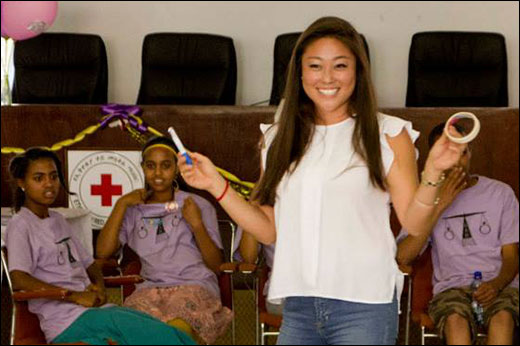
Erica Lillquist
The Black AIDS Institute's new senior mobilization coordinator, Erica Lillquist, just completed three years of international volunteer work with the Peace Corps. She credits time spent in Ethiopia as an HIV/AIDS community health volunteer with shaping her career path and drawing her to the Institute.
After graduating from the University of Pittsburgh with a master's in public administration, Erica taught in Spain before being accepted into the Peace Corps. "It's something that I had always wanted to do and it was the right time in my life," she says. "Plus, I wanted experience at the grassroots level." For two years she lived in remote villages with little running water and occasional electricity while working with health professionals and administrators in the towns of Debre Sine and Debre Birhan. "I really loved my work in international development in public health because I feel like the work I was doing was having a positive impact on my community in Ethiopia and I was helping people to live healthier lives."
To gain further experience, she extended her stay, working a third year with Population Services International, a non-governmental, global-health organization whose mission in Ethiopia is to improve sexual reproductive health and reduce the risks and vulnerability to HIV infection. "I worked with female sex workers, where there is a 20 percent rate of HIV infection. And while the epidemic is very low in Ethiopia compared to other areas of Africa, there are certain populations that are being affected."
Erica's experience working in Africa has given her a holistic view of the epidemic, helping her to see similarities and differences that exist when combatting the virus in different settings. "I learned some soft skills that were helpful in prepping me for the Institute. At Population Services International, I worked with 25 local implementing partners that were spread throughout the country. That's kind of like the Black Treatment Advocate Network (BTAN), which I'm working with now, where there are different chapters all over the country," she says. "Also, working in a small rural setting for the first two years was very different than working in a capital city in Africa. And that's very different than working in Los Angeles." And while there are some similar challenges, like linkage to care, there is a big disparity in the number of resources to prevent infection. "In Ethiopia it was easy to get discouraged because of the lack of tools to combat the epidemic from spreading," she adds.
After spending almost a decade abroad, Erica misses Ethiopia's capital city of Addis Ababa, but is glad to be back in the States. "One of the biggest downsides was that I had to be far away from family and friends most of the time. I have made friends in the places I have gone and even have people I would call my family, but there is nothing like being able to come home for a visit, especially for the holidays."
April Eugene is a Philadelphia-based writer.