The Black Treatment Advocates Network: Advocating for People Everywhere
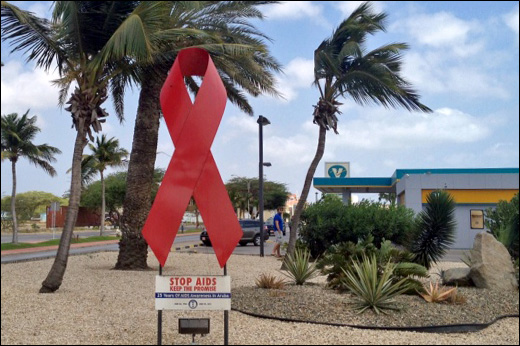
Women's Club of Aruba commemorates its AIDS awareness campaign efforts with strategically placed sculpture created and donated by Jan van Duren of Pro Paint van Duren
Aruba may be known for its surf, sand and stunning resorts, but HIV activists, cousins and Black Treatment Advocates Network (BTAN) members John T. Curry and Yolanda Price think the Caribbean nation may deserve to be known for something else: its visible fight against HIV/AIDS.
While vacationing in the capital city of Oranjestad with three other BTAN members this summer, the pair were surprised to see a giant red ribbon strung up at the Valero gas station in the center of town—a symbol of Arubans who had perished from AIDS, and a landmark of an AIDS awareness campaign begun 25 years ago.
As members of BTAN—the only collaboration that links HIV-positive Black Americans to care and treatment, strengthens local and national leadership, connects influential peers, raises HIV science and treatment literacy in Black communities, and advocates for policy change and research priorities—they understood that the ribbon, representing the plight of people of color around the globe, was no small deal. They learned that the ribbon had been raised in 2011 after seven months of negotiations between its sponsor, the Women's Club of Aruba, and the country's government. It acknowledges the 4 percent of the island's 103,484 PLWHA, according to the Department of Public Health of Aruba, as of 2008.
The club's insistence on bringing the issue to the forefront touched them, Curry says. Being seen—and thus receiving critical medical, financial and social support—is something PLWHA often struggle with.
"I was so happy to see the ribbon displayed in a place where no one could miss it," says Curry, a BTAN co-chair in Melbourne, Fla. Back home, Curry works with high-risk patients who require assistance adhering to their medication regimens in their homes as they attempt to sustain all components of their treatment plan. "I felt inspired to talk to some Arubans about what kind of services are offered in their country for PLWHA," he continues. "I wanted to know what some of their conditions and programs were like relative to back home."
And so Curry and Price, a 2015 Fellow with the African American HIV University Science and Treatment College, initiated conversations with locals to inquire about available HIV services. Some of what they learned sounded familiar.
"We interviewed a security guard, a homeless man and a couple of others about crime, homelessness and the availability of HIV services in Aruba," Curry explains. "The security guard's opinion was that generally, the incidence of HIV in Aruba is fairly low, and this may be because of the highly visible campaign the government launched to prevent them," he recounts. A 4 percent incidence rate, however, is not low.
"The homeless gentleman proudly displayed his governmental AZV health insurance card, provided to all documented Aruban citizens to cover their health-care costs, to include HIV and antiretroviral medications," he continues. "Indigence, he says, can seriously impact an individual's ability to keep up with his or her regimen."
The homeless man, whom we'll call Smith, had been raised in New York but was deported to Aruba nine years ago because of criminal activities. He became homeless and a cocaine user. He talked about the lack of government assistance for those who are insolvent, referencing some friends of his who are HIV positive. (He says that he is HIV negative.) They apparently get 300 Aruban florins a month, which equates to about $167.60, the man said, which isn't enough to cover meds and other critical items.
Smith's conclusion? "The government cares about tourism more than the homeless, HIV infected or any other social determinate," Curry relays, although he says that Smith was pleased to learn that several churches offer services to the homeless, including those with HIV.
Price, whose primary focus is helping Black women and children affected by the virus, says that she was struck most by the universal challenges facing PLWHA. "We were on vacation and yet we were provided with an opportunity to learn about some of the successes and challenges facing people living with HIV in Aruba," she says. "Understanding helps empower us to be advocates for people, no matter where they live, who don't have a voice."
For more information about BTAN or to find out how to get involved with your local BTAN, visit BlackAIDS.org.
Tomika Anderson is a freelance writer based in the Washington, D.C., area. Her work has appeared in Essence, POZ, Real Health and Ebony magazines, among others.