Remembering Julian Bond's HIV/AIDS Activism
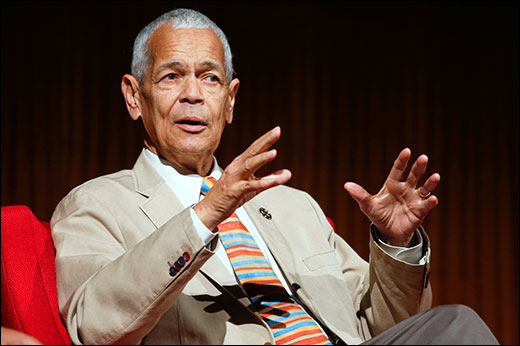
Julian Bond (January 14, 1940 – August 15, 2015), an American social activist and leader in the Civil Rights Movement, politician, professor, and writer
In 2008, the Black AIDS Institute recognized Julian Bond at the Heroes in the Struggle Award Ceremony—the annual fundraising gala held to honor individuals and corporate "heroes"—for being an "Advocate" in the fight to end HIV/AIDS, as he instinctively understood that AIDS is a civil rights issue. To remind us of the leadership and courage he exhibited in fighting AIDS in Black communities, we run an edited version of the biography we published in the event program that evening.
His name was Bond. Julian Bond. His mission: changing the course of history. The beneficiaries of his larger-than-life efforts: African Americans and history itself.
From his student days to his Chairmanship of the National Association for the Advancement of Colored People (NAACP), Bond was a longtime participant in the movements for civil rights and economic justice. As an activist who faced jail for his beliefs, as a veteran of more than 20 years of service in the Georgia General Assembly, as a university professor and writer, Bond had been a leader on the cutting edge of social change since 1960.
When HIV became part of the tapestry of African American lives, dealing with the pandemic naturally became part of the tireless activist's work. Bond understood that injustice is of a whole cloth; the threads are woven throughout. A person cannot embrace any injustice—whether racism, or sexism, or misogyny or homophobia—and still call themselves just.
"I had a very close friend who died of AIDS," said Bond, "and I am aware of the enormous toll it's taken on African Americans and people worldwide, especially before new drugs were introduced. The scientific community is going to come up with cures, but meanwhile, we have to keep hoping and taking action."
For Bond, action meant using his platform with the NAACP to support prevention efforts and advocacy of programs promoting safe sex and needle exchanges. He was the first leader to create an AIDS strategy for a national civil rights organization, and he kept HIV/AIDS front and center on the NAACP's agenda.
"It's particularly important for Black people to overcome the ignorance and homophobia that afflict our community," Bond noted, pulling no punches when it came to confronting the issues. When asked about the barriers keeping Blacks from opening up their hearts and minds, he stated emphatically: "We need to get over the idea that people can choose to be gay, then choose not to be gay. We need to help Christians overcome literalism. You take a look at Leviticus in the Bible, where it says man shall not lie with man as man lies with women. That's either a prohibition of homosexuality or endorsement of lesbianism."
Bond followed this quip with laughter, but understood that the consequences of interpreting that biblical passage literally were no joke. "Our inability to talk about sex, and more specifically homosexuality, is the single greatest barrier to the prevention of HIV transmission in our community. Intolerance has driven our gay friends and neighbors into the shadows. Men leading double lives—on the "down low"—put our women at extreme risk."
While others might have been content to rest on the laurels of his exhausting resumé, Bond never quit. In 2006, at the 16th International AIDS Conference in Toronto, he joined with other Black leaders in encouraging the Black community to accept responsibility for extinguishing the disease.
"For Black America, the time to deliver is now. We're calling on leaders to lead. The AIDS story in the United States is partly one of a failure to lead. Prominent Blacks—from traditional ministers and civil rights leaders to hip-hop artists and Hollywood celebrities—must immediately join this national call to action to end the AIDS epidemic in Black America."
Bond led by example and backed his words up with action. He did not hesitate when asked to publicly take an HIV test or to be photographed while doing so.
"We must build a new sense of urgency in Black America, so that no one accepts the idea that the presence of HIV and AIDS is inevitable. We're calling on Black Americans to get screened and find out their HIV status. I have—it took 20 minutes and was bloodless and painless. Knowing your HIV status and the status of your partner can save your life. We need a massive effort that addresses the disproportionate impact this epidemic has on Black youth, women, drug users and men who have sex with men. We must heed Martin Luther King Jr.'s warning, originally meant for others but right for us now: 'Nothing in the world is more dangerous than sincere ignorance and conscientious stupidity'."