Knowing Better, Doing Better, Part 3: Shalaurey Jones
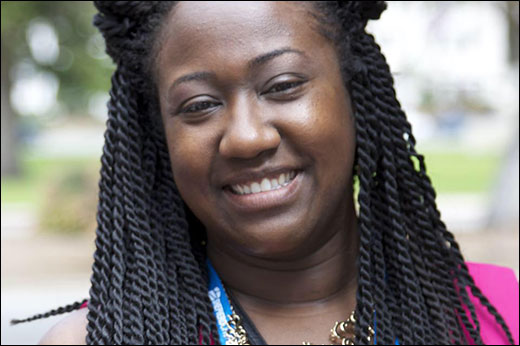
Shalaurey Jones
In February the Black AIDS Institute published the results of the first U.S. HIV Workforce Knowledge, Attitudes and Beliefs Survey, the largest study ever conducted of nonmedical personnel working with PLWHA in the United States. The results were alarming: The HIV/AIDS health-care providers at health departments and AIDS service and community-based organizations who were polled answered only 63 percent of questions correctly—essentially earning a grade of D for their knowledge of HIV science and treatment, while earning the equivalent of an F on treatment-related questions.
In part 3 of this five-part series, Shalaurey Jones, an African American HIV University Science and Treatment College Fellow and a member of the Black Treatment Advocates Network (BTAN), shares her views on why inadequately trained nonmedical staff can unknowingly put lives at risk.
Why did you become an AAHU Fellow?
I plan on pursuing my doctorate in public health and wanted to make sure I was up-to-date on the science and treatment advancements. At the AAHU boot camp, there was so much information, even regarding advancements in testing. I taught college-level sexual-health education and managed an anonymous HIV testing program, and the advancements compared to what we had seven or eight years ago are drastic. Whether it's disease-prevention education, biomedical advances, coalition building, community mobilization, program evaluations or needs assessment, AAHU has just taken everything to a grander scale.
Given your previous experience in HIV/AIDS and your current experience working with BTAN in the community, what kinds of knowledge do nonmedical providers need to help clients stay healthy?
They need to know about transmission, treatment adherence if they are HIV positive, the biomedical treatments that we have now—things like PrEP. Also, awareness of where testing and treatment are available because there's still stigma in the community regarding testing.
In your experience, do nonmedical providers have the knowledge they need to pass along that information?
I think that some providers do have the knowledge. We have some well-intentioned people who do a lot of grassroots work where they literally go out and help clients stay on path with their treatment through outreach; those folks are knowledgeable. But they may not understand the basic HIV science and treatment. The survey that the Black AIDS Institute published does highlight the fact that many of those folks are not as knowledgeable about HIV science and treatment and the importance of medication adherence.
In what ways are you helping to inform nonmedical providers about the science and treatment advances?
As part of my AAHU training, I worked with the Black Treatment Advocates Network to host a three-day science and treatment training for the city of Los Angeles, where health educators, testers and community members received training from UCLA and [University of Southern California] researchers, faculty members, medical providers and community educators.
What impact does this lack of knowledge have on the goal of ending the epidemic?
When people know better, they do better. There's no way we'll end the epidemic if the community itself does not have the relevant information to be able to share with one another.
For more information about the African American HIV University or to become an AAHU Fellow, visit blackaids.org or call 213-353-3610, ext. 100. The application deadline is June 1, 2015.
April Eugene is a Philadelphia-based writer.