Knowing Better, Doing Better: Deborah Crumm-Price
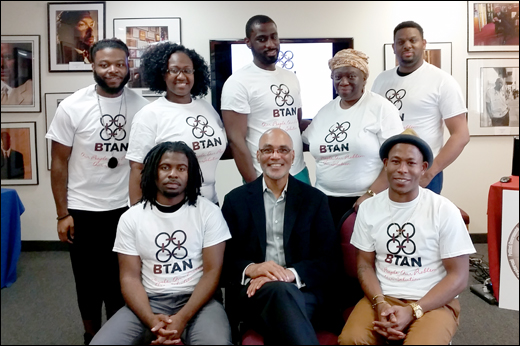
Deborah Crumm-Price, second row, second from right
In February the Black AIDS Institute published the results of the first U.S. HIV Workforce Knowledge, Attitudes and Beliefs Survey, the largest study ever conducted of nonmedical personnel working with PLWHA in the United States. The results were alarming: The HIV/AIDS health-care providers at health departments and AIDS service and community-based organizations who were polled answered only 63 percent of questions correctly—essentially earning a grade of D for their knowledge of HIV science and treatment, while earning the equivalent of an F on treatment-related questions.
In part 2 of this five-part series, we interview Deborah Crumm-Price, a member of the Black Treatment Advocates Network (BTAN) who served PLWHA for 13 years and now runs Perspectives, SOW & Co., a small HIV/AIDS service agency in the Richmond, Va., area.
What types of nonmedical HIV/AIDS service providers do your clients interact with?
My staff consists of mental-health counselors. Our clients also interact with social workers, case managers, HIV outreach workers and volunteers.
From where you sit, why is it important that the nonmedical workforce be literate in science and treatment?
So they can give the client a holistic approach to combating the problem. You need to understand the science and treatment and be able to explain biologically and scientifically how the body's immune system works and why it's important to be on the right medication. I have about 13 years of experience in dealing with the population and several HIV certifications, but it wasn't until I went to the AAHU training that I realized my own knowledge was very limited. Thanks to the AAHU training, I am now able to go out into the community and give presentations based on the information I've learned.
What is the impact of nonmedical providers not having the knowledge?
The biggest impact would be that there is a void in their ability to answer specific questions. Not everyone will just take what you say and go with it. You will run across people who have in-depth and profound questions about their disease and we should be equipped to answer those questions.
What do nonmedical providers need to know in order to help clients go on treatment when needed and to stay in care?
You have to be willing to meet people where they are and follow up to make sure they are taking PrEP and the other medications. There are some people who fit in the categories of HIV positive coupled with substance abuse and homelessness. And when you don't know where you're going to sleep that night or are carrying your whole life around in a backpack or plastic bag, taking medication may not be a priority in your life. A lot of times they get lost in the system because of circumstances where they don't make the appointments or have an inactive phone number or address. So we meet with the case manager at the shelter to follow up in keeping track of what's going on. And that's not always easy, either, because the turnover rate in the shelters is high.
What role do you believe nonmedical providers' knowledge will play in ending the epidemic?
Knowledge and education are key. How can we educate others if we're uneducated ourselves? We have to end our own ignorance before we can effectively help others. We have to be willing to learn and be educated, to go beyond our comfort zone.
April Eugene is a Philadelphia-based writer.