Christopher Wilson-Smith: When I Spoke, People Listened
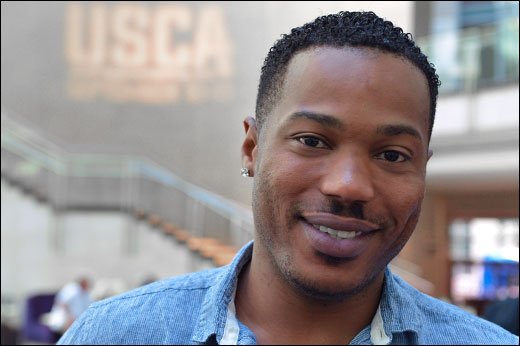
Christopher Wilson-Smith at the 2015 U.S. Conference on AIDS
I got my start fighting the AIDS epidemic about 10 years ago in Los Angeles, Calif. My god brother, who was infected with HIV, was already actively involved, and working with him, I saw that I could really make a difference.
A few years later, in my early 20s, I wasn't making the best decisions. I learned that I was infected with HIV.
I continued my work as an advocate for HIV/AIDS awareness and prevention, and when I spoke, people listened. My work took on greater depth and meaning because I was able to engage in conversations with greater detail and with greater credibility, not only as a provider, but also as someone who is living with the virus.
I serve as the prevention and care manager for Black AIDS Institute and as the manager for the Black Treatment and Advocacy (BTAN) chapter in Los Angeles, Calif.
BTAN is a collaborative network co-convened by AIDS service organizations and local health departments to streamline and improve access to HIV prevention and care services for the Black community.
The network is comprised of direct HIV-service providers and secondary social-services providers that work in housing, education and workforce development.
Currently, we have 20 BTAN chapters nationwide, in different phases of development from re-launch to advanced.
The BTAN chapter in Los Angeles is one of the advanced chapters that implemented the Seek Test Treat and Retain (STTAR) model. We work with partner organizations to do mobile testing, site-based testing, targeted testing and a peer-mentoring program that will launch January 2016.
As people go through the testing process, if they test positive or test negative but are in a high-risk population, we'll get them linked to a peer mentor.
We're also going out to find people to get them tested and conducting targeted outreach programs and "in-reach" to get people into clinics to get them tested.
Historically, the Institute has done a lot of mobilization and capacity building. We trained service providers, but we haven't been on the ground providing the services. Now, we have funding to do direct services. That means we're going to be in the community providing services and implementing the linkage-to-care model. That's exactly what BTAN brings to the Black community and having the Centers for Disease Control and Prevention fund us to do that work is truly amazing.
Next month we'll be in community doing HIV testing and outreach during the Taste of Soul in Los Angeles, a major social event that attracts tens of thousands of people.
The most important thing that the Black community should know about BTAN is that we're this central hub where people can get access to essential services like housing, mental health services, and food and nutrition.
We're also looking into getting daycare for women through BTAN so that they're able to play a bigger role in our work.
I know that this work means that we're going to have a lot of early mornings and late nights, but we put together a good team, so I'm really excited about the future of BTAN and expanding the advanced model to other chapters.
Click here for more information about BTAN.
As told to Freddie Allen, the senior Washington correspondent for Black Press of America. You can follow him on Twitter @freddieallenjr.