How Obamacare Went South In Mississippi, Part 5: A Devastating Blow
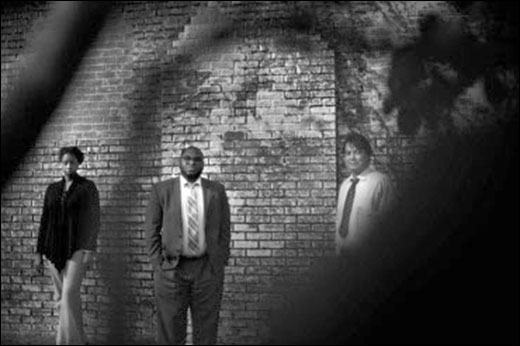
From left, Kristian Weatherspoon, Jarvis Dortsch and Roy Mitchell of the Mississippi Health Advocacy Program. The group was passed over for a navigator grant despite being a key player in the now-defunct state exchange
In the country's unhealthiest state, the failure of Obamacare is a group effort. Click here to read Part 4.
The most churched stretch of land in the nation might just be the country road in northwestern Mississippi between Hernando's city hall and the town of Coldwater. Small chapels are spaced every few hundred yards, it seems—modest buildings set amid the trees, some with bulletin boards offering plucky encouragement from the Almighty. Mississippi's churches reflect the state's small town living and racial partitions; locals worship in their own communities and those communities remain segregated. The National Baptist churches here are, in practice, all black; the Southern Baptists all white.
Minnie Wilkinson had told me to be on the lookout for a gas station so I wouldn't miss the turnoff to Oak Hill. Pastor Minor was away, and Wilkinson had agreed to show me the tiny church entrusted with President Obama's most prized domestic legacy. A brick bunker designed to withstand the brutal heat, the church's only adornments were a wooden steeple and white cross. Next door, a neighbor had posted a hand painted sign that read: "Reward for identity of chicken coop thieves."
Wilkinson apologized for the stifling temperature inside the church; someone had accidentally taken off with the keys to the room which housed the air conditioner, and she fanned herself while we talked. The telephone on her desk continues to ring with Obamacare questions from all over the state and referrals from federal operators.
During open enrollment, it had been a struggle to answer calls and tend to the steady flow of insurance seekers. "I would be here by myself and have 5 or 6 people waiting," she recounted. The people who came into the church had all sorts of health problems and were often desperate for help. "A wife came in. She had some type of cancer." There was nothing Wilkinson could do. The family's income was below the federal poverty limit, making them ineligible for subsidized private insurance on the exchange, and, since Mississippi wasn't expanding Medicaid, they didn't qualify for public insurance either.
The woman's husband returned to the church four or five times hoping to get a different answer. She dutifully referred people who landed in what became known as the "Medicaid gap" to a community clinic where they could pay a sliding-scale fee to see a doctor, but the clinics aren't equipped to treat cancer and other serious maladies, and Wilkinson knew full well Obamacare couldn't help them.
"It was so many people," Wilkinson said. "It was heartbreaking for us and for them."
Throughout the fall, during weekly conference calls, Minor told me church counselors in the Delta would be in tears: "They would have talked to 10 people in a row and not one could sign up."
People felt deceived: "They were under the impression that the less money you made, you get insurance for free," Wilkinson told me in the church office, still fanning herself. It was a rumor I heard repeated around the state. Those on the front lines were startled by the Medicaid gap's devastating blow. It killed momentum and word spread quickly: This Obamacare is a waste of time, and Obama was to blame. Bryant's decision not to open up Medicaid bedeviled the enrollment effort everywhere: At 37 percent, Mississippi had the highest percentage of uninsured adults—some 138,000— who would have been eligible for public insurance under the ACA's more generous rules. Mississippi wasn't alone: Across the Deep South, the Medicaid gap was proving to be insurmountable. Of the 4.8 million uninsured adults locked out of Obamacare plans and Medicaid, 80 percent live in the South, and they are disproportionately black.
For the health's law liberal architects who envisioned a compulsory Medicaid expansion and generous government subsidies that would ease the nation's uninsurance problem, the Medicaid gap was a cruel and unexpected outcome. "When we were designing the legislation, we were very aware that the states that, in many cases, benefitted the most were poor and generally anti-Obama," Bob Kocher, special assistant to President Obama for health care and economic policy from 2009 to 2010, told me. After the Supreme Court's ruling, "you needed a state to cooperate at a minimum level for this to work," he added.
In Mississippi, the nation's safety net program for the poor was already a vital source of care and, to conservatives, a fiscal stranglehold that threatened the state's solvency. One in four Mississippians carried Medicaid cards—some 640,000 mostly children, mothers and disabled people, costing state coffers nearly $900 million a year. Bryant argued the state could not sustain more beneficiaries without increasing taxes or cutting public safety or education programs. "I would rather pay extra to Blue Cross [to help cover uncompensated costs for the uninsured]," he said at the time, "than have to raise taxes to pay for additional Medicaid recipients."
In an alternate reality, in which the Magnolia State moved ahead with the expansion, one in three Mississippians would receive public insurance. That was a deeply troubling scenario to conservatives waging a war against government largesse and interference: "Government assistance is an impediment to the ability of the individual to act for himself," Laura VanOverschelde, the state's Tea Party chairman, told me in September.
"Our constitution was written for a virtuous and religious society, and we have been failing to do that by not allowing people to make their own decisions, rather than falling back on government assistance."
Even heady economic analyses couldn't overcome ideological opposition: A state economist projected the Medicaid expansion would bring Mississippi $1.2 billion in federal funding and 9,000 new jobs at a cost to the state of $159 million by 2025. Bryant has long held that taxpayer money doesn't come free. "If Mississippi had expanded its already massive Medicaid program," he told me, "the state would have spent between $12.4 billion and $12.8 billion between 2014 and 2020 on the Medicaid program. Those are state dollars, not federal dollars. There is no way Mississippi could shoulder that burden."
To liberal observers, however, there were racial undercurrents at work. Images of "welfare queens"—black, Delta women in Cadillacs—still held potency for conservative whites in Mississippi, and as recently as 2011, then-Gov. Barbour refreshed the image with a snazzier car. "We have people pull up at the pharmacy window in a BMW and say they can't afford their co-payment," he told the Washington Post. In reality, nearly all the adult Mississippians in the Medicaid gap are employed, albeit not at jobs with health insurance, and a significant number—some 50,000—of them are white.
Republicans weren't without a plan to confront the state's growing uninsured. Bryant offered in an opinion column "real solutions to improving health care" that didn't rely on Medicaid. "Each of us must assume personal responsibility for our own health and our own choices," Bryant wrote. But "at the core is job creation," he said of his plan to reverse health insurance losses, and he urged lawmakers to work with him "to create an environment where businesses flourish so Mississippians can secure sound employment and fund their own health insurance." Bryant's spokesman told me that the governor believed "sound employment" is "the best, most sustainable way for the state and its residents to thrive."
Sound employment had been eluding Jasmin Harrison, an achingly polite uninsured 23 year-old who lives in the small town of Raymond, west of Jackson. With a new diploma in dental assisting, Harrison told me she was frustrated when potential employers didn't return her calls. "The employer should tell the lady why they didn't get the position. Don't just get somebody waitin' by the phone," she said. Up until last year, Harrison worked as a nurse's assistant, but after a driver rear-ended her, she developed debilitating pain and couldn't keep up her shifts. She lost her job, and her health insurance, and figures she has about $40,000 in medical bills.
The community clinic Harrison went to in Jackson didn't have the orthopedic and pain specialists she needed, so when her aunt called and told her "they were signin' people up [for Obamacare] at Metro Center Mall," Harrison hurried over. "I had confidence that I was gonna receive health care that day, that I could go see the specialist," she said. Instead, a counselor told her that because she had no income, she wasn't eligible. "I said, 'What's the point of comin' here?'" The Medicaid office had already told her that she needed to be pregnant or have children to enroll.
To Harrison, it seemed un-Christian. "You should want to help another person that's in need."
By December 2013, the scope of Mississippi's disaster had become clear: a grand total 802 people had signed up for Obamacare. Healthcare.gov's epic technical problems were partly responsible. But fear of getting on the governor's bad side—and drawing attention from conservative activists—also seemed to be a remarkably effective way to quash the health law. The state's hospital association, for instance, which Bryant had scolded for "pushing talking points designed to create panic," had backed off its calls to enlarge the public insurance program, and business owners who had allowed navigators into their shops now said they could only go so far.
Anti-Obamacare zealotry, enflamed by conservative talk radio, pervaded civic life. Some white Mississippians came to view signing up for health insurance as a political act. One summer night, I met a young waiter-in-training at an upscale restaurant in Jackson who was showing off a bandaged finger; it had been badly broken, turned sideways, he said, during a flag football game. He told me he didn't have insurance and had paid a doctor precious cash to set it. The following night, I went back to the same restaurant, and he came to take my order. Why hadn't he signed up for health insurance? I asked.
"No ma'am," he answered. "I'm just not political like that."
By Sarah Varney
Jeffrey Hess of Mississippi Public Broadcasting contributed to this story.
This article was reprinted from Kaiser Health News with permission from the Henry J. Kaiser Family Foundation. Kaiser Health News, an editorially independent news service, is a program of the Kaiser Family Foundation, a nonpartisan health care policy research organization unaffiliated with Kaiser Permanente.