The Return of the Female Condom
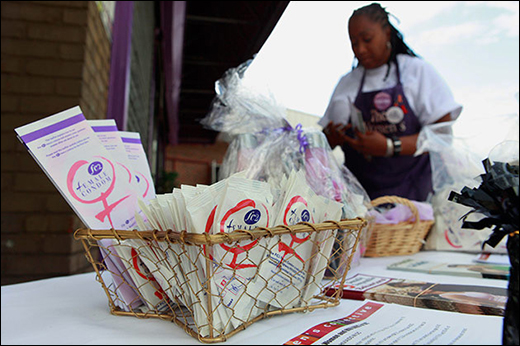
Female condoms free for the taking
Whatever happened to the female condom?
Introduced to the United States in 1993, many public health experts believed this product a "game changer" in contraceptive options, the new alternative to male condom use. Like a male condom, the female condom protects women from sexually transmitted infections, and the small polyurethane pouch, inserted in the vagina prior to sexual activity, gives women an alternative if male partners refuse to wear a condom. However, the female condom did not catch on in popularity the way its creators had anticipated.
But with the introduction in 2012 of September 16th as Global Female Condom Day (GFCD), this woman-controlled contraceptive and protective product is finally making a well-deserved comeback, as communities and organizations all around the world have begun to commemorate the observance. As Kimberly Whipkey, a global advocacy specialist, explained in her panel on female condoms at AIDS 2014, "They create a concrete opportunity for youth to not just increase their knowledge about female condoms, but also create awareness about the importance of reproductive health."
In 2013 in Kenya for example, Emily Karechio, founder of the Muthaa Community Development Center, held a key stakeholders breakfast meeting to discuss female condom availability. The meeting was attended by Kenya's First Lady Margaret Gakuo Kenyatta, delegates from the Ministry of Health and national AIDS organizations, such as the National AIDS Committee, as well as delegates from United Nations Population Fund (UNFPA), donor organizations, and national and international NGOs. The event attracted much media attention. "Last year we had 144 million male condoms in the country and if you compare it with the female condom, you can not even say 1 percent—it's incomparable," says Karechio.
The event alone helped gain much attention. In 2014, 300,000 female condoms are in the country with an additional 1.4 million expected to arrive in the coming year. This success is similar to the results of female condom initiatives in China, New Zealand, and throughout much of Africa, which have gained much popularity in recent years.
This year on Global Female Condom Day, the theme "Dance for Demand" is intended to communicate that people want access to female condoms. As explained on the women's networking zone website at AIDS 2014, the organizers hope that participants will rise and dance on GFCD, videotape or photograph their moves, and share their experience through social media. The overall aim of the campaign is to increase commitment to female condom programming among international and country-level policy makers, donors, implementing organizations, and the media.
What's the point?
According to AVERT, with every minute a young woman contracts HIV. Unprotected heterosexual intercourse has become the leading cause of HIV infection among women—higher than intravenous drug use, believed to be the leading cause in the past. UNAIDS has found that in many countries women are more likely to engage in non-consensual sex than to negotiate for condom use. So presently the female condom stands as the only available female contraceptive that protects against both unwanted pregnancy and sexually transmitted disease. This female-initiated form of protection can be inserted up to eight hours prior to sexual activity, its polyurethane material conducting heat to match the female's body temperature. The female condom's thinner material in comparison to a latex male condom is said to increase sexual pleasure.
Although costing an average $3 USD per condom, Joy Lynn Alegarbes, director of global operations at the Condom Project and master trainer of CONDOMIZE! stated, "I really see woman excited about the female condom because I think that women really do want to have the option to protect themselves from unintended pregnancy and sexually transmitted diseases such as HIV without having to rely exclusively on their male partner."
Alegarbes' negotiation advice includes to "Remind your male partner that if you are wearing a female condom he doesn't have to wear anything at all ...and we've actually received a lot of positive feedback about the roomy shape and the rings, for example, of the FC2 female condom, as many people say it actually helps to increase sensation really for both partners."
And as it turns out, the female condom is not only popular among women, but it is also gaining popularity in the MSM community. It has increasingly been used for protection during anal sex, both within the MSM population and among heterosexual couples. However, according to the World Health Organization, there is not enough evidence to show the effectiveness of this protection method.
Even so, the female condom offers a chance for women to take responsibility and truly be proactive about their own sexual health and overall safety. With women representing half of the 40 million people living with HIV/AIDS around the world, a sense of urgency exists for female-initiated effective protection. Although much work remains in creating awareness and availability, the female condom may just be the key to improved sexual health for women.
Kali Villarosa is a volunteer reporter with Black AIDS Daily, covering youth issues. She also attended the 2008 AIDS conference in Vienna. A recent high school graduate from Beacon High School in Manhattan, she is headed to Skidmore College in upstate New York this fall. She plans to pursue a career in international relations.