Sex, Lies and HIV: When What You Don't Tell Your Partner Is a Crime, Part 8
The eigth in a series of stories on HIV stigma and criminalization.
After Rhoades' police interrogation, his parents found him a lawyer: James Metcalf, a former local prosecutor who now runs his own criminal defense practice in downtown Waterloo.
As the case progressed, Rhoades pleaded with Plendl not to press charges. After the police interview, he left a final voicemail on Plendl's phone, begging him to abandon the case.
"I'm just calling to absolutely get on my knees and beg you to please drop these charges," Rhoades urged. "This has all just gone absolutely crazy. Please consider — again, I absolutely beg you, beg you, beg you to please drop these charges."
But on July 28, Abernathy submitted a criminal complaint to the court and county prosecutors, accusing Rhoades of violating the state's HIV exposure law. A judge issued an arrest warrant.
When police showed up to take Rhoades into custody, he was nowhere to be found. "Without getting into too much detail, I had a nervous breakdown," he said.
In an affidavit later submitted to the court on Rhoades' behalf, Colleen Brems, a nurse who treated him at the University of Iowa Hospitals and Clinics in Iowa City, said that he had been admitted to the hospital's mental health unit to recover "from a suicide attempt in [the] context of [a] severe depressive episode."
"In a small community like Iowa," Rhoades explained, "dealing with the most stigmatized condition, in my mind, that currently exists; becoming fodder for the media gossip mill; me and my HIV status becoming public domain; and the idea of, you know, becoming a felon and having the embarrassment to my family and feeling like my life would be absolutely — there would be no life after if this prosecution were successful.
"It was more than I could take, and I just — I crumbled."
Rhoades spent a month in inpatient care. When he was discharged on Sept. 30, 2008, he was immediately taken into custody and escorted to the county jail in Waterloo. "I walked out of the hospital in my cuffs and shackles," he recalled.
Rhoades pleaded not guilty, and the judge set his bond at $250,000. Rhoades said his family "didn't have that kind of cash," so he spent seven months in the Black Hawk County jail, waiting for trial.
For the first 20 days, the sheriff's office said, Rhoades was placed in solitary confinement and was allowed one 30-minute visit each week. He lived in the jail's secured housing unit, or SHU (pronounced "shoe"), where his HIV medications were delivered through a slot in the cell door.
Eventually, Rhoades was transferred to a cell in the jail's high-security wing. He left the jail twice, the sheriff's office said, for medical appointments, where he sat in a waiting room wearing an orange jumpsuit, leg irons and handcuffs.
In the meantime, Metcalf had suggested that Rhoades waive his right to a speedy trial so he would have more time to prepare a defense. At one point, Metcalf started deposing Plendl, but the interview was never completed.
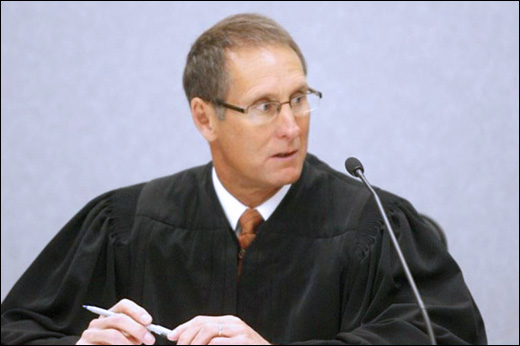
By May 2009, Rhoades had grown exhausted and frayed from jail and the uncertainty. He and Metcalf decided to enter a guilty plea and hope for a lenient sentence. But at the hearing, Judge Harris gave Rhoades the maximum sentence under Iowa's law — 25 years in state prison. The maximum sentence under Iowa law for sexually abusing a child is 10 years.
"Prison very rarely provides rehabilitation," Harris told Rhoades. "You're being sent there as a punishment."
By Sergio Hernandez, Special to ProPublica
This story was co-published with BuzzFeed.