AIDS 2014 Opening Ceremony Honors Malaysia Flight Victims, Takes on Ignorance and Stigma
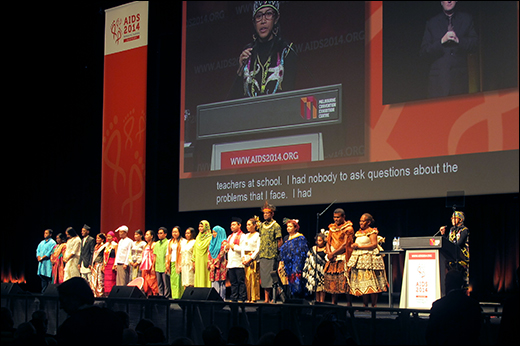
Typically, the kickoff of the International AIDS Conference is a noisy, boisterous affair. But this year, the opening ceremony at AIDS2014 in Melbourne was marked by a profound silence. At the cavernous convention center, some 5,000 delegates stood for a minute-long global moment of remembrance for delegates on flight MH17, who lost their lives en route to the conference. The six—thankfully, far fewer than the 100 conference-related deaths first reported by the media—died along with 292 others on Friday, when their plane was struck by a missile over Ukraine.
What President Obama called an "outrage of unspeakable proportions," cast a long shadow over the opening event and will continue to haunt the weeklong conference. But even as many attendees choked up when speaking of the tragedy, many were also inspired, vowing to redouble their commitment to ending the HIV/AIDS epidemic.
Michael Kirby, one of the speakers at the kick off, summed up the feelings in the room simply. "This is not the time for silence," he said from the podium. "It is why we must lift our voices."
Kirby, an outspoken, openly gay HIV/AIDS activist and former justice of the High Court of Australia, delivered the annual Jonathan Mann Memorial Lecture. Mann, a pioneer in AIDS research, died 15 years ago in a plane crash on his way to an AIDS conference, adding eerie flashback to the evening.
Kirby asked the audience to look forward, not back, explaining that Mann, along with those who were killed on Friday's crash, would "expect us to pick up our shattered spirits. They would demand that we renew and redouble our efforts."
Conference attendees agree that there is plenty of work to be done; in fact, the theme of this year's conference is Stepping Up the Pace. Despite huge gains over the last few years and encouraging news related to treating people with AIDS and reducing new infections, the HIV epidemic is far from over.
Around the world, over 5 million people are living with the virus, including more than 3 million children. In 2013, 2.3 million men, women and children became newly infected and 1.6 million died from the disease. Fifteen countries account for over 75 percent of the brunt of the epidemic, according to UNAIDS. They are: Brazil, Cameroon, China, India, Indonesia, Kenya, Mozambique, Nigeria, Russian Federation, South Africa, Uganda, United Republic of Tanzania, USA, Zambia and Zimbabwe.
Although testing has ramped up, the majority of people with HIV are still unaware that they are infected, and in resource poor areas, including many parts of the United States, people living with the virus lack access to lifesaving drugs.
The community of HIV scientists and activists has also expressed a growing concern for stigma and criminalization of people living with AIDS, a key talking point at this year's conference. "In every region of the world, stigma and discrimination continue to be the main barriers to effective access to health," said Dr. Francoise Barre-Sinoussi, the French virologist who received the 2008 Nobel prize for discovering HIV, and co-chair of the conference. (She joins Dr. Sharon Lewin marking the first time two women have led the proceedings.)
"We need to shout out loud," Dr. Barre-Sinoussi continued, "that we will not stand idly by when governments, in violation of all human right principles, are enforcing monstrous laws that only marginalize populations that are already the most vulnerable in society."
In Uganda, a law passed in February makes gays and lesbians subject to harsh penalties. Individuals convicted of homosexual acts could face up to life in prison. Nigeria and Kenya have also enacted harsh anti-gay laws. This discrimination drives the epidemic underground, fueling its spread.
Barre-Sinoussi and others are calling for people around the world to sign the Melbourne Declaration, which demands the end of discriminatory and stigmatizing practices.
Michel Sidibe, UNAIDS executive director, emphasized the importance of human rights for those who are HIV positive. "People living with HIV must live with dignity, protected by laws and free to move anywhere in the world," he stated to loud applause.
"This vision is not just my own vision; it is from my friend and mentor, Joep Lange," he added, touching his chest and tearing up. A renowned AIDS researcher from the Netherlands and former president of the International AIDS Society, Lange was the most prominent member of the HIV/AIDS delegation to die in the MH17 crash. "His vision will stay with me until becomes a reality."
Ayu Oktariani of Indonesia, the youngest speaker of the evening, brought an upbeat note to the stage—though her life story is marked by struggle. Now 27, she contracted HIV five years ago and today faces multiple responsibilities. "Raising a daughter alone, I must keep healthy and serve as father and mother for her," she explained. "I am HIV positive because of a lack of information, and what happened to me is common throughout our region and the world."
With nearly two dozen other HIV positive South Asian men and women standing by her side—also in traditional dress—she added: "Many of us got HIV because we did not have the means to protect ourselves. I'm asking all young people living with HIV, and those who care about us, to join hands and work together to make a better world where young people get the information they need and all people living with HIV are treated with respect."
Linda Villarosa runs the journalism program at City College in Harlem and writes frequently about health and social issues. This is the sixth International AIDS conference she has attended as a volunteer reporter. Follow her on Twitter @lindavillarosa.