Creating Safe Spaces for Black Men
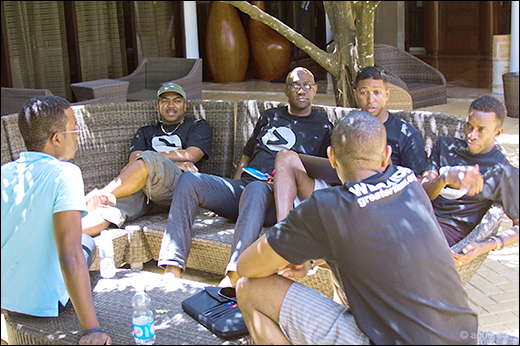
One of the missions of the Department of Justice is to ensure safety for all Americans against foreign and domestic threats. But for Black men, the right to safety isn't a given. In fact, recent events suggest that the need for safe spaces for Black men is so great that it is literally a matter of life and death.
Safe Spaces to Love
Safe spaces are particularly needed for Black gay and bisexual men. Black MSM represent more than 50 percent of new HIV infections in the Black community each year. Yet Black men are less likely than Black women to remain in treatment for HIV/AIDS, which would help control both the progression and the transmission of the virus.
Strategically creating safe spaces for Black MSM will help get more people tested for HIV and ultimately prevent new HIV infections, says Juan Pierce, executive director for the Richmond, Va.-based Minority Health Consortium, an organization that provides HIV testing and education. Part of the organization's mission is to create an environment for Black MSM that allows them to be themselves without being judged, says Pierce. For example, in January the group hosted an event designed to teach MSM safer-sex techniques that would be entertaining and decrease their risk of contracting HIV at the same time.
The results of such efforts have been positive, Pierce says. "Once we were able to engage with the community and listen to what they had to say, the community became more engaging with us." Pierce has also found that when Black men feel supported, they're more likely to get tested for HIV and, if they are HIV positive, are more likely to stay in treatment. Because early HIV treatment decreases the likelihood that the infected person will transmit HIV to his sexual partners, the creation of safe spaces ultimately promotes HIV prevention.
Safe Spaces to Play
But the need for safe spaces transcends HIV. Sports is another area in which some Black men —particularly gay and bisexual men—have been unable to be open about their sexuality without being ostracized. Former NFL player Wade Davis wrote in a column for The Guardian that although he was gay when he played professional football, he stayed in the closet. When he was growing up he knew he was gay, yet he bullied gay classmates "because they were everything I was not: They were unafraid and courageous, and their courage scared the hell out of me."
Michael Sam, a college football star for the University of Missouri for the last four years, may make the NFL—and the sports world in general—a safer space for gay and bisexual men. He announced publicly in February that he was gay. If he signs with an NFL team, which is likely, he will be the first openly gay NFL player, forcing the league and the world to embrace his truth just as he has.
Safe Spaces to Live
The killing of Jordan Davis, a 17-year-old high school student in Jacksonville, Fla., is yet another example of the threat that Black males face every day. Davis and a group of friends were sitting in a vehicle in November 2012 when Michael Dunn, a 45-year-old White man, ordered them to turn their music down. A heated exchange took place between Davis and Dunn, and Dunn shot and killed the unarmed teenager. The case went to trial and Dunn was convicted of four lesser counts, including three counts of attempted second-degree murder against Davis' companions in the car. However, the jury could not agree on whether Dunn was guilty of the first-degree murder of Davis, and a mistrial was called.
After the verdict, in February, not even a year after George Zimmerman was acquitted in the killing of Trayvon Martin, there was widespread disgust that a man had escaped conviction for the shooting and killing of an unarmed Black teenager. Many questioned the value of a Black life, particularly that of a Black male.
While some took solace in the fact that Dunn faces 60 years in prison for the crimes he committed, others say that's not enough because he was not held accountable for Davis' death. That verdict showed that for Davis—and every other Black male in America—the world is not always a safe space.
Tamara E. Holmes is a Washington, D.C.-based journalist who writes about health, wealth and personal growth.