Multistudy Analysis Details Pluses With Community-Based HIV Testing
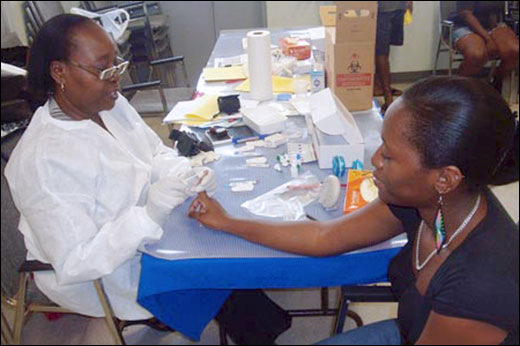
Systematic review and meta-analysis of community HIV testing programs determined that testing outside clinics and HIV testing centers raised HIV testing coverage 7-fold. Uptake of diverse community-based testing approaches was high. Facility-based HIV testing is an essential component of HIV prevention and care. But facility-based testing cannot reach all people at risk of HIV infection. Over the years, researchers and public-health authorities have innovated diverse community-based testing approaches, ranging from in-home testing to mobile testing.
To get a better understanding of how these community-based approaches work, researchers systematically reviewed PubMed, clinical trial registries, Embase, and the World Health Organization Global Index Medicus for studies of community-based HIV counseling and testing, including both randomized trials and observational studies. The investigators considered studies if they included one or more of the following outcomes: uptake, proportion receiving their first HIV test, CD4 count at diagnosis, linkage to care, HIV positivity rate, testing coverage, HIV incidence, or cost per person tested.
The 117 studies analyzed included 864,651 participants. Proportions of people who accepted HIV counseling and testing were 87% for self-testing, 87% for mobile testing, 80% for door-to-door testing, 67% for workplace testing, and 62% for school-based testing. Mobile HIV testing acceptance rates for key populations (men who have sex with men, people who inject drugs, female sex workers, and adolescents) ranged from 9% to 100%.
Compared with facility-based testing, community testing increased uptake more than 10 times (relative risk [RR] 10.65, 95% confidence interval [CI] 6.27 to 18.08), while also increasing the proportion of first-time testers (RR 1.23, 95% CI 1.06 to 1.42) and the proportion of participants with CD4 counts above 350 cells/µL (RR 1.42, 95% CI 1.16 to 1.74). HIV-positivity rate was significantly lower with community testing than with facility testing (RR 0.59, 95% CI 0.37 to 0.96).
Nearly three quarters of people who tested positive in community programs (73%, 95% CI 61% to 85%) started antiretroviral therapy after having a CD4 test that indicated eligibility by local guidelines.
Cost of these diverse community-based HIV testing approaches ranged from $2 to $126 per person. The researchers calculated that community-based testing increased testing coverage more than 7-fold (RR 7.07, 95% CI 3.52 to 14.22).
Discussing these findings, the editors of PLoS Medicine note that "the lower positivity rate of community-based HTC [HIV testing and counseling] approaches means that more people need to be tested with these approaches than with facility-based HTC to identify the same number of HIV-positive individuals." But they add that "this downside of community-based HTC is likely to be offset by the earlier identification of HIV-positive individuals, which should improve life expectancy and reduce HIV transmission at the population level."
Source: Amitabh B. Suthar, Nathan Ford, Pamela J. Bachanas, Vincent J. Wong, Jay S. Rajan, Alex K. Saltzman, Olawale Ajose, Ade O. Fakoya, Reuben M. Granich, Eyerusalem K. Negussie, Rachel C. Baggaley. Towards universal voluntary HIV testing and counselling: a systematic review and meta-analysis of community-based approaches. PLoS Medicine. 2013; 10: e1001496.
Written by Mark Mascolini on behalf of the International AIDS Society