Arizona's Reluctant Support of the Affordable Care Act Challenged by Conservatives
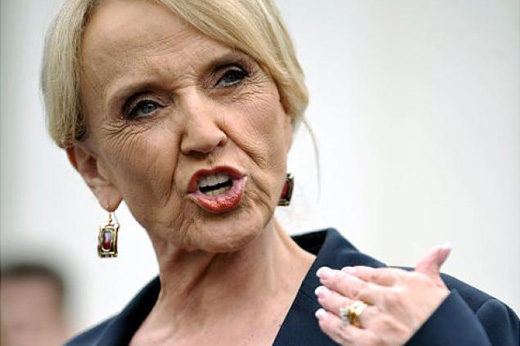
After the Supreme Court ruled to uphold the Affordable Care Act (ACA) in June 2012, Arizona Gov. Janice "Jan" K. Brewer voiced her displeasure and suggested that Arizona--like many other Republican-led states--wouldn't just go along with the program. Brewer's stance was like that of many other Republican leaders when she said in a statement (pdf): "Today's decision by the U.S. Supreme Court flies in the face of what most Americans know to be true: ObamaCare is an overreaching and unaffordable assault on states' rights and individual liberty." But to the surprise and displeasure of many conservatives, Brewer has reversed course, breaking ranks with many of her fellow Republican governors to participate in key aspects of the ACA, including Medicaid expansion, to which she had been vociferously opposed. Under the ACA, states would be able to expand access to Medicaid to cover Americans who make 133 percent of the poverty level, which is approximately $31,000 for a family of four. The expansion is optional, and many Republican-controlled states, such as Alabama and Louisiana, have refused to take part in it.
Some Arizona conservatives assumed that Brewer would do the same, but in January 2013 she surprised many when she said (pdf): "My concerns about the Affordable Care Act are well-known, but it is the law of the land. With this expansion, Arizona can leverage nearly $8 billion in federal funds over four years, save or protect thousands of quality jobs and protect our critical rural and safety-net hospitals."
Her administration pointed out that the Medicaid expansion is also expected to provide coverage for an additional 240,000 Arizonans (pdf) and the continued coverage of 50,000 childless adults. Other studies highlight other ways that the people of Arizona will benefit from the law. For example, a study by Families USA (pdf) estimates that starting in 2019, Arizonan families will be $568 better off each year than they are today.
A Political Firestorm
In June of this year, Arizona's Legislature voted to approve the Medicaid expansion, giving a political victory to Brewer despite the vocal objections of conservative lawmakers in the state. Some Arizona conservatives have even resorted to calling the state's support of the ACA "Obrewercare."
Brewer's stance on another key part of the ACA is less favorable. Under this law, residents of each state gain access to a health insurance marketplace, an exchange where Americans can shop for affordable health insurance. The states can choose to run their own exchange or can partner with the federal government to set up the exchange in time to start enrolling consumers in insurance plans by Oct. 1, 2013. If a state chooses not to set up an exchange, the U.S. Department of Health and Human Services will set up that state's exchange.
Arizona opted not to create an exchange of its own; instead, Brewer elected to participate in a federally operated exchange because of the costs, and because "I have come to the conclusion that the State of Arizona would wield little actual authority over its 'state' Exchange," she said in a statement last November (pdf).
Fight Not Over
Although Brewer signed the Medicaid expansion into law, some Arizonans who oppose the law have yet to concede defeat and want to take the issue to the voters. An organization called the United Republican Alliance of Principled Conservatives has sponsored a petition drive to get the issue put on the ballot. In order to do so, the alliance must collect 86,405 valid signatures (pdf) in support of that effort by Sept. 11, 2013.
"If they're successful, the law that was passed and signed by the governor would essentially be on hold until November 2014--the next general election," says Jaime Molera, a spokesman for Restoring Arizona, an organization that supports health-care reform in that state.
To stop that from happening, Restoring Arizona and groups such as Arizonans for Sensible Health Care Policy are educating Arizonans about why they should not sign the petition. They're also looking for any legal challenges to the petition that could help them stop it from moving forward. "We believe that at the end of the day, when Arizonans see what's at stake, [those who oppose the Affordable Care Act] are not going to be successful," Molera says. "We're just not taking anything for granted."
Tamara E. Holmes is a Washington, D.C.-based journalist who writes about health, wealth and personal growth.