AIDS Vaccine Conference 2013: Highlights From Barcelona
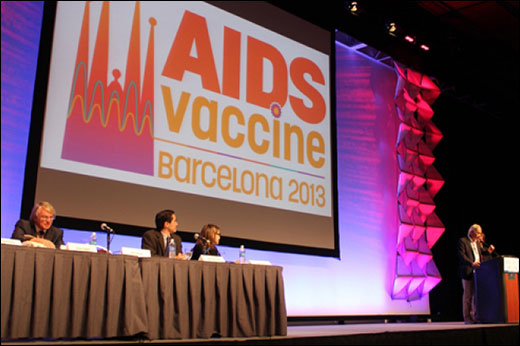
In October 1,000 scientists and activists gathered in Barcelona to discuss the state of HIV/AIDS vaccine research. And the news out of the 13th annual AIDS Vaccine 2013 conference was decidedly mixed. For African Americans, an AIDS vaccine would be a game changer. Worldwide, 2.3 million people become newly infected with the virus each year, and Africa continues to be the world's most affected region. In the United States, Blacks make up nearly half of all new HIV infections, and AIDS remains one of the top killers of both Black men and women.
Although new infections have dropped by one-third over the past decade because of improved prevention methods, even in the United States only 25 percent of PLWHA are receiving treatment to the point where the virus is "undetectable" in the bloodstream. This leaves them vulnerable to getting sick and spreading the disease to others.
The conference produced no game-changing results, but instead, the research continues to progress in fits and starts. In fact, the state of HIV/AIDS vaccine research might best be described as "hurry up and wait."
"Over the past 32 years, people have been saying we will have a vaccine in a decade," says Mitchell Warren, executive director of the AIDS Vaccine Advocacy Coalition, who attended the conference. "That's true; it just depends on when we start the clock."
Here, highlights from AIDS Vaccine 2013.
Lots of Buzz About a Promising Monkey Vaccine
Conference-goers remained cheered by recent news that an experimental vaccine "cleared" HIV in monkeys infected with the virus.
In layman's terms, cleared is as good as cured. Louis Picker, M.D., and his colleagues at Oregon Health & Science University hope to use their findings to create a vaccine that does the same in humans.
"We are not going to know until we get into humans, but the stars are aligned," Dr. Picker said during a press conference in Barcelona. "We think we have a very good chance of being able to translate this design to humans."
Dr. Picker's breakthrough reinforces the hope for an actual cure. It follows two recent cases known as the Berlin patient and the Mississippi baby. The Berlin patient, Timothy Ray Brown, was "cured" of HIV after his immune system was wiped out as part of treatment for leukemia and he then received bone marrow from a donor with an HIV-blocking mutation.
The HIV-positive baby was born to an infected mother in Mississippi, but the virus was eradicated with early and large doses of ARV drugs.
Summing up the feelings of many, William Snow, director of the Global HIV Vaccine Enterprise, called the work "a huge stride."
Building on Success
Many in the field hope to take promising vaccine research in humans a step ahead. In 2009 the RV144 trial in Thailand confirmed that an HIV vaccine reduced the risk of infection in people for the first time in history.
Next up, a set of studies known as P5 will test improved vaccine compounds in Thailand and South Africa. "P5 gives a lot of people hope by building on RV144," says Warren.
A Step Back
A new analysis, unpublished but unveiled in Barcelona, pointed toward a vaccine design that not only didn't work but actually caused harm. The pooled results of trials of three vaccines confirmed the bad news that participants in two of the three studies who received the vaccine were actually more likely to become infected with the virus than those getting a placebo. Researchers stopped all of these studies once it was clear that the vaccines weren't effective.
Although this wasn't spanking-new news, the analysis marked the first time the data from the STEP, Phambili and HVTN 505 studies--all using a virus related to the common cold--had been examined together.
Those involved in the studies took pains to look for the silver lining. "These trials tell us very important things, and the findings help us move forward," says Glenda Gray, MBBCH, FCPaeds (SA), chair of the research conducted in South Africa. "That said, every participant, whether on the placebo or the vaccine, is precious to us."
To be clear, AIDS vaccines--including the ones analyzed in the new report--do not cause infection, a common misconception. Vaccine trials work this way: Scientists recruit participants to a trial and divide them into two groups. One set receives an experimental injection that may protect against HIV, while another group is given a placebo, or "mock," vaccine.
Researchers then compare the two groups over time. Everyone in the trial receives a standard package of prevention--including safe-sex counseling, condoms and treatment for other sexually transmitted infections--to minimize the risk of contracting HIV.
The bottom line is that participants who contracted HIV during the trails got infected through unsafe sex, not as a result of the vaccine.
"The takeaway is that we cannot rely on people to change their behavior; they're going to have sex," says Steve Wakefield, director of community education for the HIV Trials Network. "It's going to take a vaccine to protect future generations from this epidemic."
Multiple Strategies: The Future of the Fight
In the meantime, prevention strategies like circumcision, microbicides, pre-exposure prophylaxis and treatment as prevention are speeding ahead of vaccines. Says Wakefield: "A combination of prevention strategies is actually the best hope to end the epidemic."
With that in mind, the AIDS Vaccine conference officially ends a 13-year run in Barcelona. Beginning October 2014, scientists and advocates from all prevention disciplines will convene together in Cape Town, South Africa, for a new conference called HIV Research for Prevention 2014. This new gathering will combine vaccine, microbicide and ARV-based science to encourage more "interconnection."
"The way the field is evolving, it's clear that to fight this disease, you need multiple interventions," says Galit Alter, Ph.D., of the Ragon Institute, an MIT-Harvard partnership. "Even hard-core vaccinologists like myself know that we have to get with the times."
Linda Villarosa runs the journalism program at City College in Harlem and writes frequently about health issues. She attended the AIDS Vaccine conference in Barcelona as a journalism fellow. Follow her on Twitter @lindavillarosa.