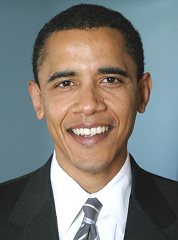
Obama Makes History
The Black AIDS Institute joins the community in celebrating the historic milestone of Sen. Barack Obama’s presumptive primary win, making him the first Black presidential nominee of a major political party. After months of often-difficult campaigning, the electoral process has worked and the Democratic Party has made its choice.
The long electoral season is not over, however. Voters must now meaningfully weigh the policy prescriptions of both Sen. Obama and Republican nominee-to-be Sen. John McCain. America faces many great challenges in the coming years, and the senators have many contrasting ideas for how to deal with them. But here’s one question that all Black voters, whether Democrat or Republican, must demand clear, complete answers to: How will the candidates end the AIDS epidemic? More than 25 years after AIDS emerged, America still does not have an overarching strategy for dealing with its own epidemic. We wisely demand that any poorer nation asking for our help in fighting AIDS first come up with just such a plan, yet our national response remains haphazard. No wonder the U.S. epidemic is now larger than ever, at an estimated 1.2 million people infected. And no wonder the impact has become so lopsided, with Blacks accounting for nearly half of those newly infected every year. In November 2007, the Black AIDS Institute surveyed all announced candidates in both parties and reviewed their public records on AIDS. The report, We Demand Accountability, found striking differences between the Republican and Democratic fields, with all Democratic candidates being far more likely to have stated or shown decisive support for strategies to end the epidemic. But questions remain unanswered for both Sens. Obama and McCain. Laudably, Sen. Obama long ago published his plan for dealing with AIDS. In it, he vows to craft and begin implementing “in the first year of his presidency … a comprehensive, HIV/AIDS strategy that includes all federal agencies.” Sen. Obama has also pledged to support both syringe exchange programs and comprehensive sex education in schools, as well as to end the federal government’s promotion of abstinence-only sex education. Meanwhile, he as led by example on the urgent issue of Black Americans learning their HIV status. During a 2006 trip through sub-Saharan Africa, Sen. Obama took an HIV test with his wife Michelle and has continued to use his bully pulpit to highlight the need for HIV testing. On treatment access, Sen. Obama’s AIDS platform declares his "strong support" for the Ryan White CARE Act, which is the primary vehicle for federal funding of the AIDS care safety net, and he has cosponsored a bill to make Medicaid more accessible to people living with HIV. But his platform’s primary solution to the building AIDS treatment crisis in America is the broader health care reform he has proposed. While AIDS certainly must be addressed holistically, voters must insist Sen. Obama explain what he will do to ensure poor and uninsured people living with HIV/AIDS get access to life-saving treatment now, whether his broader reforms are passed or not. Sen. McCain, meanwhile, has said little about how he will respond to the epidemic. He has not published an AIDS platform and has not answered queries from several AIDS organization, the Institute included. As a long-serving senator, his record is similarly sparse. Though he was an original cosponsor of the CARE Act, he has not been meaningfully involved in AIDS treatment policymaking since. Nor has he supported efforts to expand Medicaid access to people living with HIV. Sen. McCain has however repeatedly backed legislation that discriminates against people living with HIV/AIDS. He has supported the existing ban people living with the virus entering the U.S.; a bill seeking to involuntarily test patients for HIV before surgery; and one seeking to imprison HIV-positive health care workers who participate in surgery. (Standard safety procedures for all surgeries remove risk of HIV transmission between doctor and patient.) Republican voters must demand Sen. McCain explain his thoughts on these troubling positions and, more to the point, outline his strategy for ending the epidemic in America. To learn more about the records and positions of Sens. Obama and McCain, and to read a primer of what questions Black voters should demand any candidate answer about AIDS, check out our report, We Demand Accountability, at www.BlackAIDS.org.