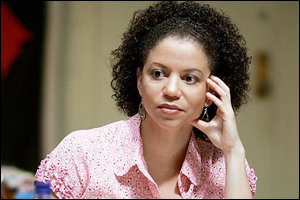
‘Life Support’ star Gloria Reuben speaks out on HIV/AIDS In the acclaimed HBO movie “Life Support,” Gloria Reuben plays the director of a real-life nonprofit AIDS outreach organization.
By Chris Bournea
COLUMBUS, Ohio -- Actress Gloria Reuben, known for her groundbreaking work as television’s first HIV-positive character in a regularly occurring role, is also an outspoken HIV/AIDS activist. Since being cast as Dr. Jeanie Boulet on the long-running medical drama “ER” in 1995, Reuben has used her notoriety to bring awareness to the AIDS epidemic around the world. Reuben stars alongside Queen Latifah in the critically acclaimed HBO movie “Life Support,” which has also helped promote dialogue about HIV/AIDS. Inspired by the real-life story of African-American director and co-writer Nelson George’s sister, Andrea, “Life Support” uses a mix of actors and real people from the HIV/AIDS community. The film tells the story of an HIV-positive Brooklyn woman named Ana (Queen Latifah), who channels her energy and regret over contracting HIV through past drug addiction into working for an AIDS outreach organization called Life Force. Reuben plays the director of Life Support. A Toronto native and daughter of a black mother and a white Canadian father, Reuben is also an accomplished singer-songwriter. She left “ER” in 1999 to pursue a music career -- including a stint singing backup on superstar Tina Turner’s farewell world tour. Throughout her career as an entertainer, Reuben has used the spotlight to speak out for increased HIV/AIDS education, testing and medical research. Her high-profile appearances include introducing then-United Nations secretary-general Kofi Annan at the 2004 U.N. World’s AIDS Day convocation and delivering the keynote address at the 2005 Black Women’s Conference on HIV/AIDS in Los Angeles. In an exclusive interview with BlackAIDS.org, Reuben discussed her role in “Life Support” and her ongoing HIV/AIDS advocacy. BA: When did you become an HIV/AIDS activist? Was it when you joined the cast of “ER?” GR: It was definitely during that time, primarily because of the storyline. It definitely started there. I think it started with the Pediatric AIDS Foundation. There were a lot of foundations that came forward to have me get involved. It really was a great way to find out what people were doing and get involved. I found out about the medicines and the work people were doing. BA: Appearing as an HIV-positive character on a television show that became a global phenomenon, did you feel a responsibility to represent the HIV/AIDS community? GR: It’s not like you’re doing a sitcom. It’s not like doing “Friends,” where you can revel in the success of the show. It’s a huge responsibility to take on. With the stigma that still revolves around the virus, I think there was a real stigma attached to me in playing the role. Hollywood can be incredibly closed-minded about what you do for work, versus what you do in your personal life. BA: You mentioned that you still receive letters and e-mails and are approached by people about how your role on “ER” affected them, since the show reruns several times a day in global syndication. Do you think that demonstrates the power of the media, particularly television, to shed light on HIV/AIDS and other important issues? GR: I think that’s a prime example of how powerful it can be. Of course, it’s entertainment. It is, and yet it’s more than that. When it’s dealing with something like this, then it crosses that line from just being entertainment. BA: At a recent speaking engagement at Ohio Wesleyan University, you described the long battle you had with “ER” producers, who suggested that your character die of HIV-related complications when you decided to leave the show. Although you were threatened with legal action, you said you were adamant that the producers honor your original agreement that Jeanie Boulet would never die from AIDS. Ultimately, your character left on a positive note, having gotten married and adopted a baby. Why was it so important to you to take that stand? BA: How did you get involved with the HBO movie “Life Support”? GR: I’m an executive producer on “Padre Nuestro,” (a critically-acclaimed independent film) which won the grand prize at Sundance Film Festival this year. We were editing the film at PostWorks, which is the best production house in New York City. So we’re editing this movie and directly across the hall from us, Nelson George was casting “Life Support.” He and I saw each other in the hallway quite often. We walked into the building at the same time, rode up on the elevator together and he filled me in on the story, which is based on his sister, and Queen Latifah was playing the role. I was like, ‘Look, I gotta be in this movie. Man. It’s way too important. It’s what I do. It’s no accident that we’re literally across the hall from each other.’ BA: Is it true that HBO sponsored screenings of the film in communities around the country where you, Queen Latifah and other cast members appeared and discussed prevention methods, treatments and other issues surrounding HIV/AIDS? GR: HBO has been very supportive. They’re using (the film) as a tool to go into communities. We had a screening in Philly with grassroots organizations and it was open to the public, so the public could come for free. BA: Has the movie helped raise the profile of Life Force, the real-life nonprofit organization that Queen Latifah’s character works for in the film? GR: If it wasn’t for outreach programs like this, people would have to go to hospitals (to obtain information about HIV/AIDS). Who’s going to go to a hospital to talk to somebody or find out information? It’s way too overwhelming and way too impersonal. (Life Force workers), they’re out there on a daily basis, handing out condoms, doing important things. The ironic thing is Life Support is on the verge of being shut down. People are rallying around it, helping to get grants and additional funding to stay open. BA: In your research on HIV/AIDS, have you found any answers as to why the African-American community has been disproportionately affected? GR: It’s such a huge, complex issue. Societal and cultural influences are such that, it perpetuates the stigma. If we look at, for the most part, the hip-hop culture, when it’s all about having sex and women are just there to have sex with -- having sex with as many people as possible, sex all the time, no protection, blah, blah, blah. If we look at economics, if you’re not educated and you don’t have a job, you’re going to end up in jail. It’s about the homophobia, it’s just unbelievable. The stigma around homophobia in the Black and Latino communities is unbelievable -- you gotta put on a front and have sex on the ‘down-low.’ The shame and stigma around it perpetuates the shame and stigma around HIV/AIDS. What ends up happening is clearly the double life that goes on. BA: What can be done to help bring down the HIV/AIDS infection rates among African Americans? GR: It’s as quick as a phone call, to get a mobile (testing) unit to come to the church on Sunday. BA: Why does there seem to be so much misinformation about HIV/AIDS, especially in the African-American community? BA: Do you think part of the reason why the African-American community is disproportionately affected by HIV/AIDS is that people are afraid to get tested and discover they’re HIV-positive? GR: If it turns out that you’re positive, there’s so much more access and medicine and information (than in the past). The chances of extending your life are so much better. But you have to get tested and find out. The sooner you find out, the sooner you can get started in treating it and managing the disease. BA: Do you think rapid testing has helped, since people don’t have to wait days or weeks to find out their results? GR: The rapid testing is a wonderful thing. You can sit for 20 minutes, you read up (about HIV/AIDS), and you talk to a counselor right then and there. That’s why foundations like Life Support, outreach programs, are so vital. BA: When you appeared at Ohio Wesleyan, you mentioned that HIV/AIDS is the No. 1 killer among African-American women ages 25 to 34. Do you think HIV/AIDS would get more media coverage if the infection rates were as high among white women? GR: No doubt, if the numbers were like this with white women, first and foremost, at the very least, people would know about it. BA: AIDS was once perceived as a gay white male disease. What did gay white activists do in the 1980s, when the disease first came to public attention, to raise awareness and funding that can be replicated by the African-American community? GR: We need to learn by example from that first group where the pandemic started. We need to mobilize and stand up as a group and not deny what’s going on, but raise our voices.