Mobilization
By Dennis Freeman
Read a full list of the participating organizations. SCOTTSDALE, Ariz. -- Black leaders say they are on the move. They have seen enough. They’ve seen enough dying. They’ve seen enough suffering. They’ve seen enough labeling that comes with the stigma associated with the HIV/AIDS virus. During a recent three-day National Black Leader’s AIDS Mobilization Strategic Planning Summit, the leaders said they are ready to put an end to the AIDS epidemic in Black America. Leaders representing 16 national civil rights, social, media, political, and faith-based organizations discussed strategies for decreasing HIV infection rates, increasing the percentage of Blacks who know their HIV status, increase the percentage of HIV-positive blacks in appropriate care and eliminating the stigma attached to the disease. The organizations, including the NAACP, the National Urban League, 100 Black Men of America, Rainbow/Push Coalition, the Congressional Black Caucus Foundation, the National Coalition of 100 Black Women and the National Newspaper Publisher’s Association, came together to strategize and plan ways to end the AIDS epidemic in Black America in five years. “This strategic summit is a response to a national call to action issued by Black leaders last August at the International AIDS Conference in Toronto,” said Phill Wilson, executive director of the Black AIDS Institute, a national HIV/AIDS think tank focused on Black people. “AIDS in America today is a Black disease. “The goal of this meeting is to develop strategic action plans for these organizations. These groups have taken a huge step toward following thru on their commitments to end HIV/AIDS in our communities. I know our goal is an ambitious one, but anything less than that is immoral,” said Wilson, from his office in Los Angeles. Panel discussions covered women and HIV, the role of the faith-based community and media organizations. The leaders identified three goals: reduce the HIV rate among black people over the next five years, increase the number of African Americans who know their HIV status and improve medical care services for those infected. Of the estimated 184,991 adult and adolescent HIV infections diagnosed during 2001—2005 in 33 states, more than 51 percent occurred among blacks. Blacks accounted for 48 percent of the new diagnoses of persons between 25 and 44 years of age. Most of these individuals were diagnosed with the disease when they were between 13 and 24 years old. And African American women are becoming the statistical leader, representing nearly 70 percent of new HIV cases diagnosed in females. Getting significant members of the Black community involved in the solution is the only way to solve the problem, speakers and participants said. Grazelle Howard, first vice president of the National Coalition of Black Women, said it is imperative that black women get out in front on this issue. “Black women are the moral and conscious voice of our community,” said Howard. “Black women are the grapevine in our community. But there seems to be a reluctance to accept our role. We need to start telling stories about ourselves. Black women are knowledgeable about every other subject in the black community except this one. If black people, in particular black women, do not pick up the bale of HIV/AIDS, we will be extinct. HIV/AIDS in America is domestic Darfur.”
Pernessa Seele, who in 1989 founded the New York-based Balm in Gilead as a way to involve the black church in the HIV prevention movement, said the faith-based community should be leading the charge as well. Seale said if the church does not take a leading role on this cause the black community will suffer. “The church must be at the forefront of this movement,” Seele said. “Without the church there is no movement. Churches weren’t having conversations about [HIV/AIDS] testing in 1989. The church is coming around because the black community is coming around.”
The summit was convened by the Black AIDS Institute, the Balm in Gilead, the Black Leadership Commission on AIDS, and the Magic Johnson Foundation. Civil rights advocates committed to developing HIV/AIDS policy statements for their organizations and mounting a national joint billboard campaign to further the message. AIDS advocates are planning to sponsor briefing sessions to educate all the presidential campaigns about the AIDS epidemic in Black America. Faith leaders, philanthropists and members of the media, suggestions ranged from launching public service announcements, sponsoring town hall meetings, setting annual testing goals, mobilizing Black youth utilizing hip-hop music, and engaging Black men. Tony Wafford, attending the conference on behalf of Rev. Al Sharpton’s National Action Network, said the lack of conversation between straight and gay black men stymies the HIV prevention conversation. “My goal is to get as many heterosexual men as possible to talk about this. Many of them are uncomfortable with men who have sex with other men. That’s just one part of this problem,” said Wafford, who has been working in HIV prevention since 1998. ”We need to have a family conversation. But unless we have real conversations about this, we’re going to die.” Wafford said he hopes to generate that conversation by getting black men in barbershops talking about the issues. Bev Smith, an on-air personality on American Urban Radio Networks, said by and large, the black media has failed its own community when it comes to reporting on HIV/AIDS, despite a recent upheaval of stories focusing on the disease. Smith, who led a panel discussion on “AIDS and the Black Media,” along with journalist George Curry, said black media is still falling short today on its HIV/AIDS coverage. “We have to be the voice to start the action,” Smith said. “I think that we [black media] are too reactionary. It should be our job to report the story. AIDS is something we don’t want to talk about. The black media has an opportunity to put a real face, to humanize this issue. The black media did not report the story, and we are still not reporting the story.” Curry, editor-in-chief of the National Newspaper Publishers Association, which disseminates information and news to more than 200 black newspapers across the country, said the black media has to personalize HIV/AIDS stories, which would draw in more readers, he said. “I think we’ve turned around, in terms of the black press,” Curry said. “But we have to tailor this message, take this story to the people. We’ve got to humanize it.” Dr. Nicole McCann, who serves as director of counseling services at The Potter’s House, which is presided over by Bishop T.D. Jakes, said the church community has come around to take on a more active role in the fight against HIV/AIDS, despite its initial slow response. The Potter’s House, McCann said, has had an HIV/AIDS program at the Dallas, Texas-based church for the past 11 years. “I think the faith-based communities, especially the black community, are stepping up its efforts against HIV/AIDS,” McCann said.
The summit began with actor Danny Glover, a longtime AIDS activist, addressing conveners as a reception host. Glover said he has seen people all around him die from AIDS. Whether it is friends, fellow actors or a child in Africa, Glover, has seen their misery. And what he sees is the black community being ravaged by the HIV/AIDS virus. Glover said the urgency to get something done is imminent.
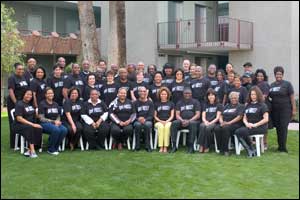
"I approach this fight on a couple of levels, and they all have some personal implications," said Glover,who has a brother afflicted with the disease. "You're able to participate or become more adamant about something when you're able to connect it to yourself personally. First of all, I've lost many friends from this pandemic. The second thing, the pandemic has had enormous ramifications in my community. My community extends beyond the artists I have performed with, but particularly with African Americans." Sixteen national black organizations participated in a three-day summit at the Hotel Valley Ho in Scottsdale, Ariz., from March 22-25 to develop strategies to end the AIDS epidemic in Black America in five years. The organizations were: African Methodist Episcopal Church, Women's Missionary Society
National Black AIDS Mobilization Strategic Planning Session
American Urban Radio Networks
Congressional Black Caucus Foundation
Metropolitan Interdenominational Church
National Action Network
National Association for the Advancement of Colored People
National Black Caucus of State Legislators
National Black Justice Coalition
National Coalition of 100 Black Women
National Coalition of Pastors’ Spouses
National Council of Negro Women
National Newspaper Publishers Association
National Urban League
100 Black Men of America
Rainbow/PUSH Coalition, Inc.
The Potter’s House and T.D. Jake's Ministry