Diaspora
By Yvonne Barlow
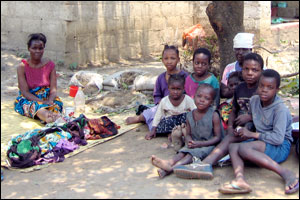
LUSAKA, ZAMBIA -- Justina Mwansa is a widow with two children. She lives in a one-room home, which she shares with her mother and eight orphans that were left with her after relatives died of AIDS. Mwansa earns a living washing the laundry of middle class Zambians, and she sells whatever she can grow from her garden. But, for a few hours each day, Mwansa steps away from her difficult life and volunteers to care for three neighbors suffering from AIDS. She bathes, feeds and ensures they take their medicines. “I want to take care of friends who are sick. It is like God’s work and I want to do this work,” she said. A few hundred yards away lives Lomance Phiri, a widow with seven children and five orphans under her guardianship. Phiri also volunteers to care for AIDS sufferers. “I nursed my husband when he died of TB and wanted to learn to give that care to others,” Phiri said. The women were trained by VK Home-Based Care, a grassroots organization based in Garden Township, a dusty settlement of around 150,000 people on the outskirts of Lusaka. Elsie Choompa, the director, is a nurse who runs the VK medical clinic in Garden Township. She takes no pay and neither does her assistant, Peter Kalemeera, who coordinates the needs of those seeking help with those volunteering assistance. The project started in 2002 after a friend asked Choompa to help a relative dying of AIDS. Choompa’s own sister was also dying from the disease and she realized that care in the home was far better than any assistance given at overstretched hospitals. At the beginning, she ran the volunteer project while keeping a part-time nursing job, but as more people needed help, she was forced to resign from paid employment. She and her three young daughters live on financial support from her ex-husband. She said it would be nice to have an income but, “It is better to see the project work, to see patients recover, see their lives improve.” Kalameera initially began volunteering for the VK project after his son was diagnosed with HIV. He was a social development worker with foreign charities for 25 years, and when his contract ended, he offered his time to the VK project. His family lives on his wife’s earnings. He said life is hard. “We struggle to eat and, once in a while, I write a project proposal for a group to earn a little bit of money.” But he believes the project is vital. “It is important for the client that new ideas of home-based care do not collapse,” he said. Many of their clients are sick and alone with no one to ensure they eat well or take their medicines. VK provides caregivers with a 10-day training program in which they learn about basic nursing care and how to recognize complications of AIDS. Anna Wilima was ill with HIV and tuberculosis when Kalameera found her a caregiver. The widow lived with her daughter, who worked long hours in order to pay for rent and keep. As a result, Wilima was alone for much of the day. Her weight dropped to 44 kilograms and her immunity to infection was desperately low. She would often take her ARV medicines on an empty stomach, which would make her feel sick and dizzy. “I wanted to collapse,” she said. VK found Wilima a caregiver and, after two months, she is gaining weight and feeling stronger. When she is well she said she wants to train to be a care giver. News of the group’s work is spreading and other communities are copying the idea, according to Maurice Shakwamba, who facilitates HIV programs for Voluntary Services Overseas in Zambia. “It works well,” Choompa said. “Patients are always happier in their own homes, and others are learning about HIV and not to be afraid.”