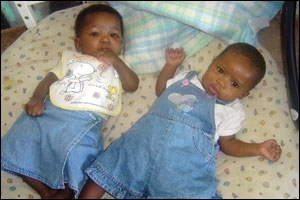
MASEUR, LESOTHO -- The Beautiful Gate Orphanage has 20-25 infants and toddlers under 5 years old. Most of the babies are abandoned on streets are in hospitals. Some are among the more than 25,000 HIV positive children born in the country each year.
Commentary
By Sharon Egiebor
It’s easy to sit back and criticize Madonna’s actions when she adopted 13-month-old David Banda from Malawi. She appeared to pay her way through the adoption process by offering more than $3 million in donations to the country, and she didn’t wait the obligatory 18 months before moving the toddler from a rural Malawi village to her luxurious home in London. The criticism was so negative that Madonna apparently felt compelled to do an “Oprah” interview to explain herself. However, she did a really good deed – reawakening the world’s attention to the millions of orphans and vulnerable children in third world countries. The United Nations estimates that there are over a million orphans in Malawi, half of whom have lost one or both parents to AIDS, according to the UN Children's Fund (UNICEF). Between 1990 and 2000, an estimated 6.4 million children in Eastern and Southern Africa lost their mother or both parents to AIDS. Another 3 million children in West and Central Africa lost parents. Little David’s mother died shortly after his birth from complications of malaria, one of the three major diseases tied to poverty and death rates in many of these countries –HIV/AIDS, tuberculosis and malaria. "However, this does not mean that the extended family system is falling apart or disintegrating,” Penson Kilembe, director of Social Welfare in the Malawi Ministry of Women and Child Development told IRIN News in October. “If this were the case, then we would have many children in the streets or in the orphanage homes.” The extended family system is a strong tradition in the Southern African country, but almost half the population struggles to live on less than US$1 a day, HIV/AIDS affects nearly a million of Malawi's 12 million people, including 83,000 children, and nearly a third of infected mothers pass the virus to their babies. IRIN reported. David’s father Yohane Banda said he placed the child in an orphanage because he could not afford to care for him. Last year, I visited Maseru, Lesotho where my colleagues and I toured the Beautiful Gate Lesotho Orphanage, an organization operated by international and interdenominational Christian missionaries. On any given day they have between 21 and 25 children between the ages of 1 week and 3 years old, says Roy Haakensen, who co-founded the orphanage with his wife Sue in 2001. The agency is temporarily housed in a rented light and airy, multi-level home. The courtyard was sunny, and the infants were clean and comfortable. The agency hires Lesotho women to care for the children thereby exposing them daily to Lesotho culture.
The women rock the babies, feed them and speak to them in their native tongue. On the day we visited, Sue Haakensen showed off the dozens of bottles in the refrigerator, the infant room and the toddler room. She explained the daily care rituals and discussed their goal to find the extended family that would be willing to adopt the children.
There is a four-star chart system on the wall – Red for children who may have family and have been in care less than three months; blue for children undergoing the adoption process; green for those newly adopted; and no star for children who are available for adoption. Sometimes the mother died without leaving next of kin information. Other times, the babies were founded abandoned along sewer filled gullies that flow through the mountainous neighborhoods. It was hard looking into the soft, sweet faces and walking away. So for 20 minutes, I didn’t. I sat down in the enclosed playpen, located in the garage outside and with a 3-year-old boy and attempted to play. I pulled out the car and went zoom. He looked at me. I picked up blocks and stacked them. He looked at me. No smile, no acknowledgement of my presence and most hurtful, no joy. During the hour that we stayed on the compound the little boy never smiled and barely spoke. They’re missing what children need most, parents. I could see how Madonna, who has the where with all and the social clout, was so quickly taken with young David. Who could turn away, knowing the dire need the children are in? But the thing Madonna didn’t consider was the cultural and family ties each child is entitled to. Of course, David will live in the lap of luxury, but how will he learn his native tongue of , who will teach him the country’s history and how realistic is it to expect Madonna to return on a regular basis for David to maintain a close relationship with his natural father and extended family? Taken the children home is an arrogant European concept that says the West knows what is best for everyone. Unfortunately, we don’t. The Family Health International and other agencies that are working to meet the needs of orphans and other vulnerable children suggest a more comprehensive approach. Changes in government policies and law; Better medical care, socioeconomic support, psychological support, education, human rights and solid, community based programs. There is no quick fix to the problem and money alone won’t fix it. At Beautiful Gate, they accept volunteers who with the proper training can spend months helping to fulfill the needs of the orphanage. When I returned from South Africa last year, I issued a plea to my family and friends. Join the problem solvers. We can’t all be Madonna, but we can be a helping hand.