News 2009
Institute Staff Travel the Nation to Represent on World AIDS Day
The Institute Participates in World AIDS Day
The Institute staff traveled the nation to represent on World AIDS Day 2009.
CEO and Founder Phill Wilson participated in local and national radio shows including a panel discussion on WNYC Radio with Dr. Monica Sweeney and a segment on the Bev Smith Show. Wilson took the opportunity to address the disproportionate affect of HIV/AIDS on the Black populace and to also address the need for Blacks to be included in the National AIDS Strategy. Wilson also attend former President Bill Clinton’s World AIDS Day event at Columbia University in New York. Institute Training and Capacity Manager Raniyah Abdus-Samad attended the National Council of Negro Women (NCNW) Conference in Washington D.C. Abdus-Samad coordinated HIV testing for conference participants; conducted a training for NCNW Collegiate Sections on how to create HIV/AIDS programming on their campuses; and participated in one-on-one planning with various sections (chapters) on how to create HIV/AIDS programming within their chapter. Further down south the Institute’s Director of Programs Charlie Baran attended a World AIDS event at Philander Smith College (and HBCU) with the Arkansas Minority Health Commission ED Idonia Trotter, the HIV/AIDS Section Director Kevin Dedner of the state health department, and other local community agencies. Jefferson Comprehensive Care System, Inc. provided HIV testing for nearly 200 students attending the event. On the home front, Institute Mobilization Manager Chris Bland attended a Los Angeles hearing held by the Assembly Health Committee, chaired by Assembly member Dave Jones, on AIDS funding for California. Bland provided testimony concerning what the Institute’s programs do and how they are affected by recent budget problems.
Seasonal Tune-Up: 4 Ways to Strengthen Your Immune System
Protecting your immune system is always essential when you have HIV. It's particularly important during the holiday season, when family (or lack of it), financial challenges, holiday preparations, weather changes and end-of-the-year work demands create the perfect storm of stress. But even if you're feeling frazzled, you don't have to get sick. We asked nurse-naturopath Roni DeLuz, RN, ND, PhD, to share some holistic approaches to keeping immune systems strong. (As always, check with your health provider before implementing them.)
Green drinks. Whether you order one at the juice stand, purchase it in powdered form at the health-food store or whip one up fresh at home, drinking your vegetables allows you to consume more nutrients per swallow than chewing. Green drinks detoxify the body, cleansing the blood of toxins, poisons and harmful buildups caused by artificial chemicals in food, pharmaceutical drugs and the environment. They are also excellent sources of vitamins and minerals; antioxidants, which fight immune-damaging free radicals; chlorophyll, an excellent detoxifier; enzymes, which help the digestive process – all of which are good for immune health. Making a green drink at home is as easy as combining green veggies of your choice into a food processor, juicer or blender. Wheatgrass, a particularly powerful food available in health-food stores, requires special equipment. But word to the wise: if you normally consume a lot of fast- and processed foods, stay close to the bathroom in case your body detoxifies quickly, causing you to have a bowel movement. Cost: varies widely, from roughly 25 cents to over a dollar a day. Antioxidant berry drink. Raspberry, blueberry, pomegranate, grape, blackberry, Gogi berry, cranberry -- nothing tastes more delicious than a drink of fresh berry juice. Berry juice offers several servings of nutrition in one small, enjoyable dose and increases your immune function by stopping free-radical damage and pumping your body full of antioxidants. Too busy to juice? Buy powdered red-drink online or at your health-food store. Cost: varies widely; plan on spending 50 cents per serving. Food (digestive) enzymes. As we age or when we experience a chronic illness, our body loses digestive enzymes. We metabolize food less effectively, our cells, tissues and muscles miss vital nutrients they need to function optimally, and our immune system, most of which is located in and around our gut, doesn't function as well. Digestive-enzyme supplements can offset this loss, greatly improving digestion, increasing our resistance to viruses, eliminating toxins, destroying free radicals, reducing inflammation and helping to cleanse the digestive tract. They are also inexpensive, typically costing less than 25 cents daily. Consume 500 mg five minutes before or after meals. Available at health-food stores. (Note: In most cases digestive enzymes can safely be taken with medications; however, check with your health provider first.) Glutathione. Research suggests that maintaining healthy levels of the peptide glutathione may slow the AIDS' progression. Glutathione enhances our white blood cells' ability to destroy viruses and cancer. The human liver produces glutathione naturally, but our bodies produce less as we age. A typical dosage of 500 mg daily costs $15-$20 per month at most health-food stores. There are no established side effects. Glenn Ellis is a Philadelphia-based health writer and lecturer (www.glennellis.com).
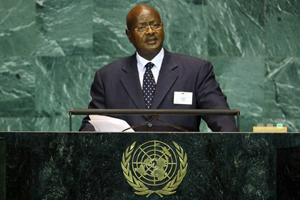
Uganda’s Proposed Anti-Gay Law Triggers Worldwide Outcry
International news services report that the Ugandan government is considering legislation that could make homosexuality punishable by death.
Homosexuality is already a crime in that nation – those caught engaging in gay sex can be imprisoned for life. But “The Anti-Homosexuality Bill 2009,” introduced last month, proposes that “repeat offenders” of homosexuality be executed. It also calls for the execution of gay men found guilty of "aggravated homosexuality," a charge that would be applied to those who are HIV positive, or who have sex with someone who is under 18 or disabled. The new bill would penalize any Ugandan attempting a gay “offense” with up to seven years in jail, no matter where they live in the world (which would mean they could face extradition). Plus, Ugandan inmates would be tested for HIV, and, if they are found to have it, would be put to death. Even heterosexuals with knowledge of homosexual acts would be at risk: the legislation calls for prison sentences for straight people who fail to report gay activity to the police within twenty-four hours. Some international gay activists, who fear the bill will prompt a witchhunt against the gay Ugandan community that could ultimately devolve into genocide, call the new legislation “evil.” “It is very difficult for me to overstate how potentially devastating this legislation is,” says Kevin Frost, CEO of amFAR, the foundation for AIDS research. “It’s bad enough that it criminalizes the lives of Ugandans and punishes them rather than protects them. It goes so far to make amfAR’s work in Uganda illegal because we’re funding men who have sex with men outreach groups on the ground there. It would threaten any of our staff that travels there. They could be arrested and imprisoned.” This is a problem, according to civil rights activists, because although the prevalence rate for HIV among adults in Uganda is only somewhere between 5 and 6 percent, this may not last if gay people don’t feel safe enough to openly seek preventative care. “Uganda is usually credited for effectively controlling transmission with active, early interventions,” says Ryan Thoreson with the International Gay and Lesbian Human Rights Commission. “It's part of the reason so many partners and donors are now alarmed. With the passage of this bill, the government would be rejecting a rational, epidemiologically-sound approach and letting politics and fundamentalism dictate their strategy for prevention, treatment, and care.” Some blame a privately funded group known as “The Family" – one of the most powerful Christian fundamentalist organizations in the United States, whose members reportedly include South Carolina Governor Mark Sanford, Senators Sam Brownback and Strom Thurmond and other influential U.S. leaders – for fueling the homophobic legislation, which may not be voted on for several months. The group is accused of using its heavy influence and funds through African-outreach programs to support the law. However, several nations have threatened to cut aid to Uganda if the bill passes – among them Canada, Sweden and the United Kingdom, some of Uganda’s largest donors following the United States. Uganda literally can’t afford to see this happen – it’s estimated that in years past, between 30 to 50 percent of the country’s budget came from foreign aid, the World Bank and other institutions. At this point, activists say, the power ultimately lies in the hands of Ugandan president Yoweri Kaguta Museveni, who has not publicly expressed his support of the bill but is said to be staunchly opposed to gay rights. They hope that with enough international pressure the bill in its current state will never make it onto the parliamentary floor. “Without even focusing on the worst aspects of the bill, this could still be a really repressive piece of legislation,” says Thoreson. “This bill puts HIV/AIDS organizations in a pretty precarious position, and is likely to hamper prevention efforts for every sector of the Ugandan population.” “Organizations like UNAIDs are working on this but I think what Americans need to do is call and speak to their congressmen and senators; reach out to the state department directly. Our leaders need to know that we expect the policies surrounding HIV and AIDS in this country to be reflected in our commitment to civil rights –human rights – overseas.” Tomika Anderson is a freelance writer who has been published in such outlets as POZ, Health.com, Essence and UPTOWN.
From “The Miracle of Uganda” to Impending Genocidal Nightmare
The Ugandan Parliament is considering legislation that completely violates any standard of human rights. The bill would not only criminalize being gay – exposing gay and lesbian people to arrest and even death – it would also, in effect, criminalize even knowing someone who's gay, requiring that nation's citizens to report homosexual activity or face imprisonment themselves.
If this pending legislation passes, it will totally undermine HIV/AIDS efforts in a nation whose previous interventions have resulted in comparatively low AIDS rates, giving rise to the phrase "the Ugandan miracle." People who already have AIDS would be subject to tremendous stigma, as would those at risk for HIV. What's more, it would call into question whether Uganda is a place where the United States can continue to invest PEPFAR or other development dollars. Most importantly, the passage of these laws would set people up for sexual-orientation-based "ethnic cleansing," including witch hunts that pit family member against family member, neighbor against neighbor, as previously happened in Rwanda. So far, the U.S. response to these proposed statues can only be described as timid as best. But we call upon the United States government to stand by its commitments to human rights and against HIV/AIDS. There is no room for neutrality. We would be loud and forceful if the Ugandan Parliament introduced a bill that made it illegal to be female with the potential penalty being death. Our response to this legislation should be no less. The State Department should declare its opposition to this legislation without delay. Ambassador Goosby must make it clear to the highest levels of the Ugandan health ministry that passage of such legislation would have severe consequences. Uganda has been held up as role model for how developing countries can create public policies that change the trajectory of the AIDS pandemic. It would be tragic to allow this type of hate-filled policy to derail those efforts. There are been too many times in our nation's past when, given the opportunity to intervene in time to avert disaster, we were slow or too timid. Let’s not repeat those mistakes here.

The Institute’s African American HIV University (AAHU) Community Mobilization College is now accepting applications
AAHU Community Mobilization College Open Enrollment
The Institute’s African American HIV University (AAHU) Community Mobilization College is now accepting applications
The Black AIDS Institute is pleased to announce that we are accepting applications for our flagship training and capacity building program the African American HIV University (AAHU) Community Mobilization College (CMC) 2010 class. Leadership in the Black HIV/AIDS community is vital to the mobilization of Black people and institutions towards ending the devastating impact of HIV and AIDS. The AAHU CMC is an intensive program that builds organizational capacity and individual leadership skills to change the trajectory of this epidemic in Black communities. This is a historic and necessary mission. The AAHU CMC utilizes a Community Mobilization Model to enhance the capacity of Black communities to address the HIV/AIDS epidemic. Through building the knowledge and networks of community leaders around the country and providing a skills-building internship practicum focused on community mobilization, individuals become capable of engaging traditional Black institutions and other stakeholders in local level community activities that will increase access to and utilization of HIV prevention services in their communities. AAHU CMC runs for approximately 11 months. By the end of the fellowship AAHU CMC, organizations and their Fellows (organizational conduit for information) will be stewards of a living, breathing mobilization campaign which they have visualized, cultivated, and shepherded. In addition, attendees will have the skill set and networks to do it all again. On behalf of the Institute, we look forward to receiving applications and are excited about training the next cadre of leaders in the fight against AIDS in Black America. Please click here for more information and to complete your AAHU CMC application. Applications are due by February 5, 2010 or contact the Institute’s Training and Capacity Building Manger Raniyah Abdus-Samad at 213-353-3610, ext. 123.