News 2010
Is the National HIV/AIDS Strategy Good for Black Americans? Part 1: Reducing HIV Incidence
When the Obama administration released the National HIV/AIDS Strategy (NHAS) in July, the activist group Coalition for a National AIDS Strategy described it as "one of the most anticipated moments" in the domestic fight against HIV/AIDS. The four-part plan refocuses resources on the domestic epidemic and prioritizes Black Americans, which means that Black people stand to gain a lot--at least in theory. Read on to learn how Black folks may be affected by the first part of the plan: reducing new HIV infections.
Experts Gather in Philadelphia to Discuss Philadelphia AIDS

AIDS-service organization BEBASHI Transition to Hope hosted two panel discussions on August 25 to discuss the potential impact of the National HIV/AIDS Strategy (NHAS) on Black Americans and also to share findings from the 18th International AIDS Conference (AIDS 2010), held in Vienna, Austria, this past July. A National AIDS Strategy, But Where Is the Funding?
James Albino, senior program manager of the White House's Office of National AIDS Policy, gave an overview of the Obama administration's new strategy. The plan has three primary goals:
- Reduce the number of people infected by HIV;
- Increase access to care and optimizing health outcomes for people with HIV;
- Decrease HIV-related health disparities.
The NHAS calls for the annual number of new infections to be reduced by 25 percent by 2015.
"We have communities that are at high risk, that have been living in the shadows for too long, and we need to develop strategies that track where the epidemic is," said Albino. "We hope to realign resources that target those populations. We are looking at intensifying prevention efforts in communities."
According to Albino, an additional $30 million in federal funding will be allotted for HIV prevention, most focused toward gay and bisexual men of all ethnicities and African American men and women.
However, panel member Jesse Milan Jr., vice president and director of Altarum Institute, a nonprofit that conducts health-systems research, countered that the $30 million is not enough funding to reduce HIV transmission.
"I can tell you how much more money we need to reduce HIV infection in the next five years, and it is not $30 million--it is $4.7 billion," said Milan, who last year chaired the Centers for Disease Control and Prevention's external peer-review committee for the division of infection disease. Milan, who is also board-chair emeritus of the Black AIDS Institute, said that African Americans must advocate for more funding.
"We need to understand what we are up against, both for the federal implementation of this plan but also in our communities. Too many people have not gone to get tested because of the stigmas in our own communities, our own families, our own churches and our own neighborhoods, and too many people have not been accessing care for that very same reason," Milan said.
Once the NHAS's implementation plan is completed, the U.S. Department of Health and Human Services (HHS) will work with communities to develop statewide plans.
"We hope that we will get more money for testing to find the 20 to 25 percent of those people who don't know they are infected with the disease," said Susan B. Wyche, a Philadelphia-area HHS resource consultant on the panel.
Updates From Vienna AIDS Conference
A second panel discussed participant impressions of AIDS 2010, including research that has identified a breakthrough microbicide that reduced HIV transmission by 39 percent.
Helena Kwakwa, M.D., M.P.H., medical director of the Philadelphia Health Management Corporation Care Clinic, discussed reducing the Black community's viral load. Some experts believe that Black America's high rates of HIV-related complications and death can be partially explained by the fact that too many HIV-positive Black Americans are not taking antiretroviral (ARV) therapy, Dr. Kwakwa explained. ARVs lower the amount of virus in HIV-positive individuals' bodies, making them less contagious.
"We need to think of the ways to treat more widely--not just throwing drugs out there, but really treating effectively to bring down the community viral load," she said.
Robin Stevens, Ph.D., M.P.H., senior research associate at the University of Pennsylvania School of Medicine, discussed her presentation at AIDS 2010 that addressed the impact on Black communities of the lack of AIDS coverage in U.S. newspapers over the last decade. Dr. Stevens said that AIDS coverage dropped as the disease's prevalence decreased among White Americans but rose among Blacks.
"Because our country's epidemic is not among the right group of people, it is no longer a news agenda item, and it hasn't been for the last 10 years," said Dr. Stevens. She reported that U.S. news coverage of AIDS tends to focus on Africa, and when the issue is highlighted in Black Americans, it is not placed in context.
These discussions have come as Philadelphia faces growing rates of HIV infection. According to BEBASHI executive director Gary Bell, the city's HIV rates are five times the national average, which means it ranks sixth in the nation. Bell said that 70 percent of the new infections are occurring in African Americans.
In addition to BEBASHI, the Magic Johnson Foundation, the National Black Leadership Commission on AIDS, the Black AIDS Institute and local organizations helped support the event.
Ayana Jones is a Philadelphia-based health and business reporter.
Black Women Living With AIDS Thrive Thanks to Peer Support

Roberta Willis (name changed), 26, has come a long way since first discovering she was HIV-positive, thanks to a little help from her friends: peers and mentors who are also living with HIV. Raped and impregnated by a neighbor when she was 15, Willis didn't tell anyone, including her ob-gyn. It wasn't until her daughter was born that she learned they were both infected. "A year later my mother put us out," Willis says. "I was overwhelmed and ashamed, with nowhere to turn."
Willis saw a newspaper article about a clinic that specialized in caring for women and families affected by HIV/AIDS. "We just showed up, not knowing what to expect," she says. A female volunteer who had been living with AIDS for a decade greeted them. "She told me her story, helped me fill out the paperwork, and introduced me to the case managers and told me about services," Willis says. "I trusted her because she wasn't afraid to say that she was living with AIDS, and she wanted to help me." Nine years later and doing well, Willis volunteered as a peer advocate at the same clinic, offering emotional support and helping to link other women to medical care; sharing information on treatment, resources and support services; accompanying women to the doctor to help them ask questions and take notes; and role-modeling how to live a productive HIV-positive life. A year later she was hired as a paid peer advocate-educator--the first job she had ever had. "I never want another girl or woman to go through this alone," Willis says.
Most HIV programs and support services were designed to address the needs of gay men, the largest demographic group living with HIV/AIDS and, during the early years, the most visible. But having peer support can help keep women in care, says ob-gyn Jean R. Anderson, M.D., the founder and first director of the Johns Hopkins HIV Women's Health Program. Her program is one of the first to utilize HIV-positive women as peer advocates. Dr. Anderson says, "The social framework within which women live . . . is perhaps the major determinant of their quality of life, and ultimately serves as either a facilitator or a barrier to good clinical care." Peer counseling is "an effective strategy for helping patients overcome some of those barriers," she adds.
Linda Scruggs of the Washington, D.C.-based AIDS Alliance for Children, Youth & Families (AACYF) was diagnosed with HIV 20 years ago. Instead of seeing her diagnosis as a death sentence, Scruggs saw her journey as an HIV-positive woman as an "opportunity to be a lifeline for other women." She now manages the AIDS Alliance's peer-training program for women. "We've trained 200 women from all over, and that work has touched 37,000 people around the country," Scruggs says. "I consider those 200 women my sisters."
Vanessa Johnson, executive vice president of the National Association of People With AIDS, was one of the first women to attend Scruggs' training. "I was already working in HIV/AIDS," Johnson says, "but this program gave me a different perspective on working with women. One of the big challenges is that women often struggle with disclosing their status."
Willis can relate. "It wasn't until I was 20 that I told anyone that I am HIV-positive," she says. "I got into a women's group that encouraged us to not just talk about the stuff around infection, but to talk about what it means to be an HIV/AIDS-infected woman." She adds: "How can you be a support to somebody if you won't talk about the thing that brings you together?"
"As difficult as an HIV/AIDS diagnosis can be, it can also be a turning point in a woman's life," says sociologist Celeste Watkins-Hayes, Ph.D., the lead researcher on "Health, Hardship, and Renewal," a study looking at the specific economic and emotional experiences of low-income Chicago women living with HIV/AIDS. Many HIV-infected women learn how to navigate services and systems in a way that they could never seem to do before their diagnosis, she says.
"Connecting with women who have walked in my shoes helped me, as a young mother, be determined not just to survive infection but to make a good life for me and my daughter," Willis says. "I am not an AIDS victim or a victim of my circumstances. That's what the ladies taught me." That is a lesson she will keep on teaching as she pays it forward.
Andrea King Collier is a freelance health and health-policy journalist. She is the lead author of The Black Woman's Guide to Black Men's Health.
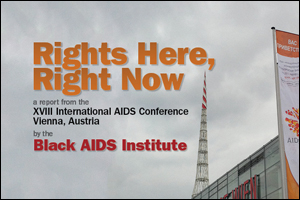
Rights Here, Rights Now, a collection of news stories by the Black AIDS Institute's media delegation to AIDS 2010 is now available. The report includes stories that ran in our daily updates from Vienna and several that first appeared in other media outlets such as the Chicago Defender, Essence.com and TheRoot.com. The report is available in both hard copy and as a downloadable PDF. For more information, email
Finding Our Voices and Sharing What We Learned in Vienna
Ending the HIV/AIDS epidemic requires that all of us step out of our comfort zones. We need to demonstrate courage, ask awkward questions and take challenging stands whether with ourselves as we change our habits, in our relationships, in our families and or beyond. In this issue Black AIDS Weekly editor Hilary Beard shares her experience summoning the nerve to ask a difficult but essential question at the International AIDS Conference (AIDS 2010) in Vienna and relates that to the need for Black people to demonstrate bravery collectively.
This week the institute is publishing Rights Here, Rights Now, a collection of news stories that the Institute's Black media delegation to AIDS 2010 published about that conference. Some of these pieces have been published on the Institute's site, while others first appeared in a variety of media outlets, from About.com to the Chicago Defender to Essence.com to theTheRoot.com. The report is available in both hard copy and as a downloadable PDF.
Yesterday our training and capacity building team traveled to Houston, where the second Black Treatment Advocates Network (BTAN) training is taking place. On Wednesday in Philadelphia, former Institute board chair Jesse Milan, Jr., J.D., and James Albino, senior program director at the White House's Office of National AIDS Policy, will participate in that city's community briefing AIDS In Black America: At the Crossroads: Successes, Challenges and Opportunities, from 3:30 to 5:30 at the Free Library's main branch downtown. For more information, click here.
Yours in the struggle,
Phill