News 2008
2008 International AIDS Conference
Black Leaders Insist on a National AIDS Plan
By Jerry Thomas
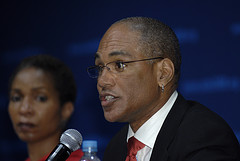
Watch the news conference, get transcript, listen to podcast Visit Black AIDS Institute´s Youtube page. MEXICO CITY -- Angered that the HIV/AIDS epidemic in the African American community has been neglected and is on the rise, while U.S government funding has been stagnant and its priorities have been global, Black leaders gathered in Mexico City called for the U.S. government to create and implement a new National AIDS strategy. During a news conference at the XVII International AIDS Conference Monday, the group also appealed for the U.S government to commit $1.3 billion annually to HIV prevention, an amount they said is needed to reverse the large and growing AIDS epidemic in the U.S, especially in the African American community where the largest growth is occurring. Those gathered for the press conference included Phill Wilson, CEO of the Black AIDS Institute; Congresswoman Barbara Lee (D-Calif.); Dr. Helene Gayle, president and CEO of CARE; Sheryl Lee Ralph, actress and activist; Jacob Gayle, deputy vice president of the Ford Foundation; and Pernessa C. Seele, founder and CEO of the Balm in Gilead, Inc. This call for a new strategy and increased funding has gained more urgency in recent days as the U.S. government has acknowledged what Black leaders have known all along: the U.S has been systematically undercounting its epidemic and consistently failing to respond to the needs of those infected and those at risk. On Sunday, the CDC announced that the spread of the disease was 40 percent higher than their annual estimates. “The U.S. is failing its people and that is a direct attack on Black America,” said Wilson of the Black AIDS Institute. “This failure to respond is particularly acute in the epidemic in Black America. The institute has just released a report titled “Left Behind,” which illustrates just how profoundly AIDS in the United States has become a Black disease. Among its findings: • Twenty-seven years after the identification of AIDS and 12 years after combination antiretroviral therapy became available, 500,000 Black Americans are infected, with as many as 30,000 new infections in Black Americans each year. • As new data show that people can live healthy lives indefinitely on antiretrovirals, AIDS is still the leading killer of young Black women between 25-34 years of age and the second-leading cause of death in black men between 35-44. • A Black woman in the United States is 23 times more likely than a white woman to be diagnosed with AIDS. “We’re not here to wring our hands about the situation,” he added. “We are calling today for a National AIDS Strategy…a clear, aggressive plan of action to provide HIV education, prevention and treatment to all who need it. This National AIDS Strategy would be the equivalent of a `U.S. PEPFAR,´ incorporating many of the same approaches the U.S. recommends for other countries with serious HIV epidemics.” Saying there is no more time for talk, but action, the leaders said the strategy must address the following: • Set and meet ambitious national AIDS reduction goals through measureable, sustained increases in access to effective HIV prevention and treatment. • Invest at least $1.3 billion per year, as identified by Federal AIDS Policy Partnership, to implement a comprehensive national prevention strategy to include sexual risk reduction including abstinence, negotiated safety, and proper condom usage; risk reduction for IV drug users including needle exchange and other harm reduction measures, and access to substitution therapy and drug treatment; and access to preventative healthcare for all Americans. • Support efforts such as “Test 1 Million,” a national campaign to raise awareness about the importance of HIV screening and utilization of treatment by providing voluntary testing and counseling to 1 million people at elevated risk for infection who do not know their HIV status. • Support traditional Black institutions to develop their capacity to make AIDS a top priority and a central component of their work. While she applauded the U.S government’s response to the AIDS crisis abroad, Seele of the Balm in Gilead said, “I am very disgusted and frustrated by my government’s response to AIDS amongst its own citizens.” In Tanzania, for example, Seele said the U.S. government has a fundamental plan that involves the government, the civic organizations, the NGOs and everyone together to make sure plans are implemented. “And yet in Black America, there is no plan,” said Seele. “It’s a patch work not well coordinated and not very accountable. The national AIDS plan lacks clear objectives and does not coordinate work across agencies as it does in Tanzania.” Gayle of CARE agreed, noting that the newly released data shows that “we are behind the eight ball.” “It’s really high time that we reinvigorate our efforts on AIDS with the focus on those most affected,” Gayle said. Jacob Gayle from the Ford Foundation, one of the supporters of the ‘Left Behind” project, said, “The new report demonstrates to me that private foundations must once again step up to the plate.” Actress Ralph, bringing her passionate and oratorical skills to the struggle, said the government and public must do something different to address the AIDS crisis in the Black community. “This cannot be business as usual when it comes to Black people and AIDS,” she said. “The ‘ism’ is playing a big part in what is happening, what does not happen and what will not happen if we don’t do something different.” She added, “When will the national emergency take place? When will someone get truly outraged? When will somebody truly value Black people? …I need a seat at the table. Stop looking pass me but at me. Stop writing policy for me and you have not talked to me. Stop telling me what I need to be doing and you have not talked to me.”
Statistics
US HIV Rate 40% Higher Than Originally Believed
By George Curry
Presidential Candidates Respond Visit Black AIDS Institute´s Youtube page. The number of people infected with HIV, the virus that causes AIDS, is 40 percent higher than the Centers for Disease Control and Prevention has been reporting each year, new figures released Saturday show. According to the CDC, approximately 56,300 new HIV infections occurred in the United States in 2006. The previous estimate had been 40,000 new infections per year. “It’s important to note that the new estimate does not represent an actual increase in the number of new infections, but reflects our ability to more precisely measure HIV incidence and secure a better understanding of the epidemic,” said Dr. Kevin Fenton, director of CDC's National Center for HIV/AIDS, Viral Hepatitis, STD, and TB Prevention. “This new picture reveals that the HIV epidemic is – and has been – worse than previously known and underscores the challenges in confronting this disease.” The study shows that HIV has the greatest impact among African-Americans and gay and bisexual men of all races. “The rate of new infections among non-Hispanic Blacks was seven times as high as that among whites in 2006 (83.7 versus 11.5 new infections per 100,000 population),” the CDC said. “Blacks also accounted for the largest share of new infections (45 percent, or 24,900). Historical trend data show that the number of new infections among Blacks peaked in the late 1980s and has exceeded the number of infections in whites since that time.” The CDC acknowledged what activists have being saying all along: More concentrated prevention efforts are needed if the virus is ever going to be contained among African-Americans. “The continued severity of the epidemic among Blacks underscores the need to sustain and accelerate prevention efforts in this population,” the CDC said. “While race itself is not a risk factor for HIV infection, a range of issues contribute to the disproportionate HIV risk for African Americans in the U.S., including poverty, stigma, higher rates of other STDs, and drug use.” Gays and bisexual men -- referred to as men who have sex with men (MSM) – represented a significantly greater proportion of new infections in 2006 than any other group. “MSM accounted for 53 percent (28,700) of estimated new HIV infections in 2006,” CDC reported. “CDC’s historical trend analysis indicates that HIV incidence has been increasing steadily among gay and bisexual men since the early 1900s, confirming a trend suggested by other data showing increases in risk behavior, sexually transmitted diseases, and HIV diagnosis in this population.” Heterosexuals accounted for 31 percent of new HIV infections in 2006. The new CDC figures were expected to be announced at a news conference Sunday at the international conference on AIDS in Mexico City. However, after several news outlets reported the findings on Saturday, the embargo was lifted. CDC said it was able to come up with the new figures showing greater incidences of HIV by using new technology that allowed them to pinpoint when a person was actually infected with HIV. In the past, the agency could only determine when a person was diagnosed, which could have been years after the infection. [Email This Article To a Friend] Sen. John McCain (R-Arizona): "The U.S. Centers for Disease Control and Prevention (CDC) yesterday announced that in 2006 there were 56,300 new HIV infections in United States, significantly higher than the previous estimate of 40,000 cases. More than a million Americans live with this devastating disease. As President, I will work closely with non-profit, government, and private sector stakeholders to continue the fight against HIV/AIDS. By focusing efforts on reducing drug costs through greater market competition, promoting prevention efforts, encouraging testing, targeting communities with high infection rates, strengthening research and reducing disparities through effective public outreach, we as a nation can make great progress in fighting HIV/AIDS." Sen. Barack Obama (D-Illinois) "We have now learned that 56,300 new HIV infections occurred in the United States in 2006, not 40,000 that had been previously cited. These new figures should bring new focus to our efforts to address AIDS and HIV here at home. "As president, I am committed to developing a National AIDS Strategy to decrease new HIV infections and improve health outcomes for Americans living with HIV/AIDS. Across the nation, we also need to prevent the spread of HIV and get people into treatment by expanding access to testing and comprehensive education programs. This report also demonstrates the need for more timely data about HIV transmission so that we can effectively evaluate prevention efforts. "Combating HIV/AIDS also demands closing the gaps in opportunity that exist in our society so that we can strengthen our public health. We must also overcome the stigma that surrounds HIV/AIDS -– a stigma that is too often tied to homophobia. We need to encourage folks to get tested and accelerate HIV/AIDS research toward an effective cure because we have a moral obligation to join together to meet this challenge, and to do so with the urgency this epidemic demands."

2008 International AIDS Conference
AIDS in Black America as Severe as in Africa
By Linda Villarosa
Visit Black AIDS Institute´s Youtube page. MEXICO CITY -- The United Nations released its massive, bi-annual “Report on the Global AIDS Epidemic," recently, but you had to dig deep to find much about the HIV/AIDS crisis in America. Despite a large and growing epidemic in the United States—a crisis that disproportionately affects African-Americans--the 350-page report barely skimmed the surface of what is going on within American borders. And though the United States should be applauded for leading the world in global HIV/AIDS funding, it has failed to funnel adequate dollars to our national problem. The $48 billion legislation to fight AIDS and other diseases overseas that now sits on President Bush’s desk—triple the amount from 2003—does little for the millions who are newly infected and living with the disease in the U.S. "More Black Americans are infected with HIV than the total populations of people living with HIV in seven of the 15 countries served by PEPFAR," noted Phill Wilson, CEO of the Black AIDS Institute, referring to what is known widely as the President's Emergency Plan for AIDS Relief. According to the UN report, around the world, an estimated 33 million people were living with HIV in 2007, and 2.7 million people were newly infected with the virus. Overall, 2 million people died of AIDS in 2007. The report notes that while the percentage of people living with HIV has stabilized since 2000, the overall number of people living with HIV has increased steadily as new infections occur each year and HIV treatments extend life. Sub-Saharan Africa remains the hardest hit. Two-thirds of people living with HIV reside in this region and three quarters of all AIDS deaths occurred there. The prevalence rate, a revealing statistic which compares the number of people living with the disease with the number of residents of the area, is also highest in the countries of sub-Saharan Africa. Overall, the rate is 5 percent, which means one in 20 people is infected with HIV. And in seven of those countries, that rate was even higher. In Botswana, Lesotho, Namibia, South Africa, Swaziland, Zambia and Zimbabwe three out of every 20 people are infected. The Caribbean has the second highest prevalence rate. In that region, one out of every 100 people is infected with HIV. Of the estimated 230,000 people living with HIV in the Caribbean, three fourths of them reside in the Dominican Republic and Haiti. The report summarized the epidemic in the United States in two pages. It didn’t give North America its own section; the continent was combined with Western and Central Europe. Two million people living with HIV reside in North America, Western and Central Europe; 1.2 million of them in the U.S. Outside of sub-Saharan Africa, only four countries – and only two in the Western Hemisphere – have adult HIV prevalence as high as the conservative estimate (2 percent among adults) for Black America. In other words, 1 in 50 African-American adults is living with HIV here. A recent report estimated that in Washington, D.C., which is 60 percent Black, one in 20 city residents is infected with the disease. "U.S. policy treats AIDS as a foreign policy priority, but virtually ignores the epidemic among Black citizens here at home," said Rev. Al Sharpton, founder and CEO of the National Action Network (NAN). "U.S. policymakers seem to be much more interested in the epidemic in Botswana than the epidemic in Louisiana. This is an unnecessary and deadly choice. Both need urgent attention." Other highlights from the UN report: • Globally, the percentage of women among people living with HIV has remained stable at 50 percent for several years, although women’s share of infections is increasing in several countries. In sub-Saharan Africa, nearly 60 percent of people living with HIV are women. According to U.S. government statistics, African-American women are 23 times more likely than white women to be diagnosed with AIDS, and the disease remains the leading cause of death among Black women between 25-34 years. • Young people aged 15-24 account for an estimated 45 percent of new HIV infections worldwide. In the U.S., Blacks make up 70 percent of new HIV diagnoses among teenagers and 65 percent of HIV-infected newborns. • Though HIV creates a heavy burden on low-income communities, it is not just a disease of poverty. In sub-Saharan Africa, for instance, HIV prevalence is highest not in the poorest countries, but in two of the wealthiest, South Africa and Botswana. In Botswana, nearly one out of every four people is living with the virus. In the end, UNAIDS did its best to put a positive spin on its report. "We've achieved more in the last two years than in the preceding 20," UNAIDS director Peter Piot said last week. "We need now to continue these efforts more than ever.”

2008 International AIDS Conference
Global community converge to combat HIV/AIDS
By Kenneth Miller
Visit Black AIDS Institute´s Youtube page. MEXICO CITY -- With an empty thoroughbred race track as a backdrop, the >a href=httpÑ//www.aids2008.org>XVII International AIDS Conference took off to the races in its ongoing global battle to combat the HIV/AIDS epidemic that is mushrooming right here on their fertile Latin soil. “In Mexico, as in the great majority of countries in the region except for the Caribbean, we have a concentrated epidemic,” said AIDS 2008 co-chair Dr. Luis Soto Ramirez. Hailed as the bridge between Latin America and the world and incorporating the theme, “Universal Action Now,” the bi-yearly gathering of an estimated 30,000 opened its conference here at The Center Banamex on a cloudless Sunday afternoon. It is the first time the conference has been held in a Latin country, and the confab will feature a bevy of world doctors, scientist, AIDS activists and individuals infected with the virus, providing solutions and or ideas to the pandemic. New and already existing preventative strategies, along with those to be developed will be discussed at the conference. The search for a microbicide or a vaccine will be a major topic of discussion, while advising the use of condoms and preventative measures for drug users sharing needles will also be among the dialogue. Failure of a highly touted HIV vaccine in 2007 raised tough questions about the best approach to designing such a vaccine and questions whether the HIV vaccine research should continue. Scientists from the Tulane National Primate Research Center in the United States added a new twist to the vaccine maze with evidence that antibodies do not help control simian immunodeficiency virus (SIV) in monkeys. Those results confuse expectations in such a nonhuman primate model of HIV infection. African green monkeys did not get sick with AIDS diseases despite high and persistent SIV loads. Among the other highlights at the conference will be the Black AIDS Institute daily media roundtable panel discussions. The briefings will continually offer updates to the throng of more than 3,000 media members and also offer experts from the Black AIDS Institute’s delegates.

2008 International AIDS Conference
‘Prince Charming’ Knocked Teen off her Throne
By Ivan Thomas
Visit Black AIDS Institute´s Youtube page. MEXICO CITY -- Marvelyn Brown was living the dream life for a high school student nearing graduation. She was athletic, attractive, and had the popularity that every teen desires. She was the type who hung out with the prom queen, the one who actually got to date her prince charming. But her prince charming turned into a dark knight, and several months later, the world as she knew it would change forever. On July 17, 2003, at 19, Brown lay sick in a hospital bed in the intensive care unit, with doctors unable to determine what was wrong with her. After being there for two weeks, she was told that she had only 24 hours to live. Immediately, her mother called in a priest, and the family started making funeral arrangements anticipating the worst possible outcome. She lived through that traumatic night. Doctors told her she had pneumonia. She prepared to return to life as normal, but that would not happen. Her doctor would pay a visit to her room. There, he revealed some startling news: “You have HIV.” Not knowledgeable about the virus, she reached out to friends. “I started calling people to get some immediate answers and to tell me that it was going to be OK,” she recalled. “So, I called my best friend. She told me that she was going to come to the hospital to visit me.” “The next person I called was my friend who was 8 months pregnant, and I was supposed to be the godmother of her child. And I told her that I was HIV positive. And she told me that she did not want me to be her child’s godmother anymore, and that she didn’t want anything to do with me. So then I called my sister, and then I called my aunt, and finally I called my mom. My mother told me not to tell anyone anything, tell them that you have cancer.” Brown told her story at least twice before two different groups of journalists during training sessions prior to the opening of the XVII International AIDS Conference in Mexico City. Appearing nervous and weak, she stood strong, realizing that her message needs to be shared with the world to enlighten people of the realities of HIV and also to dispel stereotypes. Brown falls into one the rising categories of HIV/AIDS infections outside of gay men, and that is young African American teenagers. African Americans accounted for 55% of all HIV infections reported among persons aged 13–24. Now 24, she will soon join the Black women between the ages of 25 and 44 that accounts for 60 percent of all women in the United States living with HIV/AIDS. AIDS is the leading cause of death among women 25 to 34. “I kept thinking to myself that he doesn’t have a condom,” said Brown, a native of Nashville. “But I thought, this is my Prince Charming, and I wouldn’t mind being his baby’s mother if this is the worst that could happen.” Obviously, she said, she thought wrong. “I never got tested for HIV; I didn’t even really know what it was,” said Brown. “I heard about it, but as a teenager I felt invisible and didn’t think it could ever happen to me. At 19, HIV is the last thing on my mind.” The word spread quickly in her community, and that is when her HIV status began to take a toll on her not only in terms of her social life, but also physically, emotionally and psychologically. “Every day I wanted to die,” she said. “My Nashville community had a way of making me feel like I was the only one with the virus.” For a while Brown remained in a state of depression, but she read her Bible for inspiration and strength to make it through each day. In addition, as her family became knowledgeable about the disease, they became more supportive. Brown said her boyfriend new he was infected when they had unprotected sex. “I had a choice, and I chose to have sex without protection,” she said. “I think a lot of people want to place the blame on someone else, but we have to take responsibility for our own actions. What if he didn’t know? I would still have it.” She attributes her decision to have unprotected sex to her lack of self love. In fact, she believes that contracting the disease actually taught her the importance of caring for herself, and not relying on attention she got from others to determine her worth. “Having HIV has actually brought peace to me,” said Brown. “It has taught me self love and responsibility, and that is the message that I try to send to others, responsibility.” However, being visible to the public has not come without its hardships. Brown has a MySpace page that is intended for people to come to for encouragement, and information. But there are those who take out the time to share their displeasure by leaving hateful comments. “The worst thing about HIV/AIDS is the stigma, said Brown. “Some people don’t like the fact that I am so vocal about my status. They say I am glamorizing the disease, making it seem easy to live with HIV. I have heard everything from you are disgusting to you should just kill yourself, you are making the United States look so bad.” Still, she stands firm. In her biography, titled “The Naked Truth: Young, Beautiful, and HIV Positive,” scheduled for release later this month, she will go in depth about her experiences, and also promote the ideas of education, self love, and responsibility. “Young people have to be able to relate to the virus,” said Brown. They have to see people like them who are able to impact them so that they can take it seriously.” As for how she is coping with HIV now, Brown says that she has accepted it and remains positive about life, but it does not come without its share of challenges. “I will always feel the pain, but I just choose not to let it get to me. I have finally learned how to take care of myself.”