News 2006

Presidential unease
By Erv Dyer
TORONTO -- Former U.S. President Bill Clinton, in a keynote address Tuesday at the XVI International AIDS Conference, said that in the 1990s, even during the height of his administration, the United States was too blind to the fact that HIV rates were escalating among black Americans, especially women.
Clinton also said the country should rethink needle exchange as a viable option to prevent infections. Particularly, since evidence shows it does not increase rates of drug use. This is notable because as president he largely opposed such harm reduction measures. “I think I was wrong,” Clinton admitted. Many HIV advocates argued that providing a place for clean needle exchange would slow infections rates because sharing syringes was a high-risk behavior that fueled the spread of HIV. Community activists say such denial of who the virus was touching and the squelching of attempts to halt it are to blame for HIV’s rapid-fire increase in the black community. Also, in the mid-1990s, said Clinton, Congress turned its attention overseas to address AIDS, and “everything was not all right at home.” Despite such mistakes, Clinton said he has learned much since he started his William Jefferson Clinton Foundation, which addresses HIV, that there remains a “long, long way to go,” to end the pandemic. Scientists say a vaccine is still at least a decade away and that stigma continues to haunt people living with HIV. Since leaving the White House, however, Clinton has become more deeply involved in HIV issues. In 2002 Clinton attended the international conference in Barcelona and was greeted warmly on Tuesday when he discussed the need for bold leadership in the AIDS fight. The audience even sang happy birthday to the former president who will celebrate 60 years this month and applauded many of the recommendations he proposed for keeping HIV at bay. In recent months, Clinton has visited Rwanda, Lesotho and other African nations hit hard by the virus. He’s been on a mission to draw more attention to the plight of rural areas, which desperately need services and healthcare providers. In those areas he wants to work to keep more nurses and doctors in their home countries. Clinton was not afraid to support some controversial measures, notably a call for public health officials to act on evidence that circumcision can sharply reduce the risks of transmission of HIV-AIDS. “If this saves lives, we have to get after it,” he said, regardless of how uncomfortable the issue might make men. Yesterday, he called the U.S. abstinence-only policy an “error,” but stopped short of completely bashing the conservative initiative that funnels 30 percent of U.S. dollars to abstinence-based AIDS education. However, Clinton did acknowledge that moral conditions shouldn’t be tied to saving people’s lives. “It’s OK to say you disapprove of prostitution,” Clinton said, “but then say here’s some money, go save some lives.” While America’s research and funding position it as a global leader to fight HIV, there are lessons to be learned, said Clinton. For example, he said, too many middle-income Americans who live with AIDS must grapple with the high costs of treatment because their incomes don’t allow them to access Medicaid. For the next 25 years to look differently, said Clinton, HIV advocates must work to make individuals more accountable. Too many people, he said, act irresponsibly because they don’t know their status or if they’re in a high-risk group and continue to take chances. Appropriate levels of funding must continue to flow, he said. “Every single wasted dollar puts a life at risk.” Without sufficient funding, he added, quality of care, delivery and resources all dwindle. “I’m in for the long haul,” said Clinton of the HIV fight. “I can’t foresee anything diverting me from this commitment short of a life-threatening illness or success.” Erv Dyer is a reporter with the Pittsburgh Post-Gazette.
Mobilization
By Erv Dyer
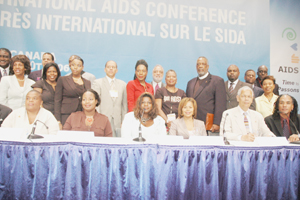
For the first time in the history of the International AIDS Conference – and indeed in the larger community -- leaders from eight of black America’s most venerable institutions were openly talking about HIV/AIDS and agreeing to what they needed to do to move forward – together. They created a Marshall Plan to reverse the high rates of infection among blacks by 2011. It is clearly ambitious, but leaders said to aim for anything less was immoral. There was Julian Bond, chair of the NAACP; U.S. Congresswoman Maxine Waters, a former head of the Congressional Black Caucus’ AIDS Initiative; the Rev. Edwin Sanders, who runs a Nashville church active in HIV ministry; entertainer Sheryl Lee Ralph, who brings great passion and star-wattage to the fight against AIDS and representatives from national women’s groups. “This is historic,” said Grazell Howard, program director of the National Coalition of 100 Black Women. “Black people don’t talk to each other. This is the first time since the civil rights movement we’ve come together in America.” Each of the groups will now go home and hammer out the specifics of integrating the declarations into their organizational agendas, but there are many common goals they share. These include efforts to cut infection rates, increase the percentage of blacks who know their infection status, get more blacks into appropriate care and end the stigma. Each of the organizations pledged to appoint a national AIDS director, set annual testing goals and spotlight HIV at their national conferences. The news is significant and comes against the back drop of a conference where African and Caribbean HIV advocates recognizing that must work together to win the war against HIV. With both frustration and resolve, a panel of HIV activists, community advocates, and legislators on Sunday opened the gates on a broad-ranging discussion of how the Diaspora of black and Caribbean peoples must move forward in the battling. But just assembling the panel represented progress for the black community, which in the 25 years of the AIDS pandemic has been severely hampered by issues of stigma, homophobia, poverty and conflict on how best to educate a population that has often lived in denial. Lee, often a lone voice of black legislators at the international conferences, was optimistic about the coming together. “It shows that the work of a few is having some success,” she said, “and that together we can break the silence. This shows that there are others in the struggle.” The Black AIDS Institute and the African and Caribbean Council on HIV/AIDS in Ontario were joint sponsors of the panel. Each group works to increase awareness of HIV/AIDS and improve access to better treatment and prevention efforts. The conference in Toronto is one of the few times the international event has come to North America and the two groups believed that – given the proximity to the United States and high number of black Americans being impacted – it was a good time to bring global attention to HIV/AIDS and people in the African and Caribbean Diaspora. There has been a distance, said Cornelius Baker, an HIV advocate from Washington, D.C. and a former director of Whitman-Walker, a non-profit services group in the nation’s capital. “Politically and socially, this is a good environment. There are a large number of blacks in Toronto and the enormity of the fact that AIDS has a black face can no longer be ignored. Now is the time to forge an agenda to move forward." AIDS has not been kind to blacks. Across the globe, they suffer the highest incidences of the virus. Whether talking about women in the Congo who acquire the virus through rape, or the drug-addicted who use tainted needles in Oakland, Calif., or the church wife who’s infected by her husband in Cleveland, the goal, the panelists said, was to unite. There is strength in numbers, said Bond, who pledged to work with the NAACP to advocate for more funding, better treatment and push for testing for inmates entering and exiting prisons. Erv Dyer is a reporter for the Pittsburgh, Post-Gazette.
Mobilization
By B. Denise Hawkins
Washington (Aug. 14, 2006) — For Donna Christian- Christensen (D-VI), the equation should be simple and the response swift when there is a matter of “national security” looming. But there is no war raging as HIV/AIDS continues to disproportionately ravage African- Americans and other people of color, says the first female physician in Congress.
“If some of us are compromised by AIDS and other health disparities, then the whole country is at risk,” says Christian-Christensen, who is among the more than 20,000 international officials and delegates attending the XVI International AIDS Conference in Toronto. In 2003 she was named to the House Select Committee on Homeland Security and currently is urging fellow lawmakers to make responding to HIV/AIDS a matter of national security. “A strong country is one that has people who are in good health,” she says. Christian-Christensen sounds weary as she wonders aloud what more must happen before the nation provides increased funding and greater access to HIV/AIDS care, education and treatment. The number of African Americans aged 25-44 dying of the virus “isn’t making a big enough difference in how this country is responding,” declares Christian- Christensen. “I don’t know what we will have to say or do to make a difference,” says Christian-Christensen, who is known as the legislative go-to person on matters of health disparities. She hopes that revamping HIV/AIDS “arguments and messages” to ones that emphasize the epidemic’s “economic impact and link to national security” will gain the attention of Congress and translate into action. "If the HIV/AIDS crisis is [not addressed] in other minority communities, they will soon mirror the tragedy that has befallen African American communities nationwide,” she predicts. With the recent reports from the Centers for Disease Control and Prevention, which have shown that the epidemic continues to rage in African American and Latino communities, the Congressional Black Caucus' Health Braintrust, along with the minority caucuses in the Congress, have joined forces to demand $540 million to fight the epidemic. The Minority AIDS Initiative, as it has become known, was the main feature in the call for a “State of Emergency” to deal with the growing infection rates in communities of color. For the first time, the medical concerns of African Americans were brought to the attention of national policymakers. An opportunity to apply to public policy what she learned caring for her patients was a motivating factor in her decision to seek office in 1996. Christian-Christensen was a practicing family physician and public health administrator in the Virgin Islands in the mid-1980s when HIV/AIDS arrived. Then the virus was new and complex, but healthcare providers at her hospital knew enough to be frightened. Christian-Christensen recalls treating her first patient and the “hell” that erupted in those early days. The young man came to her office with a raging fever and a “crackling sound in his throat.” She ordered a chest X-ray and an AIDS test that returned positive. Before the results were even confirmed, Christian-Christensen's patient was shunned by nurses and other hospital staff. With time and increased education about how HIV is contracted, attitudes and treatment began to change, explains Christian-Christensen. But she’s doubtful whether she will see an increase in funding, treatment or focus in the U.S. on minorities with HIV/AIDS. The spread of the disease in parts of Asia and Central Europe, she suggests, may also eclipse attention given to African Americans and those in Africa with HIV/AIDS.

Media & Culture
WASHINGTON (July 24, 2006) – Culminating an extensive national call for submissions, BET Networks, the Black AIDS Institute (The Institute), and the Kaiser Family Foundation are proud to announce the 10 finalists in the 3rd Annual Rap-It-Up/Black AIDS Short Subject Film Competition (RIU/BASS), who are now eligible for the next level of competition from which the winning entry will be selected. The RIU/BASS film competition seeks to highlight the issue of HIV prevention, testing and treatment, and to help raise awareness about the magnitude of the HIV/AIDS epidemic in Black communities. Screenwriters were encouraged to use their creativity to evoke a 'fresh' and culturally unique angle on these issues in a way that will resonate with African Americans and other minority communities. This film competition is especially important this year, as the world commemorate 25 years of fighting HIV/AIDS and acknowledging the people who’ve worked tirelessly in the struggle. Over 150 entries were received and reviewed by a select group of judges from across the country, and the ten finalists are: •Beverly Abbott, Casey Arrillaga & Wyndle Jordan (Reseda, CA), Odicie; •Mya Baker (Brooklyn, NY), An Angel Scorned; • Blu Fox (North Hollywood, CA), The Gift; •Menelek & Tafari Lumumba (Los Angeles, CA), In My Skin; •Layla Mashavu (Los Angeles, CA), Lemonade; •Johneshia McCray (Philadelphia, PA), In Memory Of; •Jerry McGill (Phoenix, AZ), Degrees Of Anger; •Elliot Porter (Chicago, IL), Draft Pick; • Cassandra Riddick (Washington, DC), Shining Star; and • Kimberly Singleton (New York, NY), Conscious. “The RIU/BASS film competition is one of the only vehicles that is able to integrate two very different elements: film and health,” commented Phill Wilson, Executive Director of the Black AIDS Institute. “Through this effective integration, up and coming screenwriters are not only given the opportunity to showcase their skill, but also tackle the disturbing subject of HIV/AIDS and educate uncountable persons on its devastation within the Black community.” “In its third successful year, BET is extremely proud of the community response and positive impact the RIU/BASS film competition has had on our young viewers,” said Kelli Lawson, BET’s Executive Vice President of Corporate Marketing. “This competition has not only opened the door to potential filmmakers, but has also created a platform for families, educators and communities to discuss the various issues surrounding HIV/AIDS and raise awareness to effective preventive methods.” “Each year this film competition receives an impressive mix of powerful stories illustrating the magnitude of HIV/AIDS among African Americans throughout the U.S.” said Tina Hoff, Vice President and Director of Entertainment Media Partnerships at the Kaiser Family Foundation. “The screenplays are a powerful inside look at the epidemic in African-American communities.” BET continues to lead the pack with its long-standing commitment to providing fresh, culturally-unique and issues-targeted public affairs programming. Whether it’s a poignant short film about HIV/AIDS or a new public service announcement featuring today’s hottest celebrities giving advice on healthy lifestyles, the network consistently exhibits innovative ways to educate its viewers on the important health and social issues impacting young adults today. ABOUT BET NETWORKS BET Networks, a subsidiary of Viacom, Inc. (NYSE: VIA and VIA.B), is the nation’s leading provider of quality entertainment, music, news and public affairs television programming for the African-American audience. The primary BET channel reaches more than 81 million households according to Nielsen media research, and can be seen in the United States, Canada and the Caribbean. BET is the dominant African-American consumer brand with a diverse group of businesses extensions: BET.com, the Number 1 Internet portal for African Americans; BET Digital Networks – BET J, BET Gospel and BET Hip Hop, attractive alternatives for cutting-edge entertainment tastes; BET Event Productions, a full-scale event management and production company; BET Home Entertainment, a collection of BET-branded offerings for the home environment including DVDs and video-on-demand; and BET Mobile, a service venture into the lucrative world of ring tones, games and video content for wireless devices. ABOUT THE BLACK AIDS INSTITUTE The Black AIDS Institute is a training and mobilization center focused exclusively on Black people. The Institute's mission is to stop the AIDS pandemic in Black communities by engaging and mobilizing Black institutions and individuals in efforts to confront HIV. The Institute interprets public and private sector HIV policies, conducts trainings, offers technical assistance, disseminates information and provides advocacy from a uniquely and unapologetically Black point of view. ABOUT THE HENRY J. KAISER FAMILY FOUNDATION The Henry J. Kaiser Family Foundation is a non-profit, private operating foundation dedicated to providing information and analysis on health issues to policymakers, the media, and the general public. It is not associated with Kaiser Permanente or Kaiser Industries. Information on HIV/AIDS is available at www.kff.org, and a daily news summary report on developments in HIV/AIDS is available on www.kaisernetwork.org, the Foundation’s free health information service.

Community Activism
LIFEbeat, a musical industry charitable organization dedicated to reaching America’s youth with the message of HIV/AIDS prevention, canceled its July 18 benefit concert featuring Bennie Man and TOK, following protests by GLBT organizations. REGGAE GOLD LIVE 2006 SUMMER JUMPOFF was scheduled for New York’s Webster Hall. The GLBT community calls Beenie Man and TOK two of the most homophobic artists in America because their lyrics encourage anti-gay violence. The protest movement was kicked off by Keith Boykin, who sent a letter to LIFEbeat’s Executive Director John Cannelli on July 10 asking him to reconsider featuring the two artists at the concert. Boykin is a Black Gay Author and Board member of the National Black Justice Coalition. In a telephone conversation with Boykin, Cannelli said LIFEbeat was aware of the controversy surrounding the artists, but the goal was to reach an audience that may be missing the HIV/AIDS prevention message. All of the artist perform free, he said. Boykin sent out an e-mail blast, which spurred a firestorm of letters and calls to LIFEbeat and concert sponsors BET, Vibe magazine, Music Choice and Power 105.1. The negative publicity appeared to be too much. Following a news conference in New York last Thursday by Gay, Lesbian, Bi-sexual and Transgendered Community activist, LIFEbeat canceled the concert. In a release, the organization said, “The Music Industry Fights AIDS has collectively decided to cancel its Reggae Gold Live concert,” the statement posted on their site said. “While the organization’s staff and board believe very strongly in the positive purpose and intention of this event, the possibility of violence at the concert from the firestorm incited by a select group of activists makes canceling the event the only responsible action. Dialogue is important and LIFEbeat’s staff and board respect the opinions of those who came forward to make their feelings known. We have always and will continue to support the GLBT community.” “It is very unfortunate, however, that the intended good that could result from bringing this community together around this potentially ground breaking event will not be realized,” the statement continued. “The Caribbean American community needs our help in bringing attention to this unspoken and often stigmatized illness. We hope in the wake of this decision that those who came forward and spoke out will now come forward again to do something positive for the Caribbean American community and help bring attention to the devastation this disease has wreaked in that community so awareness, prevention and healing can follow."