News 2006
Mobilization
By Sharon Egiebor
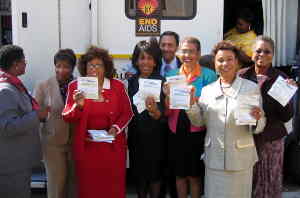
Congresswoman Barbara Lee, D-California, was one of several members of the Congressional Black Caucus to take an HIV test on Capitol Hill recently. Lee took a rapid or quick swab test from a medical mobile outreach vehicle that was provided by the Washington, D.C. Department of Health. The pain-free, non-invasive test examines the saliva for the presence of antibodies created by the body to fight HIV/AIDS. It is considered a rapid test because results are available within 20 minutes. Among those joining Lee were Corrine Brown of Florida, Donna Christian-Christensen of the Virgin Islands, Eddie Bernice Johnson of Texas, Eleanor Norton Holmes of Washington, D.C., Gwen Moore of Wisconsin, Melvin L. Watt of North Carolina and Maxine Waters of California. "We have to stop the devastation this disease is causing in our community, and promoting testing is a critical first step," said Lee, who co-chairs the CBC Global HIV/AIDS Taskforce. "People need to know their status, and I will be working with local Black lawmakers and others to promote testing in the Bay Area." According to the Centers for Disease Control and Prevention, an estimated 250,000 people, more than one in four of those infected, have HIV and do not know it. The HIV/AIDS epidemic is devastating the African American community. Today, African Americans account for nearly 50 percent of all people in the United States living with HIV/AIDS even though they represent about 12 percent of the population. African American women account for nearly 70 percent of new infections among women, and AIDS is now the leading cause of death for African American women between the ages of 25-34. The event comes in the immediate wake of new testing recommendations issued by the Centers for Disease Control and Prevention, and on the heels of the XVI International AIDS Conference in Toronto, where African American leaders from the United States announced a national call to action to end the AIDS epidemic in black America. Lee, Christensen, Waters and Pennsylvania State Sen. Vincent Hughes were among the politicians participating with the Black AIDS Institute in the national call to action in Toronto. As part of that mobilization effort, Lee recently held a forum in Oakland designed to raise awareness about the toll the disease is taking on the African American community and to foster community involvement in stopping its spread. She has introduced resolutions recognizing the goals of National HIV Testing Day, and in 2005 the House of Representatives passed her resolution supporting the goals of National Black AIDS Awareness Day. She has introduced legislation aimed at ensuring continuing care and treatment for Gulf Coast residents living with HIV/AIDS who were displaced by hurricanes Katrina and Rita, and recently introduced legislation to allow the distribution of condoms in federal prisons and to develop a strategy to reduce HIV and other STIs in prisons. As the lead author of the Global AIDS and Tuberculosis Relief Act of 2000 and the principal co-author of legislation establishing the President's Emergency Plan for AIDS Relief (PEPFAR), Lee's accomplishments in promoting effective, bipartisan measures to stop the spread of HIV/AIDS and bring treatment to those living with HIV/AIDS have earned her international recognition as a leader in the fight against the HIV/AIDS pandemic. Prior to her testing, Moore spoke on the floor of the U.S. House of Representatives about the effects of HIV/AIDS on the African American community. In her district in Milwaukee, 4,600 people have been diagnosed with HIV/AIDS since 1983, 47.9 percent of them African Americans. “While these data are appalling and frightening, we must remember that this is entirely preventable,” said Moore. “And we must spread the hope of preventing AIDS.”
Medicine
San Francisco, Calif., Sept. 27, 2006 – Gilead Sciences, Inc. (Nasdaq: GILD) has announced two presentations of long-term efficacy and safety data from Study 903E on the company’s leading once-daily anti-HIV medication, Viread® (tenofovir disoproxil fumarate). This clinical trial is an ongoing open-label extension of Gilead’s Study 903, a three-year double-blinded randomized clinical trial that compared once-daily Viread to twice-daily stavudine (d4T), both in combination with lamivudine and efavirenz in treatment-naïve patients. A subset of patients who completed Study 903 were enrolled in Study 903E and received two additional years of treatment with Viread, lamivudine and efavirenz. Long-term data were presented for patients who remained on a Viread-containing regimen for a total of five years and for those who switched from twice-daily stavudine to once-daily Viread upon enrollment in Study 903E. Data from both analyses of Study 903E were presented at the 8th International Workshop on Adverse Drug Reactions and Lipodystrophy in HIV, held September 24-26 in San Francisco (Posters #82 and #29). “With the rapid progress in HIV therapy and the availability of potent, safe and well-tolerated regimens, long-term safety and efficacy data are increasingly important,” said Norbert Bischofberger, PhD, executive vice president, Research and Development, Gilead Sciences. “Our decision to extend Study 903 four additional years to a total of seven years in duration underscores our commitment to helping physicians and patients properly assess the long-term impact of treatment on side effects such as lipodystrophy and changes in cholesterol.” Viread is a component of two once-daily fixed-dose combination tablets, Truvada® (emtricitabine and tenofovir disoproxil fumarate), and ATRIPLA™ (efavirenz 600 mg/ emtricitabine 200 mg/ tenofovir disoproxil fumarate 300 mg). ATRIPLA is the first and only once-daily single tablet regimen for the treatment of HIV-1 infection in adults as stand-alone therapy or in combination with other agents. Study 903E Study 903E is an ongoing four-year open-label extension for a subset of patients who successfully completed three years of treatment in Study 903. In Study 903, 600 patients were randomized and received treatment for three years with once-daily Viread (n=299) or twice-daily stavudine (n=301), both in combination with lamivudine and efavirenz. Patients who completed three years of treatment in Study 903 at sites in Argentina, Brazil and the Dominican Republic were rolled over into the open-label Study 903E extension. Eighty-six patients randomized to receive three years of treatment in the once-daily Viread arm of Study 903 were rolled over into Study 903E and continued on the same regimen for two additional years. (Of these patients, nine discontinued prior to year five; four either withdrew consent, were non-compliant or lost to follow-up, two discontinued due to pregnancy, two experienced virologic failure and one discontinued due to an adverse event.) Eighty-five patients randomized to receive three years of treatment in the twice-daily stavudine arm of Study 903 were switched and received two additional years of open label therapy with a once-daily regimen of Viread, lamivudine and efavirenz in Study 903E. (Of these patients, two withdrew consent and discontinued prior to year five.) Of the 86 patients from the Viread arm of Study 903 who entered 903E at year three, 83 percent experienced viral load suppression to less than 50 copies/mL following two additional years of treatment in Study 903E. These patients experienced a mean increase from baseline in CD4 count of 273 cells/mm3 at year three in Study 903. An additional mean increase in CD4 cell count of 148 cells/mm3 was observed from years three to five in Study 903E. No patient developed the K65R mutation during the open-label extension of the study. Limb fat measurement was initiated in Study 903 at year two. Among Study 903E patients from the Viread arm of Study 903, mean total limb fat remained stable from years two to five (8.0 to 8.2 kilograms). There was no evidence of lipoatrophy among Viread-treated patients. Loss of limb fat, or peripheral lipoatrophy, is a hallmark of lipodystrophy, which has been associated with long-term administration of some anti-HIV medications and with HIV disease.
The overall adverse event profile observed during the open-label extension was similar to that seen in the first three years of the study. There were no discontinuations due to renal adverse events and no patient reported Fanconi syndrome. Additionally, there was no evidence of clinically relevant effects on bone mineral density related to Viread. One patient experienced bone fracture during the open-label extension phase which was trauma related and not associated with study drug.
In a second presentation, data were presented for patients randomized to the twice-daily stavudine arm of Study 903 who were switched and received two additional years of open-label therapy with once-daily Viread, lamivudine and efavirenz in Study 903E. Of the 85 patients from the stavudine arm of Study 903 who entered Study 903E at year three, 91 percent experienced viral load suppression to less than 50 copies/mL at two years in Study 903E. These patients experienced a mean increase from baseline in CD4 count of 343 cells/mm3 at year three in Study 903. An additional mean increase in CD4 cell count of 103 cells/mm3 was observed from years three to five in Study 903E. No patients discontinued treatment due to adverse events. Study 903E patients in the twice-daily stavudine arm of Study 903 experienced a decrease in mean total limb fat from 5.0 kilograms at year two to 4.6 kilograms upon entering Study 903E. Following a switch to the once-daily Viread-containing regimen, an increase in mean total limb fat was observed (4.6 to 5.5 kilograms; p<0.001) at two years in Study 903E. Study 903E patients in the twice-daily stavudine arm of Study 903 experienced a mean increase in fasting triglycerides of 102 mg/dL and mean increase in fasting total cholesterol of 59 mg/dL at year three in Study 903. Following a switch to the once-daily Viread-containing regimen, a mean decrease in fasting triglycerides of 75 mg/dL (p<0.001) and a mean decrease in fasting total cholesterol of 23 mg/dL (p<0.001) was observed at two years in Study 903E. Among patients who switched from stavudine to Viread upon entry in Study 903E, no significant changes in bone mineral density (BMD) were observed at the spine and a mean decrease of 2.3 percent was observed at the hip (p<0.001) from years three to five in Study 903E. One patient experienced a fracture which was trauma related and not associated with study drug.

Voices from ... Toronto
By Freddie Allen
Even with his eyes closed in complete darkness, it's nearly impossible for AIDS activist Henry Luyombya to get any sleep at night. Days filled with speaking engagements, planning sessions, and televised interviews leave the 26-year-old Ugandan's mind and body restless. "I try not thinking about it, but it's hard knowing that I will probably die from AIDS," said Luyombya, who was diagnosed with HIV four years ago. Before the diagnosis that changed his life forever, Luyombya's family had great expectations for his future. Smart and charismatic, Luyombya chose to become an AIDS activist rather than the lawyer or politician his family was expecting. In some Ugandan circles, AIDS "activist" carried as much stigma as the epidemic itself. "Stigma still exists and the only way to fight it is to address it. If I don't talk about it, who will?" One of Luyombya’s first goals was to gather information.. In 2004, with a sense of urgent responsibility, he flew to Bangkok, Thailand to the XV International AIDS Conference to learn more about the disease and the role he would play in fighting the disease. In Bangkok there were over 400 youth delegates registered, a sharp increase from the 50-plus that attended the 2002 conference in Durban, South Africa. Luyombya looked at the dismal international infection rates among youth and knew that more had to be done. So the rookie activist used the Bangkok conference to campaign for greater youth participation at the IAC and access to education about HIV/AIDS. Luyombya even moved to Toronto in November 2005, joining the Leadership Programming Committee to assist in planning for the AIDS 2006 Conference. "For the first time young people directly affected the content of the sessions. Every program had an elevated youth presence and that was very exciting." Luyombya said. Although 1,000 youth delegates attended AIDS 2006 in Toronto, Luyombya lamented the missed opportunity for young people from the U.S. and Canada to come out in force. He said he believes the onus rests on the shoulders of the world leaders. "AIDS should be a priority on President Bush's agenda. The U.S. and Canada can do more." Luyombya said. Youth members of the Leadership Programming Committee have already received a commitment from the Mexican government and planners of AIDS 2008 to ensure that double the number of young people attend that conference. When Luyombya struggles with the inevitability of AIDS, he finds comfort in the words he receives during his travels. "The number one question people always ask me is 'where do you get your courage to continue [fighting the epidemic]?' I tell them the thousands of people that e-mail me, that embrace me and that accept me give me that strength." Luyombya said. Luyombya said that more people must understand what HIV is and understand that there is life after HIV. "[People infected with HIV] should join support groups, attend meetings and network with others to work out solutions to the problem." Luyombya hopes that the world leaders that made commitments at AIDS 2006 stay the course. "Its time to deliver. We don't want to be in Toronto in another 25 years."
Prevention
By Sharon Egiebor
Click here to see CDC recommendations The Centers for Disease Control and Prevention’s recommendation that voluntary HIV testing become part of routine medical care should increase the number of people who know their HIV status, according to doctors and those who advocate an increase in national testing. Although the testing is a positive step, it should be treated as one action in the process of reducing the rate of HIV infections, doctors and AIDS activist say. Dr. Keith Rawlins, medical director of the Peabody Clinic in Dallas, said the concept of signing a general consent for all medical care is an important thing to do. “I support the idea of doing testing in this manner because it really makes it easier for people to find out their status. If you don’t want to know, you can say, ‘I don’t want to know,’” said Rawlins. Rawlins said the new recommendations should work well in private settings and in emergency rooms where timing becomes critical. He and others expressed concerns on the effects the additional testing may have on the health care industry and for the people who will test positive. Rawlins, whose practice mainly consists of HIV/AIDS patients, said the increase in testing is going to raise the demand for more knowledgeable medical personnel, which may be difficult for some people to get. The care will depend on an individual’s geographic location, economic status and whether or not they have health insurance, he said. On Thursday, the CDC issued new recommendations that health care providers implement routinely test for HIV, without a separate or additional consent form from patients. “We urgently need new approaches to reach the quarter-million Americans with HIV who do not realize they are infected,” Dr. Julie L. Gerberding, CDC director, said in a news release. “People with HIV have a right to know that they are infected so they can seek treatment and take steps to protect themselves and their partners.” The CDC said the new recommendations are designed to overcome several barriers that hindered implementation of the earlier recommendations, which called for HIV testing for patients in health care settings with high HIV prevalence (above 1 percent) and for all high-risk individuals. Implementation of these recommendations was difficult because many health care facilities do not have information on HIV prevalence, and many providers report that they do not have sufficient time to conduct risk assessments. Physicians also report that the processes related to separate, written consent and pre-test counseling for HIV testing have posed significant barriers. In surveys and in consultations held by CDC, health care providers consistently reported these time-consuming processes were not feasible in emergency rooms and other busy health care settings. Secondly, Rawlins said, “once you get to an experienced clinician, you need the medication. If you can’t get to the medication or can’t afford the medication, you are not going to get the particular outcome you want.” Dr. David Malebranch, an assistant professor at the Division of General Medicine at Emory University’s School of Medicine in Atlanta, agreed with Rawlins that making the test as routine as a mammogram or colonoscopy should increase the number of individuals who know their HIV status. “We still have a way to go make sure that it is not just targeting specific groups,” he said. “From my understanding, some of the language is a little bit strange because they still focus on risk groups men-who-have-sex-with men (MSM) or heterosexuals who have had sexual relations with drug users or MSM. But if you have had unprotected anal or vaginal sex, you are at risk for HIV. “You could say because you are a MSM, you need an HIV test, but if they use condoms every time or only have one partner, then they don’t need an HIV test every year.” Malebranche, who supervises health care providers-in-training at the Urgent Care Center at Grady Hospital in downtown Atlanta, also sees his own panel of patients at the Ponce Infectious Disease Center, a local AIDS clinic in Atlanta. Malebranch said he has long advocate for and taught his residents that any patient who is sexually active should take an HIV test. Many people, he said, felt he had gone overboard. “The definition of a good screening test is one of that is going to actually reduce morbidity and mortality,” he said. “Not only do people get their tests results, they are more likely to wear condoms or disclose to their partners, they have a higher likelihood of being treated.” Part of the controversy of routine testing is whether or not doctors – private or public – will take the time to explain the results to a patient. Under the new recommendations, the CDC is suggesting doctors could forego the pre-test counseling. Privacy advocates also are concerned that doctors will include the HIV test in the routine panel without the patient’s knowledge. ”Historically, in academic institutions and clinics, you have an uninsured population and a population that has less health literacy,” Malebranch said. “There is a problem and a very real sense of expectation that goes on there that someone can get an HIV test without their consent. “The job upon us, especially those who work in academic settings like I do, is to encourage better training of our residences that this is not a free license to do an HIV test. They still have to be prepared to do testing for both positive and negative results. We have been doing that at Grady for a while -- teaching how to ask about sexual history and how to give good news and bad news.” The subjective feelings of a medical provider have been too frequently used in deciding who should take an HIV test, he said. “That is a byproduct of supporting risk groups, rather than risk behavior,” he said. For instance, medical personnel may assume a homosexual black male should have an HIV test, whether or not he engages in risky sexual behavior, while ignoring a white, married heterosexual woman who may be engaging in anal sex or have multiple partners. Malebranch says this results in skewed results of who is HIV positive. “ If you screen a certain population more frequently, you get more of those people testing positive.” CDC’s recommendations were developed over a three-year period with extensive input from health care providers, public health experts, community-based organizations, and advocates nationwide. Major components of the new recommendations include: · HIV screening for all patients, regardless of risk: Despite prior CDC recommendations for routine testing for high-risk individuals and for all patients in settings with high HIV prevalence, many patients with unrecognized HIV infection access health care but are never tested for HIV. To normalize HIV screening as a routine part of medical care, the revised recommendations advise that all patients aged 13-64 be screened. · Voluntary, “opt-out” approach: CDC’s recommendations strongly emphasize that HIV testing must be voluntary and undertaken only with the patient’s knowledge. The recommendations advise that patients be specifically informed that HIV testing is part of routine care and have the opportunity to decline testing. Before making this decision, patients should be provided basic information about HIV and the meanings of positive and negative test results, and should have the opportunity to ask questions. · Simplified testing procedures: To overcome the most significant barriers to testing in health care settings, the recommendations advise that pre-test counseling and separate, written consent for HIV testing should no longer be required. Consent for HIV testing can be incorporated into general consent for medical care. Regarding counseling, the recommendations underscore the need to ensure that patients who test positive for HIV are provided prevention counseling and linked to ongoing care. Additionally, CDC continues to encourage prevention counseling for all patients where feasible, especially when the health care visit is related to substance abuse, sexual health, family planning, or comprehensive health assessments. · Enhanced screening for pregnant women: Existing CDC recommendations for routine prenatal HIV screening have already contributed to remarkable success in preventing mother-to-child HIV transmission in the U.S. The estimated number of infants born with HIV declined from a peak of approximately 1,650 in 1991 to fewer than 240 each year today. The new recommendations are intended to help reduce this number even further. They state that repeat HIV testing should be provided in the third trimester not only for women at high risk for HIV, as current recommendations advise, but also for women in areas with high HIV prevalence among women of childbearing age or in facilities with at least one HIV diagnosis per 1,000 pregnant women screened. They also specify that a rapid HIV test should be used during labor for all women whose HIV status remains unknown at the time of delivery.
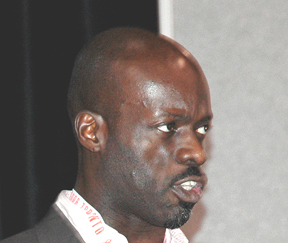
For more on this topic, visit African & Caribbean Council on HIV/AIDS in Ontario. TORONTO -- In virtually all African and Caribbean communities today, homophobia is so rampant that it remains a challenge -- 25 years into the HIV pandemic -- to do outreach to gay, bisexual and transgender communities. But with the ever-rising HIV infection rates, this vast population is slowly coming out of the shadows and is beginning to stand up and demand effective treatment and prevention strategies, activist say. Activist came together during the XVI International AIDS Conference in Toronto, to demand strategies and urge their compatriots to become public with their gender identification. They participated in a session titled “Being Queer in the African/Black Diaspora.” They demanded also that heterosexuals join in the fight for equality for their queer brothers. “You can be met with fines, imprisonment and death. The police can legitimately cut you off on the side of the road, do harm against your body and your spirit and it would be OK,” said Llana James. James is a Canadian resident who hails from Trinidad and Tobago. “You cannot fight for rights for one side of you and then leave the other out because we are your children. We made you, we pay for you to show love, pick up our sisters in the middle of the night and we expect the same. When we look at HIV prevention, it is about love. It is about remembering that all black people count,” James said. Tokes Osubu, who lives in New York City and runs the Gay Men of African Descent, (GMAD) agreed. “We’re dealing with a human-rights issue. At the end of the day, if we don’t do it we certainly will go to our graves very depressed,” said Osubu, who is 46 and has lived with HIV for 22 years. “We’re not at home in Canada. We’re not at home in the U.K. We cannot even be at home when we go home,” he said. During the six-day conference, Osubu made an effort to seek out African delegates and introduce. He also committed to traveling to Africa so he could help in the fight on the ground. Oludare Odumuye, the head of Alliance Rights Nigeria, the only rights group for sexual minorities in Nigeria, said outreach in Africa’s most populous country for gays is an up-mountain battle. “We’re not within the national response. There is no funding. There is no recognition of the fact that we do exist. There is criminalization. There is a lot of societal and religious discrimination,” Odumuye said. We’re here to increase our visibility,” Odumuye added, saying that gays and lesbians abound in Africa. “We want our voices to be heard. AIDS is killing all of us in Africa and we want our voices to be heard.” Robert Carr, co-founder of the Caribbean Vulnerable Communities Coalition from Kingston, Jamaica, said it is extremely difficult to do outreach on that island nation, known worldwide for its homophobia. “It drives people underground at this point. There are very few people willing to embrace a gay identity or a lesbian identity at this point. Its difficult to live openly. Most people end up living in the shadows,” said Carr, who organized and moderated the session. “The more the issue is discussed, the more there is international support for people’s rights."