News 2006

Mobilization
By Sharon Egiebor
Pennsylvania State Sen. Vincent Hughes is putting money where his mouth is. For the past three years, Hughes, (D) has pushed for and received millions of new dollars from the Pennsylvania state budget for HIV/AIDS in African Americans, with a good portion of the funds targeted toward young people. In 2004, Hughes added $1 million to the HIV/AIDS prevention budget, going to $7.8 million from $6.3 million. In 2005, the budget rose to $8.3 million. For 2006, Keystone Hospice, which treats AIDS patients, received a $500,000 grant from the Governor’s Redevelopment Assistant Capital Program to renovate its 19-room residence. He is seeking to add another million to the upcoming budget, Hughes said. “This is all new money that these organization have never had available,” he said. “We weren’t going to shift money from programs they were already working on. No, we didn’t have that luxury. We added new dollars to the equation.” Hughes said he believes Americans can win the fight against HIV/AIDS and reduce the number of new infections in several populations. “We need to change how we think about this disease. I’ve spoken to too many groups where everybody is all sad and down,” said Hughes, who was first elected to public office as state representative in 1987. “There is no sense of victory. There is no sense that we can win on this disease. Philadelphia County, Hughes’ home base, is particularly hard-hit by the disease, according to state health statistics. The estimated prevalence of HIV is almost three times greater than the statewide average. Hispanic and African Americans are disproportionately affected, accounting for 60 percent of total cases in recent years, although they comprise of only 12 percent of the population. The prevalence of AIDS in Philadelphia County also has been increasing. The percentage of Pennsylvania AIDS cases in Philadelphia County has grown to an average of 61 percent in 1997-2002 from an average of 53 percent in 1980-1993. “We can win on this disease,” said Hughes, as his voice rose with passion. “It is primarily a disease of behavior. It is not like cancer where out of nowhere it is in you. You change behavior. Obviously this includes being equipped with everything else that goes along with proper health – good health insurance and good information.” Hughes said changing perspective is the first step to changing behavior. He cited the success of lowering parent-to-child HIV transmission rates as an example. In 2004-2005, Hughes serves as honorary chair of the Circle of Care, a program designed to increase HIV testing for pregnant women. “The first thing you have to do is to claim victory. From that assumption to that attitude, then you basically order your steps and order your work. You have to get more money flowing and make sure the new money flows to where the disease is,” he said. Hughes learned about HIV/AIDS impact on African Americans in 1987 when he met with Rashidah Hassan, a Muslim nurse who founded BEBASHI (Blacks Educating Blacks About Sexual Issues) Transition to Hope, an AIDS service provider located in North Philadelphia where AIDS cases are the highest in the city. Hughes served on BEBASHI’s board for several years, said Gary Bell, executive director. “God Bless him. There are very few elected officials who are really taking on this fight against HIV,” Bell said. “It is certainly not something that most politicians must consider very sexy. “It would have been very easy for him to give us a lot of rhetoric, but he has actually put his money where his mouth his. And that is what makes it real to us,” said Bell, who took over leadership of BEBASHI 10 years ago. “It is not a bunch of empty promises. He has actually put money on the street.” Bell said his agency is using some of the $100,000 in state funds it received to conduct HIV/AIDS prevention workshops for at-risk youth. BEBASHI is working with young people living in state-sponsored group homes.
“We are using a curriculum that is a series of workshops for our youth looking at different issues -- peer pressures, behavior choices,” Bell said. “The funding has enabled us to do more than a one-time program. We work with youth over a series of weeks, where you have a better chance of reaching them.”
Bell said his agency also is using state funds to conduct outreach programs with local churches. Meetings are currently being held with several churches to arrange onsite rapid testing. Hughes, who recently married Entertainer Sheryl Lee Ralph, is part of the Black AIDS Mobilization Movement created by the Black AIDS Institute, the first national Black HIV/AIDS policy center dedicated to reducing HIV/AIDS health disparities. Hughes and Ralph were part of the largest African American political and social delegation ever to attend an International AIDS Conference in August. The delegation included leaders from eight historic African American organizations who pledge to have HIV/AIDS as part of their ongoing agendas and to work to reverse the high rates of infection among blacks by 2011. In March, Hughes participated in National Women and Girls HIV/AIDS Awareness Day Event announced a new testing and counseling campaign. He said he is negotiating with a Philadelphia company to arrange rapid HIV testing throughout Philadelphia. Rapid testing results are available within 20 minutes “With traditional testing usually takes about a one-week turnaround. In Philly, we have about a 40 percent drop off. People don’t come back,” he said. Because of the drop offs, Hughes said HIV/AIDS workers developed new programs. “We really try to be creative on the testing, utilizing dinners at restaurant, cosmetics, tickets to athletic games as incentives,” he said. “In other words, if you get tested you get a gift.” Philadelphia agencies partnered with Black AIDS Institute in 2004 for the Verizon Ladies First Tour featuring Beyoncy, Alicia Keyes and Missy Elliot to give concert tickets to individuals who returned for test results. Hughes and Ralph have hosted town hall meetings for young people and encouraged on-site testing. At one session, 100 youth were tested and at a following session, called “Can We Talk,” more than 300 people attended and 80 were tested, he said. Hughes' hands-on work and his leadership have been recognized both locally and nationally, according to his office. He was awarded the John Blue Award from BEBASHI. Black AIDS Institute recognized him with its prestigious Heroes In The Struggle Award in 2005. On Dec. 1, he will be recognized as one of three honorees to receive the Red Ribbon Award by the Center For AIDS Research at the University of Pennsylvania. “Here is the way I roll. I deal with all kinds of issues. I usually deal with issues that most folks don’t want to do, like sex. It is not easy. It is not fun to talk about HIV,” he said. “But if no one talks about it, what are you going to do?”
Global AIDS Conference || Toronto 2006
By Erv Dyer
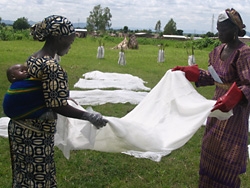
TORONTO -- If poverty and ignorance are accelerators of the HIV epidemic, malaria is, too. Roll Back Malaria Partners and a coalition of anti-poverty activists are urging those who fight HIV to become more vocal and concerned about malaria, which strikes at least 250 million people world-wide annually. Dr. Louis Da Gama, the malaria advocacy director at the Global Health Advocates, an NGO that monitors health practices in Africa, called them twin menaces because HIV and malaria impact millions of people and disproportionately burden women and children. During the XVI International AIDS Conference, a panel of physicians and activists joined HIV activists to share ways to address both diseases simultaneously. Both diseases demand better treatment, prevention and methods to empower women to acquire better health services. Malaria disproportionately affects the poor, with 58 percent of malaria deaths occurring in the poorest 20 percent of the world’s population, according to the The Global Fund, an agency that provides grants to reduce the infections of HIV, tuberculosis and malaria. “Having HIV or malaria can be deadly, but having both at the same time is particularly dangerous,” said Yvonne Chaka Chaka, a celebrated singer known as the Mariah Carey of Africa and a UNICEF spokesperson on malaria in eastern and southern Africa. “If you are pregnant, it can lead to serious complications for the mother, as well as increasing the chance that the baby will be born underweight and possibly HIV-positive. HIV antenatal services should always include malaria treatment and prevention.” Roll Back Malaria was launched in 1998 by the World Health Organization, the United Nations Children's Fund (UNICEF), the United Nations Development Programme (UNDP) and the World Bank. The agencies are supplying condoms and mosquito nets treated with pesticides to several countries in an effort to stem the infection of both diseases. About 40 percent of the world is exposed to malaria. It hits Asia and South America, but the highest rates of infection occur in sub-Saharan Africa, according to United Nation reports. Up to 500 million people a year will have at least one bout of malaria, a 3,000-year-old disease where infected mosquitoes will pass the parasite that causes the malady onto humans. Annually, one million will die. Because it is so common and so crippling – sometimes keeping people fatigued and weakened for weeks – malaria slows African economies by $12 billion a year, Roll Back Malaria Partners say. The presence of malaria in a region reduces tourism, influences social economic decisions, and slows industrial development and capital growth. Malaria and HIV are tragically linked. Poverty is an engine for both, leaving fractured economies unable to afford medicines, treatment or proper awareness campaigns. Scientists say there is research to suggest that having one and catching the other can lead to treatment failure. According to Charles Gilks, a physician who works with the World Health Organization on HIV and malaria, there is evidence that because HIV weakens the immune system, it leaves the body less able to fight off malaria. Treating malaria with blood transfusions, which has been a common practice, would often expose children to a greater risk of HIV infection. In addition, having malaria present in the placenta while pregnant could increase the likelihood of an HIV-infected mother passing the virus on to her child. Also, some studies show that in the presence of malaria, HIV replicates faster in the blood. “People with malaria have no voice,” said the singer Chaka Chaka. She lost a band member to a virulent strain of malaria and another friend died five days after contracting the affliction. The death prompted Chaka Chaka to get involved. “Now is the time,” she said, “to walk the talk.”
Erv Dyer is a reporter for the Pittsburgh Post-Gazette.
Research
By Reuters
AMSTERDAM, Oct 9, 2006 (Reuters) - Dutch biotechnology firm Crucell on says it had secured a $16.2 million U.S. contract to develop a vaccine against HIV, the virus that causes AIDS. The contract is with the National Institute of Allergy and Infectious Diseases, part of the U.S. National Institutes of Health (NIH), the company said in a statement The program will be fully covered until the clinical trials start. Crucell shares rose after the announcement, and were up 2.4 percent at 18.77 euros by 1330 GMT. Crucell will collaborate with the Beth Israel Deaconess Medical Center at Harvard Medical School and Charles River Laboratories Inc., it said. "Multiple high-level vaccine initiatives are essential if we are to be successful in delivering the safe, effective and accessible HIV vaccine that the world needs so urgently," Crucell's Chief Scientific Officer Jaap Goudsmit said. The firm's PER.C6 gene technology uses human cells as a platform to produce drugs. Researchers are also using the technology in hopes of developing vaccines against illnesses such cancer. There is currently no vaccine against AIDS, but two vaccine candidates are in advanced human trials -- one made by Merck and Co. (MRK.N:) and another by Sanofi-Aventis SA (SASY.PA:). The AIDS virus infects more than 39 million people globally, more than 60 percent of them in sub-Saharan Africa. It kills more than 4 million people every year and has killed 25 million people since it was identified in the 1980s. It is difficult to vaccinate against because the virus infects the very immune system cells that are usually stimulated by a vaccine. www.reuters.com
Treatment News
WASHINGTON -- A total of 302 individuals were on AIDS Drug Assistance Program (ADAP) waiting lists in six states as of Sept. 20, according to the National Alliance of State & Territorial AIDS Directors. Two of those states have had ADAP waiting lists for nearly two years. Although one ADAP was able to eliminate its waiting list since NASTAD’s August ADAP Watch due to Medicare Part D savings and rebate funds, two other states have had to reinstitute waiting lists within months of eliminating them. State programs also have been forced to adopt cost-containment measures other than waiting lists in order to stay fiscally solvent. Three ADAPs – including one with an extensive waiting list – have instituted such measures, which include formulary reductions, medical eligibility restrictions, and annual per capita expenditure caps, since April 1, 2006 (the beginning of the 2006 ADAP fiscal year). Six other states anticipate the need to implement new or additional cost-containment measures during the current fiscal year, which ends March 31, 2007. In FY2006, ADAPs received a $2 million increase from Congress – the smallest increase in the history of the program. “A long-term investment in the financial stability of ADAPs is essential to ensure that these critical programs avoid waiting lists,” urged Julie Scofield, NASTAD’s executive director. “Without a commitment to stable, predictable funding at levels that keep pace with demand, waiting lists will soon become a permanent feature of ADAPs,” she added. Despite the growing demand for HIV medications as people with HIV/AIDS live longer, more productive lives, the funding outlook for ADAP for FY2007 remains uncertain. NASTAD supports proposed funding increases for FY2007 in both the House and the Senate for sections of the Ryan White CARE Act, given the tight budget year. However, the need for ADAPs is substantial – estimated to be $197 million more than FY2006 funding levels. In conjunction with reauthorization of the CARE Act, a $70 million increase must be approved for the Title II base. NASTAD also calls for an increase for ADAP, considering that ADAPs grow by $100 million annually. NASTAD urges Congress to provide stable, predictable funding for ADAPs to meet the increasing need. “The CARE Act is a crucial safety net for our nation’s poor and uninsured,” stated Scofield. “We urge Congress to continue to work with the AIDS community to help ensure that waiting lists and other program restrictions become obsolete and that access to treatment for people in need is maximized.” ADAPs provide HIV treatments to low income, uninsured, and underinsured individuals living with HIV/AIDS in all 50 states, the District of Columbia, the Commonwealth of Puerto Rico, the U.S. Virgin Islands, and Guam. Each year, approximately 135,000 individuals receive services from ADAPs, representing about 30 percent of those estimated to be living with HIV/AIDS and receiving care in the U.S. ADAPs are a discretionary grant program funded through the Ryan White CARE Act. Because ADAPs are not entitlement programs, funding levels are not based on the number of people requiring prescription drugs or on the cost of medications. In addition to federal funding, many ADAPs may also receive state general revenue support and other funding, but these sources are highly variable and dependent on local decisions and resource availability.
Religion The Balm in Gilead is hosting the “The Black Church Institute on HIV/AIDS and Other Health Disparities” from Oct. 24-27 at the Charleston Riverview Hotel in Charleston, S.C. The conference is exclusively designed for leaders of Black churches who strive to increase their knowledge about HIV/AIDS and other diseases and to strengthen their commitment to education and supporting those who suffer. Pernessa Seele, the organization’s executive director, said this year’s conference will “broaden discussions on how African American congregations are responding to the challenges of other diseases that are devastating our families and communities.” In addition to the devastation and impact of HIV/AIDS, other diseases, such as cervical cancer, hepatitis C and, renal disease, are also killing African Americans, including children, at rates that can be compared to those of third world countries. “We must stop the killing of African Americans from a multitude of diseases that are 100 percent preventable,” she said. Invited participants include pastors, deacons, missionaries, church school educators, youth ministry leaders, church nurses and other auxiliary church leaders. ”The overall health status of African Americans is poor. One in every Black man and one in every 160 Black woman are living with the virus that causes AIDS," said Seele. "In some communities within the US, the AIDS epidemic among African Americans is comparable to the AIDS epidemic in poor African villages—Out of Control!” ”The role of leadership is critical at this time in our lives,” Seele said. “Our elders and children are struggling to survive the torment of diseases that are preventable and curable. History has already recorded the role of the church in the survival of African Americans through the ages. Today, we must recommit ourselves as congregations and as individuals to the tremendous work that it will take to stop the widening gap of health disparities in our community, especially the destruction of HIV/AIDS.” Program participants include the Rev. Dr. Kenneth Samuels, senior pastor of Victory for the World Church, Atlanta, Ga.; Ron Simmons, PhD, executive director of US Helping US, Washington, D.C.; Entertainer Sheryl Lee Ralph; Phill Wilson, executive director of the Black AIDS Institute, Los Angeles, Calif.; Bishop George W.C. Walker, senior bishop of the African Methodist Episcopal Zion Church; Dr. Maria Borum, director of gastroenterology and liver disease at the George Washington University Hospital, Washington, D.C.; Dr. Bambi Gaddist, executive director of the South Carolina HIV/AIDS Council, Columbia, S.C.; Rev. Ronald Hopson, PhD, associate professor of Pastoral Care & Counseling at Howard University, Washington, D.C.; and Dr. Jamesina Evans, international president of the National Women’s Missionary Society for the African Methodist Episcopal Church. The Balm In Gilead seeks to create an environment of knowledge, support, care, compassion and unconditional love to overcome the barriers of ignorance, stigma, homophobia, denial and hate. For more information contact: The Balm In Gilead Inc., 130 West 42nd Street, Suite 704, New York, NY, USA 10036. Tele: (212) 730-7381/ (888) 225-6243 Fax: (212) 730-2551; e-mail: