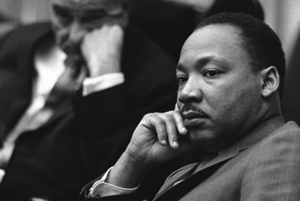
What Would Martin Do?
Opinion Editorial by Institute CEO and Founder Phill Wilson
This Monday marked the commemoration of what would have been Dr. Martin Luther King Jr.'s 81st birthday, had he not been assassinated in 1968. As we pause to reflect upon his life, it's appropriate--actually, imperative--that we ask ourselves "What would Martin do?" about the major challenges facing America today.
Of course, everyone knows of Dr. King's stand on racial segregation and civil rights for Negroes, as we were then called. The Civil Rights Act of 1964 is in large part a testament to the leadership, commitment and vision of Dr. King and other committed citizens and leaders who courageously imagined a better world and worked to make it happen.
But as time passes and fewer and fewer people have a firsthand memory of Dr. King's work and his life, we risk losing the significance of his entire body of work and of other important stands he took during his life, which ended when he was just 39.
In addition to his leadership around civil rights, Dr. King was committed to economic justice. The reason he was in Memphis that fateful April evening was to help the Black sanitation-workers union--the trash men (yes, they were all men back then)--obtain better treatment and wages. And earlier that year, he and the Southern Christian Leadership Conference organized the Poor People's Campaign, a coalition pushing Congress to create a bill of rights for economically disenfranchised people of all races.
Dr. King fought against injustice, poverty, hunger and homelessness during his lifetime--issues that are inextricably connected to the AIDS epidemic today in the United States and globally. He also spoke out against the Vietnam War. Roughly 58,000 Americans died during the 10 years that our nation deployed combat troops to Vietnam, a little more than get infected with HIV/AIDS every year.
Forty-one years after his assassination, America is still struggling with injustice, poverty, hunger and homelessness; the divide between the "haves" and "have-nots" is greater today than it has ever been. Our country is engaged in two wars. But there is no question where the Prince of Peace would have stood on the major issues of our day.
Dr. King would be leading a movement against the war and for creating jobs, passing meaningful health-care legislation, educating our young and protecting our environment. And yes, just as he stood up for the sanitation workers, Dr. King would be passionate about HIV/AIDS. There is no question that ending the AIDS epidemic would be at the top of his agenda. And because it would be at the top of his agenda, it would be at the top of our agenda.
As we celebrate Martin Luther King Day, we should honor the life and work of Dr. King by courageously standing up on behalf of the weakest members of our society--people of color, the poor, those who are homeless, folks without health insurance, people with HIV and AIDS. We can make our voices heard at the highest levels of government. We can demand that resources be allocated to AIDS prevention, treatment and research just as they have been allocated to the Iraq and Afghanistan wars, to the H1N1 (swine-flu) virus and to Wall Street.
We can remember Dr. King and continue his legacy by standing up and taking action on the issues confronting our country today.
Phill Wilson is the founder and CEO of the Black AIDS Institute.