Supervised and Unsupervised HIV Self-Testing Both Earn High Marks
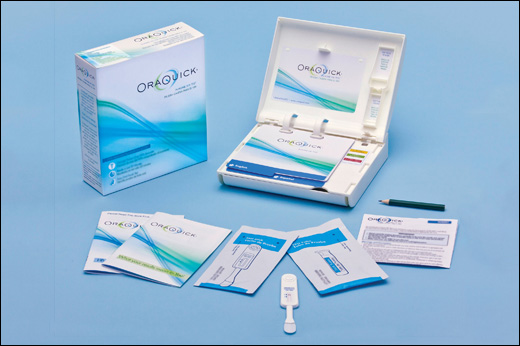
Supervised and unsupervised HIV self-testing both had high acceptability scores and often resulted in partner self-testing, according to a systematic review of 21 international studies. Test sensitivity was marginally lower with unsupervised testing, and no studies evaluated posttest linkage with counseling and treatment.
Stigma, discrimination, lack of privacy, and long waiting times prevent some people from using facility-based HIV testing. By some estimates, 6 of 10 people with HIV do not use facility-based testing. Self-testing eliminates these barriers and could improve testing rates. An in-home HIV self-test is available in the United States, and access to such tests will probably spread.
To assess acceptability, feasibility, and linkage to care with health professional-supervised self-testing and unsupervised self-testing (with counseling via phone or internet), researchers reviewed seven databases and abstracts from six major conferences on HIV and sexually transmitted infections. They identified 21 studies, seven involving unsupervised testing and 14 involving a supervised strategy.
The analysis revealed that both HIV self-testing strategies had high acceptability (range 74% to 96%), high preference scores (range 61% to 91%), and high partner self-testing rates (range 80% to 97%). Studies that compared acceptability of the two strategies with facility-based testing showed that people preferred self-testing and preferred oral self-testing to blood-based self-testing.
Specificity was high with both supervised and unsupervised testing (range 99.8% to 100%), while sensitivity was lower in one unsupervised study (range 92.9% to 100%) than in three supervised studies (range 97.4% to 97.9%). (Sensitivity is the ability of a test to single out people who have a certain disease. Specificity is the ability of a test to classify people who do not have the disease as negative.)
In one unsupervised study, 102 of 106 participants (96%) said they would seek posttest counseling. No studies assessed actual posttest counseling or treatment outcomes. Most data came from people in high-income countries (11,019 of 12,402 individuals, 89%). Fifteen of 21 studies (71%) were cross-sectional rather than longitudinal.
The researchers proposed that “controlled trials of high quality from diverse settings are warranted to confirm and extend these findings.”
Source: Nitika Pant Pai, Jigyasa Sharma, Sushmita Shivkumar, Sabrina Pillay, Caroline Vadnais, Lawrence Joseph, Keertan Dheda, Rosanna W. Peeling. Supervised and unsupervised self-testing for HIV in high- and low-risk populations: a systematic review. PLoS Medicine. 2013; 10: e1001414.
Complete article provided by PLoS Medicine, an open-access journal
Written by Mark Mascolini on behalf of the International AIDS Society