Ron Simmons: On the Cutting Edge for 25 Years
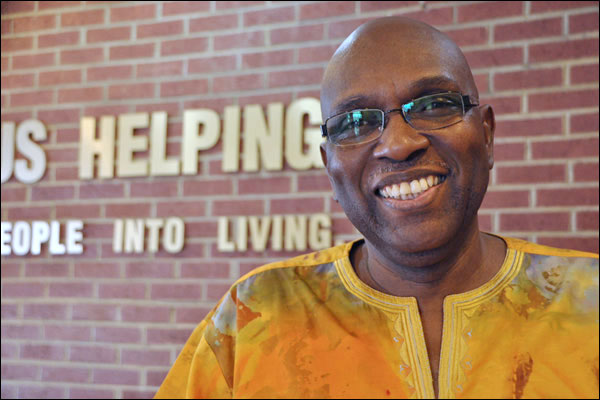
Ron Simmons, Ph.D., President and Chief Executive Officer, Us Helping Us, People Into Living, Inc
As we continue to mark the 35th anniversary of AIDS in the United States, we honor Ron Simmons, who has been the executive director of Us Helping Us for 25 years and will retire at the end of 2016. Under his leadership the organization has grown to become the oldest and largest group committed to improving the health and well-being of Black gay men and to reducing the impact of HIV/AIDS in the entire Black community.
I've always been immersed in the African American gay community's struggles, but it wasn't until I was diagnosed HIV positive and introduced to Us Helping Us (UHU) that I found my calling. That was 26 years ago on my birthday. A friend suggested that I attend a support group meeting held in the living room of the organization's founder, Rainey Cheeks. It was a 12-week program that helped Black gay men living HIV positive gain self-respect and empowerment. The program focused on adopting a holistic approach to health that included learning about internal cleansing, diet, nutrition, herbs, stress management, meditation and the importance of exercise—body, mind and spirit, because if there's a conflict in any one of these areas, the person probably will not successfully integrate the program into daily life. I immediately gravitated to the ideas, becoming a volunteer and learning the principles well enough to facilitate a support group in my own living room.
It wasn't my idea to become the executive director. In 1992 Rainey Cheeks asked me to take the position on a voluntary basis. I had been teaching at Howard University for 12 years. I told him no and he said he would pray on it. That year, Howard did not renew my contract and Cheeks' prayers were answered; I agreed to accept the position for a year. I am now in my 25th year.
UHU was already on the cutting edge, being the only Black gay HIV organization that offered the mind-body-spirit connection, and I intended on pushing the boundaries even though there was no money and I did not have a background in organizational procedures or business. A board of directors made up of prominent members of the medical and health communities was formed, and the writing I had done while working toward a Ph.D. in mass communications from Howard paid off when I began writing grants, procuring $30 million of grant money over the past 25 years.
I am most proud of being able to take a support group from living rooms to being a certified treatment center with 24 full-time employees and a $2.4 million budget. We were the first Black gay organization to purchase and renovate a building for its headquarters and service facility, and I want to thank [UHU Controller] Barbara Prince, a CPA specializing in nonprofit organizations, for UHU being the oldest and largest Black gay organization in the country. A lot of organizations have failed due to inaccurate accounting procedures.
About a decade ago, we saw the writing on the wall regarding the future of the HIV epidemic. HIV prevention and treatment is now purely a biomedical model; they have pills that work. If positive, you can pop a pill a day and not only be undetectable but can't infect others. You can give a HIV-negative person a pill a day and it protects them, and they're already doing research on injectables where you get an injection and are protected from HIV for 30 or 90 days.
What we've done at UHU, with the help of the District of Columbia Department of Health and the Centers for Disease Control and Prevention, is try to integrate ourselves as much as possible into the health-care system. We've become more of a full-service health organization incorporating case management, youth programs, a women's group, a mental-health facility and third-party billing into our system. I think anyone continuing in the field should look at ways to apply the skills they've learned in other health-related fields.
I'll be leaving as executive director at the end of the year, but I plan to stay active as a consultant and grant writer. I am now ready to write my memoir—I was suicidal at 13; only the word of God stopped me. I want to continue to build up and empower Black gay men. I've been studying African culture since college and have been researching the European influence on Western gays and lesbians, in contrast with the concept among the Dagara people of West Africa. Because once you understand this African perspective, you'll see that gays and lesbians have a vital role to play in our community, and I need to begin to inform them and prepare them for that.
As told to April Eugene, a Philadelphia-based writer.