Profile
By Chris Bournea
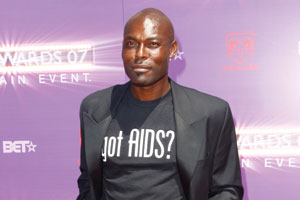
Actor Jimmy Jean-Louis is featured among the cast of the television phenomenon “Heroes,” about a group of ordinary people gifted with superpowers who are trying to save the world. In real life, Jean-Louis may not be taking on something ambitious as saving the world, but his mission of bringing awareness to HIV/AIDS is just as noble.
“It’s one disease that we can definitely stop if we try -- if you’re positive, don’t pass it on. If you’re not, try not to get it,” Jean-Louis said during a recent exclusive interview with Blackaids.org. “If we do this, within 15, 30 or 50 years, we can get rid of it.” The cause is one that literally hits home for Jean-Louis, a native of Haiti, which was widely believed to have incubated HIV when the virus first emerged in the early 1980s. Jean-Louis has not only worked to dispel that myth, he is using his high-profile status to bring much-needed awareness to HIV/AIDS treatment and prevention. “Back in the ‘80s when AIDS was discovered, they used to blame it on Haiti,” he said. “Therefore, all the Haitians from all over the world would be suspect for HIV or AIDS.” Being on an internationally popular television show such as “Heroes” has given Jean-Louis a platform on which to bring attention to HIV/AIDS and other important issues. “It shows the power of media, being on a hit show. As a person, I try to always bring some type of message that could help a lot of people that wouldn’t usually be serviced,” Jean-Louis said. “As a Haitian, first of all, I love that they call me ‘the Haitian’ on the show. Because Haiti has such a bad rap all over the world, and to have an actor on a successful show forces the world to know about Haiti, to have the name out there.” Born in Petion-Ville, Haiti, Jean-Louis left his native country in 1980 and moved to Paris, where he earned a business degree. His love of performing earned him a spot in Paris’ L'Academie Internationale de Danse. Although he grew up speaking French and Creole, Jean-Louis found that France did not always embrace citizens from its former colonies. “As a black person living in France, there are things that I wanted to get but I could never, never get,” he said. “Any hope of a high position in a job would be a huge challenge because we don’t have Black CEOs, we don’t have Black politicians [in France]. Those doors are closed to us over there. That’s why I started to move away from France, and from there I went to Spain, to try another country, to try my luck elsewhere. That’s where I started to work in musical theater.” Upon relocating to Barcelona in 1992, Jean-Louis spent two years performing in a musical production titled “La Belle Epoque.” He also lived in Italy and South Africa and he speaks five languages. Jean-Louis’ diverse international experience makes him an ideal ambassador to speak out on HIV/AIDS and other global issues. “As an actor, I try to take the important issues very seriously,” he said. “Millions of people might be listening. It’s a duty to try to send the positive message out there, whether it’s AIDS, what’s happening in Darfur, in South Africa, or even within the United States of America. It’s unbelievable to know that this is the No. 1 country in the world, but you still have poor people, you have people who cannot feed themselves.” Jean-Louis returns to Haiti several times a year and recently filmed a movie there about the HIV/AIDS epidemic called “The President Has AIDS.” The movie has been winning critical raves at the Pan-African Film Festival and other film festivals around the world.
“It was a way to spread the message, because the media’s not going to do it,” Jean-Louis said. “It can entertain, but at the same time there’s a message, there’s a lesson.”
Another recent film where Jean-Louis can be seen is opposite African-American comedienne Mo’Nique in the comedy “Phat Girlz.” In the movie, Jean-Louis plays an African doctor who falls for Mo’Nique and appreciates her curvaceous frame. “What I like about the movie is there’s interaction between the Africans and African Americans. There’s a clash there,” Jean-Louis said. “In general, I don’t think African Americans know a lot about Africa. It was one way to give them a little taste.” Jean-Louis can also be seen in the forthcoming film “Diary of a Tired Black Man,” which is scheduled for release in September. He has also begun filming the second season of “Heroes,” which debuts on NBC in the fall. Jean-Louis is concentrating on staying grounded, despite the phenomenal success of the show. “Ultimately, it’s just a job. I just go there and work like everybody else. The difference is as an actor, what you do is seen by millions,” he said. “When I start receiving e-mails from China, from India, from Germany or even Iceland, then I realize I’m part of something that’s really, really big.” The show’s global reach has made Jean-Louis all the more vigilant about raising his voice about HIV/AIDS and other causes. The devoted international following of “Heroes” has reinforced Jean-Louis’ belief that issues that impact one part of the world have ripple effects. “I always welcome people who come to me,” he said, “because ultimately we’re all the same.”