Health and Hip Hop Conference at Morgan State University Promises Real Talk for Young Black Men
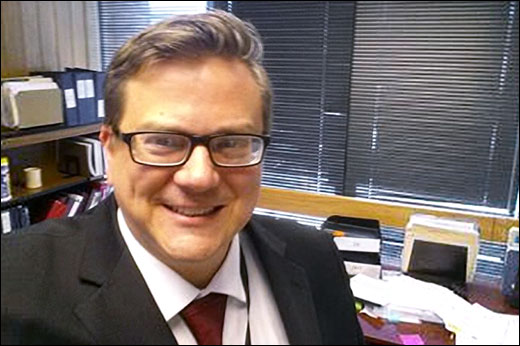
Jeffrey Hitt, the director of the Infectious Disease Prevention and Care Services Bureau of the Department of Health and Mental Hygiene
One in a series on the Health and Hip Hop Conference, sponsored by the Black AIDS Institute and the Maryland Department of Health and Mental Hygiene. The conference will be held Oct. 24, 2015, at Morgan State University in Baltimore.
Later this month, Morgan State University will host the Health and Hip Hop Conference, a free, men-only event to confront rising HIV rates among Maryland's young Black males. It is sponsored by the Black AIDS Institute, the Maryland Department of Health and Mental Hygiene, local AIDS organizations, and the state's four HBCUs—the University of Maryland Eastern Shore, Bowie State University, Coppin State University and Morgan State University—and organizers hope that at least 200 young Black male HBCU students will attend.
Maryland's young Black men who are gay or bisexual, same-gender loving or MSM are particularly at risk for HIV. The state ranks second nationally in its rate of new adult and adolescent diagnoses, and metropolitan Baltimore ranks third among cities in its rate of new HIV diagnoses overall. According to The Baltimore Sun, among those newly diagnosed with HIV, the proportion of young adults ages 20-29 nearly doubled—from 16 percent in 2003 to 31 percent in 2012—with the greatest increases in infection rates statewide occurring among Black gay men.
"We're in the same boat as a lot of other places," says Jeffrey Hitt, director of the state health department's Infectious Disease Prevention and Care Services Bureau. "We have to make sure that we are responding appropriately and focus on what's necessary."
Changing Perceptions
Coronado "Cody" Lopez Dyer Jr.—a nonmedical case manager for transgender youths at the STAR TRACK (Special Teens at-Risk, Together Reaching Access, Care and Knowledge) program at the University of Maryland and the program coordinator for Safe Experiences Xcite Me (SEX Me) at Morgan State's counseling center—is working with fraternities, social clubs and other campus groups to encourage attendance.
He thinks the conference will help change perceptions.
"We often stigmatize Black MSM by targeting them with messages that perpetuate the stigma that HIV is a gay disease," says Dyer. In his opinion, too many HIV prevention campaigns slightly feminize Black men's posture or clothing, unintentionally communicating a caricature. He'd rather see a greater variety of images, including ones of men whose sexual orientation might not be apparent.
"Not everyone identifies as gay or bisexual," he says. "They may be engaging in the behaviors but miss some of the messaging" because the images don't resonate with them.
Conference organizers recognize the importance of getting HIV/AIDS information in front of sexually active young Black men. But the fluidness of some students' sexual identity makes reaching those most at risk difficult.
"Sometimes, sexual activity comes before sexual identity," says conference organizer Justin Wooley, a Black AIDS Institute consultant.
"It's not necessarily gay sex that we're going to be talking about; we're just going to be talking about sex," says Dyer. "We don't want to stigmatize certain sexual acts as 'gay' acts."
Speaking a Language Young Men Understand
Consistent with this, Wooley believes that to achieve an AIDS-free generation, health-care providers and community stakeholders must give up their "prehistoric ways of communicating" and make prevention messages as relevant as the hottest hip-hop songs. HIV/AIDS workers must behave like a "cool uncle and talk to young men in language that they understand so we can hear them and create new strategies," he says.
"It's almost as important that we're there to listen as it is for them to have the conversation," says Hitt. Although he knows the difficulty of creating an environment that supports people in choosing their own path to an authentic, integrated sexual identity—whether straight, gay, same-gender-loving or bisexual—he hopes that the conference helps health-care providers engage young Black men across that identity spectrum.
Participants will attend workshops like "Real Talk about Sex, Sexuality, and HIV in 2015" and take a pretest and a posttest to assess their knowledge of HIV prevention strategies. They will also be invited to participate in Baltimore's Black Treatment Advocates Network, engage with local AIDS service organizations, and continue dialogue around health and hip-hop in social media, especially on the event's Facebook page.
"Some conversations are going to make people feel uncomfortable," says Wooley. "We're not going to shy away from those conversations. We're going to shy away from stigma and judgment."
Click here to register for the free Health and Hip Hop Conference.
Freddie Allen is the senior Washington correspondent for Black Press of America. You can follow him on Twitter.